This Wednesday, we welcome guest blogger Elizabeth K. Mahon, who writes the Scandalous Women blog, covering women of repute throughout the ages. In addition to that, Elizabeth is the past President of RWA-NYC, a former actress, the consummate New Yorker, and a woman who wears the most incredible shoes.
Welcome, Elizabeth!

I’m thrilled and excited to be here at the Risky Regencies today. I write about Scandalous Women, and one of my favorites is Emma Hamilton and her love affair with Horatio Nelson. The film That Hamilton Woman, starring real life lovers Laurence Olivier and Vivien Leigh at the height of their beauty and fame, was my first introduction to their story (How crushed was I when I realized that the real Lord Nelson looked nothing like Olivier). Nelson and Emma’s rise to fame neatly coincided with the rise of the tabloid press in Britain. Their affair was not just the talk of Britain, but France and Italy as well. England’s Hero and England’s Mistress coming together seemed designed to sell newspapers and magazines. Not since Antony and Cleopatra had the world seen anything like it. Their romance was a publicist’s dream come true.
Maid, wardrobe mistress, celestial goddess, courtesan, artist’s model, fashion icon, and ambassadress, Emma Hamilton had lived more lives by the time she met Nelson than most women do in a lifetime. Born to a dirt poor family, she started life as plain Amy Lyon on April 26, 1765 in Ness, a small village twelve miles from Liverpool. By the time she was twelve, young Amy was on her way to London to find work as a maid.

By the age of seventeen, Emma had found her first protector–Sir Harry Fetherstonhaugh, a spoiled young squire. The relationship lasted until Emma found herself pregnant with his child whom she named Emma. Sir Harry refused to acknowledge the child as his, kicking Emma to the curb. But she had already met her next protector, Charles Greville. Now calling herself Emma Hart, she began to pose for the great artists of the day including George Romney and Sir Joshua Reynolds. Soon prints of her portraits were available everywhere, making her an 18th century sex symbol. Emma had the type of beauty that transcends time and fashion. Looking at her portraits, one sees a young woman who radiates on the surface an innocent sensuality but with a slightly knowing look in her eye. When Greville began to tire of her, he passed her on to his uncle Sir William Hamilton who had long been the ambassador to the Kingdom of Naples.
At first upset to learn that she was being treated like a hand-me down sweater, Emma soon realized the opportunity she had been given. Always anxious to please, she made herself indispensable to Sir William, fussing over him when he was sick, learning to speak French and Italian, and taking singing and dancing lessons. Entertaining English visitors and foreign guests with her ‘Attitudes,’ Emma soon found herself the toast of Naples. She became a confidante of the Queen, Maria Carolina, and cultivated the friendship of celebrities like the Duchess of Devonshire. After several years as his mistress, Sir William and Emma were secretly married, probably around 1791.
In late 1798 Emma and Nelson met again. They had met briefly in 1793 when he was plain Captain Nelson. Now he was the hero of the Battle of the Nile and Emma was determined that Nelson would fall in love with her. Not only would it be her crowning achievement but it would catapult her onto the world stage. Before he’d even arrived, she’d primed him by writing a passionate fan letter to him. ‘How shall I begin? It is impossible to write….I am delirious with joy and assure I have a fervour caused by agitation and pleasure.’ When he arrived at the docks to a hero’s welcome, Emma threw herself into his one arm, weeping. She flattered him; threw huge parties in his honor, and went out of her way to make friends with his step-son Josiah. Not exactly a dreamboat, Nelson was less than five foot six, scrawny, weather-beaten, with one good eye and arm. It was a dream come true that this beautiful woman found him exciting.
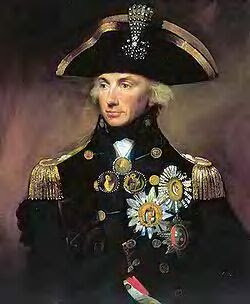
In Emma, it seemed he’d found his ideal woman. Like her, Nelson was a self-made man, ambitious, headstrong, longing for fame and riches. Born to a country rector, he joined the navy at the age of 12 as a midshipman. Married to a widow with a young son, the marriage floundered when it became apparent that there would be no children and that she wasn’t the great heiress he’d assumed she was. Before Emma and Nelson were lovers in truth, everyone was gossiping about the two. Nelson was so in love that he was soon neglecting his duties, reluctant to leave his mistress. Sir William turned a blind eye to the relationship between Nelson and his wife. He was fond of him, and was probably happy to have someone else entertain his energetic young wife. All of London was buzzing about the scandalous affair; caricatures soon appeared in the print shops depicting the relationship.
Emma determined to give Nelson the one thing that his wife couldn’t give him, a child, preferably a son. During her pregnancy, she started a fashion craze for what was essentially a maternity dress. In January 1801, she was granted her wish, when she gave birth to Nelson’s daughter whom she named Horatia. The idyll ended with Nelson’s death in 1805 at the Battle of Trafalgar. Emma had already lost Sir William in 1803, but Nelson’s death sent her into despair.
She was also deeply in debt. Emma had always lived beyond her means, and now with limited funds from Sir William’s estate, she was hard pressed. Despite Nelson’s dying wish that the nation should take care of his mistress, no money was ever forthcoming. For the next several years Emma tried to keep up appearances, giving lavish parties for her friends. She was also supporting several of Nelson’s relatives as well as her own poor relations. Three years after his death, she owed thousands of pounds to a host of creditors. Soon she was forced to sell Merton, the home she had shared with Nelson and many other mementoes of their life together.
A wiser woman would have quickly tried to find another husband or at least a protector. But when one has been the beloved of one of the greatest heroes England had ever known, how could any mortal man compete? Emma finally fled to Calais in 1814 to escape her creditors. By now her health was ruined from too much rich wine and food, and she also might have caught a parasite. Racked with pain, and tended by her teenage daughter Horatia, Emma died on January 15, 1815. She is buried in Calais, far from her lover Nelson. Their daughter Horatia married a clergyman and had eight children. Although she was happy to claim Lord Nelson as her father, until her death, Horatia refused to believe that Emma was her mother.
Emma’s story continues to fascinate because it is a story about ambition and heartbreak, love and pain. She rose from the depths of poverty to the heights of fame and fortune, only to end up back where she started. Her childhood had left her ambitious, and hungry for the limelight, but it was a hunger that could never be appeased. Emma always wanted more. Like Icarus in the Greek myth, perhaps she flew too high.
Thanks, Elizabeth! Please visit Elizabeth’s blog Scandalous Women to read more about other fascinating ladies.
What’s your favorite historical true-life romances? What movie or book got you first intrigued about the period, like That Hamilton Woman did for Elizabeth?

 So what is Prussian blue?
 Previously, the only way to get a vivid blue was to use ground lapis lazuli, expensive and rare, which is one of the reasons the color blue has powerful religious symbolism, the color of the sky and of the Virgin Mary’s robes. Prussian blue quickly became the first, easily available commercial blue color, used in paint and fabric, the “greatest hit” color of the eighteenth century, and one of its first commercial uses was for the uniforms of the Prussian army.
 It quickly caught on as a popular color for house interiors. The bright blue showed off elaborate plaster ceilings to great effect. This is the drawing room at Kenmore in Fredericksburg, VA, where George Washington’s sister Betty lived (and which reopens after restoration on March 1). This is Prussian blue mixed with yellow ochre, to give the “in your face” shade so popular at that time.
 Here’s painting underway at Montpelier, VA, the home of James Madison, which reopened after major restoration last year. The original Prussian Blue, applied in 1775, lasted until 1844, when the last of the Madison line sold the house–the durability and resistance to staining or fading of the color was another reason for its popularity. I blogged about visiting Montpelier while it was under restoration in 2007 and I’m hoping to go back and see the finished product soon (and blog about it!).
 These gorgeous, restored blue doors are from the Temple of Concord and Victory at Stowe House, UK. The building of the temple was started by Lord Cobham in the mid eighteenth century, with James Gibbs, architect of St-Martin-in-the-Fields and other famous buildings. In the great tradition of aristocrat dabblers, Cobham’s descendants messed with the design. Below, left, is Stowe, and the restored temple to the right.

 For more about the color blue, read this wonderful book by Michel Pastoureau.


