 Today we welcome Kathryn Johnson whose historical, The Gentleman Poet: A Novel of Love, Danger, and Shakespeare’s The Tempest, has received some spectacular reviews and kudos:
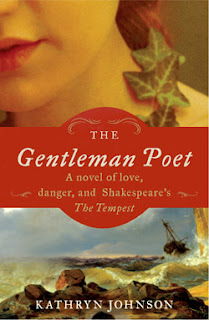
Set in the 1600s, this well-researched novel is sure to win praise from
historical-fiction readers, but it will also appeal to Shakespeare buffs, who
will enjoy the parallels to The Tempest. Pair The Gentlemen Poet with Robert
Nye’s The Late Mr. Shakespeare (1999) and Bruce Cook’s Young Will (2004), among the numerous novels that speculate on the life of the Bard.–Heather Paulson,
Booklist
Johnson imagines a backstory for Shakespeare’s The Tempest in this entertaining tale of mystery, romance, and shipwreck. . . .Johnson may not be Shakespeare, but her tribute is nevertheless a well-crafted drama.–Publishers Weekly
“The Gentleman Poet is the best kind of historical novel—well researched, beautifully written and wildly entertaining.”–Daniel Stashower, author of The Beautiful Cigar Girl, and Edgar Award winning Teller of Tales
“Kathryn Johnson weaves a marvelously original story that combines history, adventure, and a young woman’s growth to produce a rich and atmospheric tale The Gentleman Poet took me to a time and place that were new to me, and gave me wonderful companions to share my journey!”–Mary Jo Putney, New York Times bestselling author of Never Less Than a Lady
Not only did I enjoy this book, I was extremely impressed. Kathryn’s use of language was beautiful and completely evokative of the time period. Under her hands, this most unusual setting came sparkling to life.
Here’s a sample:
A storm was coming. For weeks since our departure from Plymouthe, I had beenblessedly free of the seasickness that plagued others aboard our ship. Then one cloudless, azure-skied morning as the gentlest of zephyrs billowed our white sails, Demons took possession of my poor head and I began to fear the worst, for here in the middle of the vast Atlantic Ocean we were at the mercy of the elements.
Kathryn will be giving away one signed copy of The Gentleman Poet to one lucky, randomly-chosen commenter.
Give a big Risky welcome to Kathryn Johnson!
Tell us about The Gentleman Poet, Kathryn.
I think the full title tells a lot about it. The Gentleman Poet: A Novel of Love, Danger, and Shakespeare’s The Tempest. It’s a story based on a Shakespearean legend that poses the possibility of the Bard basing his famous play on an actual written account of a shipwreck off the coast of Bermuda in 1609. One of the passengers on a ship that was sailing from England to Jamestown, Virginia wrote an account of a hurricane that blew the Sea Venture onto a reef, destroying it. Luckily, the 150 passengers and crew survived and were less than a mile from what we now know as Bermuda. They struggled ashore and lived on the uninhabited island for 9 months while building a new ship to sail on to Jamestown. This is all remarkably true, and I used it as a basis for the novel. But in fiction we get to play with the facts, elaborate on them, create even more drama, tension, excitement. So I’ve posed the question: Since we can’t know for sure where William Shakespeare was during the time of this adventure (too little data), might it be possible that he didn’t simply read an account of the wreck? Might he have actually been aboard the ill-fated ship and part of this story?
Where did you come up with this idea?
It all began on my honeymoon in—you guessed it—Bermuda! We actually stood on the beautiful pink-sand beach where the Sea Venture’s survivors dragged themselves ashore. And we visited the replica of the Deliverance, the ship that the settlers built from the local cedar trees and wreckage of their old ship. That started my mind working on a possible plot. Plus I’d always wanted to write a book that somehow included Shakespeare. I think that part of it came to me whenever I remembered the movie, Shakespeare in Love, which I adored. I thought, they can make the Bard human and appealing in the movies, why can’t I do something like that in a book?
I can’t imagine how much research this took. Tell us about one of the favorite things you discovered in your research.
Oh, I love research. I can get lost in a good library. And because I live in the Washington, D.C. area I’m very fortunate to have the famous Folger Shakespeare Library nearby. This is where they have the largest collection of Shakespearean first folios, artifacts, manuscripts, and objects related to William Shakespeare and his times. It’s an amazing place. They even have an Elizabethan theater where you can see his plays produced. I’ve taken my granddaughter to several, and she loves them! The library’s reading room is where I discovered the account of the wreck that Shakespeare must have read. You can’t really doubt it when you compare the wording to his opening scene of his play, The Tempest, they are so similar. The account was actually a long letter or journal written by one of the men on board the ship, William Strachey. It was Strachey who actually gave me many of the plot points for my story.
We’re all about being risky in our writing. What is risky about The Gentleman Poet?
I tell my writing students and the authors I work with at Write by You, my writer’s mentoring business, “Sometimes you just have to take risks. Believe in yourself and your vision of your novel.” It’s hard, I know, and sometimes it doesn’t work out because you’re leaving the safety zone; you’re doing something different, something readers don’t expect. On the other hand, that’s how really innovative and interesting books get written.
The Gentleman Poet was a risky book to write because historical novels are, I believe, just beginning to enter a renaissance. Some savvy publishers realize this and they’re buying them enthusiastically; others are waiting to see what hits the bestseller lists before they take a chance.
Everything points to historical romances becoming even more popular than they were in previous years, and then there is the heavily researched fiction (like Hilary Mantel’s Wolf Hall) that’s so dependent upon fact that it approaches nonfiction. But readers are beginning to look for other creative ways of using history in novels—like the alternative histories, post-apocalyptic tales, and reimagining.
This last, reimagining, is what I’ve done with The Gentleman Poet. I’ve suggested it’s just possible that William Shakespeare might have done more than read Strachey’s account; he might have been on board the Sea Venture when it stranded its passengers on Bermuda. Reimagining is a wonderful way of using history and interweaving facts with fiction, creating an even more exciting and appealing adventure for readers. For instance, Elizabeth Persons, my heroine, was a real person. She was listed on the ship’s manifest as a servant. And Strachey mentioned in his account that Elizabeth married the ship’s cook while on the island. Now, we can’t be sure of anything else about Elizabeth—what she looked like or if she was deeply in love with her cook or what she wore. But we can imagine all sorts of possibilities and weave them into the story. The facts support a love story and a Survivor-style adventure complete with a murder and threats of mutiny.
I’m guessing that lots of people assume you are a debut author because this book is so different. Tell us about your other books and about Write by You.
Well, yes, this is the first novel of this type that I’ve written, so in a way it’s a debut for me, at least in regard to style. But over 40 of my novels have been published under various pennames: Kathryn Jensen, KM Kimball, Nicole Davidson. Some have been for adults, some for children. They’ve been romances, mysteries, thrillers, historical and sagas. It’s rather exciting to reinvent yourself every once in a while.
When I’m not writing my own books, I’m teaching. I developed a course for The Writer’s Center in Washington, D.C., called The Extreme Novelist. The goal for the students who enroll is to produce a complete rough draft of a novel in 8 weeks. They actually sign a contract with me pledging to write a minimum of 90 minutes, 6 days a week for the duration of the course! It’s called by some a “bootcamp” for novelists, and it produces amazing results. Some draft a full 300-page novel while others manage to get 200 pages or more drafted, which jumpstarts them so that they can then carry on and finish on their own in a few more weeks.
I’ve also carried over my teaching instincts to a mentoring business for writers. This is http://www.writebyyou.com/. In this way I can work one-on-one with writers who are living virtually anywhere in the world. My clients live in California, Texas, Maryland, Connecticut, Virginia, D.C., Tennessee, and many other states as well as in Canada. I offer guidance in many forms, from practical advice about creating a marketable manuscript to hands-on editing and full critiques. Many of my clients stay with me during the entire process of creating their novel—we brainstorm, work on techniques, polish and talk about things like how to find an agent. Our emails zip back and forth. I love working with new authors, but also help published authors who wish to try out a new genre or move up from a small press to a big-name publisher. We work on sharpening their game.
What’s next for you?
Another book, of course! LOL! But yes, I think it will be another historical novel involving reimagining and, if my editor agrees, it will focus on another beloved literary figure. I have a few favorites in mind, but wonder if your readers have any suggestions. What literary figures would you most like to read about in a novel? What historical periods most interest you?
Answer Kathryn’s questions or ask her one of your own. Comment for a chance to win a signed copy of The Gentleman Poet.

 Happy Halloween week, everyone! I can’t believe the holiday is getting so close, I need to go buy more candy and put the finishing touches on the decorations. The weather is finally cooperating here, getting cool and crisp, with leaves drifting to the ground and cloudy, spooky evenings, perfect for little trick or treaters…
 “Souling” also involved using candle lanterns carved from turnips to commemorate the dead. Large turnips were hollowed out and carved with scary faces, then placed in windows to keep spirits away. (Pumpkins started being used in the New World, where they were widely available and larger, thus easier to carve than turnips!). I don’t think Hello Kitty was a motif used back then, but I love this pic…
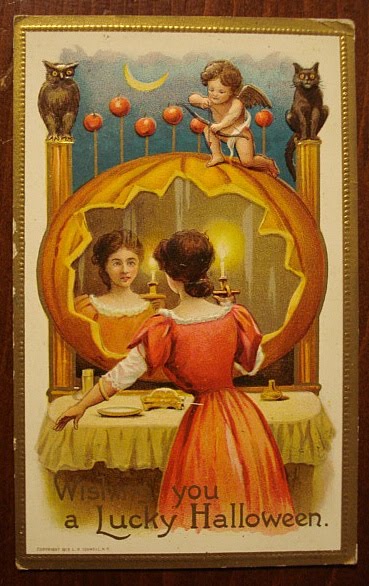 There always seem to be games at Halloween parties, like bobbing for apples. Traditional games seem to involve divination of some sort–a traditional Scottish practice said that to divine one’s future spouse you should peel an apple in one long strip, then toss it over your shoulder. It will form the spouse’s initials. (This seems pretty iffy to me!). Unmarried ladies were also told if they sat in a dark room and looked into a mirror on Halloween night, the face of their future husband would appear in the mirror. But if they were to die before they married, a skull would appear instead! (This seems to be a variation of the “Bloody Mary” game so beloved of slumber parties…). Thsi sort of thing seemed so popular in Victorian/Edwardian times that there was a wide range of postcards available for the holiday.


