Back to Top

Monthly Archives: October 2010

These last few days have seemed like autumn here in Virginia. We’ve had brisk, sunny days and cool nights. Leaves are falling, even though the trees are still stubbornly green.

On 19 September 1819, John Keats took an evening walk along the River Itchen near Winchester and was inspired to write one of the most perfect poems in the English language:

To Autumn

Season of mists and mellow fruitfulness,
Close bosom-friend of the maturing sun;
Conspiring with him how to load and bless
With fruit the vines that round the thatch-eves run;
To bend with apples the moss’d cottage-trees,
And fill all fruit with ripeness to the core;
To swell the gourd, and plump the hazel shells
With a sweet kernel; to set budding more,
And still more, later flowers for the bees,
Until they think warm days will never cease,
For summer has o’er-brimm’d their clammy cells.

Who hath not seen thee oft amid thy store?
Sometimes whoever seeks abroad may find
Thee sitting careless on a granary floor,
Thy hair soft-lifted by the winnowing wind;
Or on a half-reap’d furrow sound asleep,
Drowsed with the fume of poppies, while thy hook
Spares the next swath and all its twined flowers:
And sometimes like a gleaner thou dost keep
Steady thy laden head across a brook;
Or by a cider-press, with patient look,
Thou watchest the last oozings, hours by hours.

Where are the songs of Spring? Ay, where are they?
Think not of them, thou hast thy music too,–
While barred clouds bloom the soft-dying day,
And touch the stubble-plains with rosy hue;
Then in a wailful choir the small gnats mourn
Among the river sallows, borne aloft
Or sinking as the light wind lives or dies;
And full-grown lambs loud bleat from hilly bourn;
Hedge-crickets sing; and now with treble soft
The redbreast whistles from a garden-croft,
And gathering swallows twitter in the skies.


Here’s the poem read by Ben Whishaw, the actor who played Keats in the movie, Bright Star:

I think the imagery in To Autumn is just beautiful, giving the mood of autumn as well as the sights and sounds.

The poem was included in volume of Keats’ works printed in 1820 to better reviews than his earlier works. A year later, Keats died.

You could say he wrote the poem in the autumn of his young life.

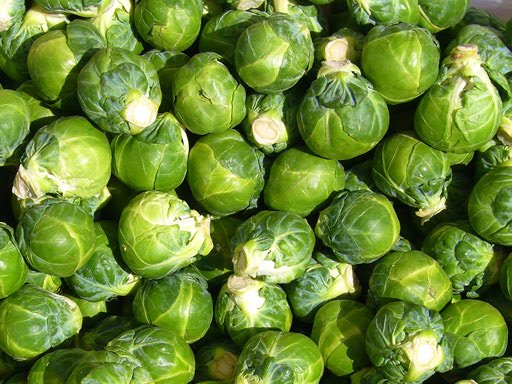
Last Friday Megan asked about fall vegetables, so I’ll ask this: If you took a walk near your house, like Keats did, what would catch your eye? What’s your favorite part about being outdoors in autumn?

Check out the review of Chivalrous Captain, Rebel Mistress in the Chicago Tribune!
Don’t forget to visit the new Harlequin Historical blog on eHarlequin and Diane’s Blog on Thursday!
Posted in Uncategorized | Tagged , | 14 Replies

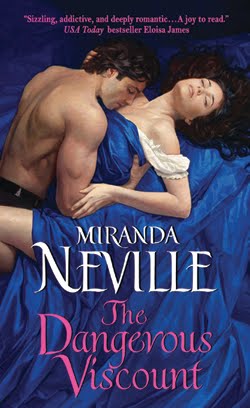
Today we welcome Miranda Neville as guest blogger with a copy of her latest release THE DANGEROUS VISCOUNT to offer as a prize. Your question or comment will enter you into the drawing and Miranda will drop in during the day to chat. And now, over to Miranda…

When I helped my father move out of my childhood home, he asked me to go through a box of family papers. Along with my grandfather’s World War I diaries, I discovered a curious volume listing family members and friends and their weights. Investigation revealed that for seventy years, beginning in 1850, there had been a weighing scale in the hall of the family house in Norfolk, England. After reeling with gratitude that the practice of weighing visitors had ceased long before my time, I decided I needed to put this piece of lunacy in a book.

THE DANGEROUS VISCOUNT is, among other things, a book about opposites attracting. Sebastian Iverley is a bookworm, a real Regency nerd and a misogynist to boot. Diana Fanshawe is a girly girl. She loves parties and fashion and worries about her weight. And she knows about her weight, even without the chart of Recommended Weights For Women (I hate that chart, but I digress), because her eccentric father has a scale in the hall and insists on weighing his friends and relations.

I had to find out what the scale should look like. The St. James’s Street wine merchant, Berry Brothers & Rudd, still exists from the Regency. Gentlemen (including Byron) used their scale—shown here in a photo from their website–to weigh themselves, but it’s obviously a commercial machine. With a little research I figured out what kind of contraption Diana’s father might have owned.

Then, in one of those bits of serendipity that occur in writing, I was researching a scene set in Gentleman Jackson’s Boxing Saloon. Beau Monde member Anke Fontaine produced an engraving which includes – a weighing machine! And it was pretty much as I had described it three hundred pages earlier.

Unable to avoid her father, Diana submits to being weighed and there’s a witness to her humiliation. Luckily it isn’t Blakeney, the hunky ducal heir she has her eye on. It’s only Blake’s nerdy cousin Sebastian and who cares what he thinks?

“Up you get, my dear,” Mr. Montrose ordered. She looked around as though contemplating flight, then climbed into the swinging chair.

Watching her father conduct some business with blocks of metal hanging from a horizontal bar, Sebastian realized the device was a weighing machine.

“Eight stone, two pounds,” Mr. Montrose announced. “Let me see.” He picked up a vellum bound volume from a small table and flipped through the pages. “Five pounds more than last time.”

“I’m wearing a riding habit. This cloth is very heavy,” she said.

Her father wagged his finger at her then pointed at the entry in the ledger. “None of that. Last time you wore a winter gown and full-length fur-trimmed pelisse. See? You made me record it in the book.” He dipped a pen in an inkwell kept handy for the task and entered his daughter’s new weight.

Although not in the habit of judging people’s emotional reactions—men, thank God, didn’t have them—Sebastian noticed Lady Fanshawe looked as though she were about to cry. Was she, for some reason, upset about the increase in her weight? He couldn’t imagine why. He found her figure absolutely perfect. Its diminution by even an ounce would be a sad loss.

Though things like counting calories and the science of nutrition were in the future, people of the period did go on reducing diets. The most famous is probably Byron’s regime of vinegar and mashed potatoes. Diana wants to lose the extra inches from her bust so I invented a couple of diets for her, including one in which she eats nothing but dessert. (That one isn’t a great success).

Despite her appalling obesity (I’d pay good money to weigh only eight stone two [114 pounds]!) Sebastian falls for her. She is totally not interested (in addition to all his other disadvantages her mother likes him). Trying to impress the future duke, Diana bets Blake she can get Sebastian to kiss her and Sebastian is devastated when he finds out about the wager. With the help of his friends in the Burgundy Club, he gets a makeover, transforms himself into an eligible London bachelor, and plots to seduce her. Stuff happens, yadda yadda yadda, and they live happily ever after. If you want to know whether Diana loses the weight you’ll have to read the book.

What’s the oddest thing from your own life you’ve put into a book? And if you are sensible enough not to attempt the writing of fiction, help out a desperate author by sharing an experience I can turn into an utterly improbable scene in a novel. One commenter will win a copy of THE DANGEROUS VISCOUNT.


Hello Risky Folks!

It’s been a week of recovery, following the Yukky Unnamed Ennui/Illness. I’ve been editing my Regency-set historical, the one with the opium-addicted marquess and the illegitimate vicar’s daughter. It’s got an new title–Her Wicked Desire–and a few new scenes. My Champion Agent will be sending it out when I’ve finished the revision.

I know these characters so well that editing their story is really kind of easy–I know what they should say, often opposed to what I originally wrote. I thought I’d share some of their conversation. In this scene, they’re at an inn, eating dinner. They don’t know much about each other except that they think they can help the other in some way. She doesn’t know yet about his addiction.

She rested her elbows on the table and leaned forward, an interested look in her eyes.

“Your mother—where is she?”

“Dead.” Chew, swallow, chew.

“Oh, I’m so sorry. Your father too, of course.”

He nodded in agreement. “Dead.” Stab another bite of food onto the fork.

“Oh.”

“And before you ask, my brother’s dead, too. You already know about my wife.”

“Oh.” She uttered the word in a soft voice.

He couldn’t bear her sympathetic expression. He dropped the fork onto the plate, where it clattered on the ceramic, pushed himself away from the table and strode back to the bed.

“I’m sorry for your pain.” Her quiet words sent skittering prickles of irritation across his skin. He lay down against the quilt, resting his feet just off the edge of the bed.

“Don’t apologize. That’s all anyone’s ever done.”

“Well,” she asked with humor edging her voice, “what else would you expect? People feel sorry for other people, they express sympathy. What is wrong with that?”

Alasdair flung his arm over his eyes. “Nothing. Of course, nothing. People utter platitudes that mean absolutely nothing because it’s what’s expected. I never apologize.”

“I’ve noticed,” she replied. Now she was definitely amused.

He removed his arm and glared at her. “Are you trying to aggravate me now?”

“If I were, is it working?”

He put his arm back. “No.”

“Then I’m not.”

What I like about these two is that they are both difficult in different ways. He, of course, is an arrogant aristocrat; she is a managing woman whose life has been thrown into chaos. That they’re together is purely chance, but of course, eventually, they fall in love.

That, and two separate freelance projects, plus the continual integration of the Boy into middle school has kept me well-occupied. I’ve barely had time to notice the cooler weather and fall vegetables!

Hope everyone’s Friday is going well; does anyone have something they’re looking forward to? What’s the last book you read? What’s your favorite fall veggie?

Megan

Posted in Uncategorized | Tagged | 11 Replies

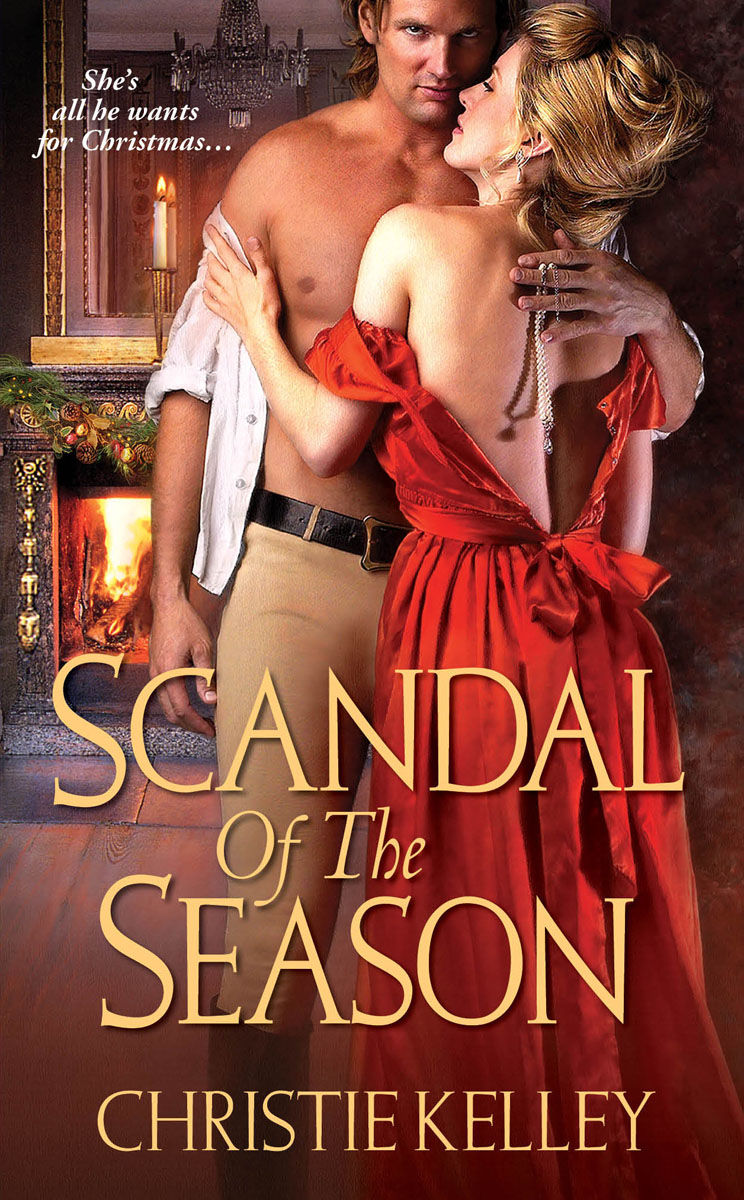
A big Riskies welcome to Christie Kelley who’s here to talk about her October release SCANDAL OF THE SEASON and to whom I’m grateful for saving me from independent thought today. She’ll be giving away a signed copy to one person who comments, so please post a question or comment.

I’ve known Christie just about as long as I’ve been writing. She’s my critique partner and one of the best plotters I know. When Christie was starting this book, she posed the innocent question to the critique group: Can you think of a good reason why the hero’s mother should run a brothel? Much hilarity ensued.

Kelley’s fresh and vibrant romances are emotional, fast-paced and intriguing. Her originality captivates readers and grabs their attention. She gifts everyone with a holiday-set story that’s a little bit Hans Christian Andersen merged with all of her sensual storytelling ability. 4 stars, Kathe Robin, Romantic Times

This book sparkles like diamonds and dazzles like rubies. The Reading Reviewer

This is book number four in your series about a group of women who’ve vowed never to marry, although it reads very well as a stand alone. Do you miss your characters when a book is finished?

I don’t normally because they pop up as secondary characters in the next book. I did just finish writing the last of the Spinster Club series. It was difficult to finish because these characters have been part of my life since 2004 when I first started writing EVERY NIGHT I’M YOURS. All the spinsters wanted more “on screen” time in the last book as if to get their last words in.

Who did you visualize as Somerton when you were writing him, or who would you cast in the movie?

What an easy question! As soon as I started writing Somerton as a secondary character I visualized Jensen Ackles from Supernatural. He was my perfect Somerton in looks and character.

What’s your favorite scene in the book?

I don’t want to give too much away but it’s when my heroine, Victoria does something completely selfless because she loves Somerton. She gets hurt in the process and he can’t understand why she did it. She tells him she loves him and didn’t want to see him hurt. The fact that someone would do something for him because of love just about breaks him. I love it!

What was the most difficult part for you to write?

I had too much plot in this book. It just wasn’t working. Thankfully, my other critique partner, Kathy Love speed read the book and we replotted a few things. After two weeks of rewriting I was able to kill some of the external plot that was taking over the book. I guess that what I get for not being a plotter.

Which writers have influenced you?

Jane Austen for one. But I didn’t really discover her until college. I grew up reading modern historical romances so I think I was most influenced by Johanna Lindsey.

What’s next for you?

The final Spinster Club book, ONE NIGHT SCANDAL, will be a June 2011 release. Right now, I’m busy writing a proposal for a shorter series based on a very minor character in SCANDAL OF THE SEASON.

Thanks, Christie, and let’s chat!

Posted in Uncategorized | Tagged , | 29 Replies
Follow
Get every new post delivered to your inbox
Join millions of other followers
Powered By WPFruits.com