In case you’ve missed it, today is Valentine’s Day! The day when stores look like they’ve exploded with a red and pink bomb, there are jewelry ads every 5 minutes on TV, and local papers and magazines want to interview romance authors. It’s a cheesy, silly, goofy holiday full of chocolate…so of course I love it!!
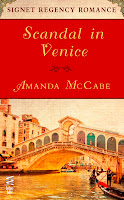
This Valentine’s Day is also special because Signet is re-launching its Regency line as ebooks, and my very first Regency, Scandal in Venice, is the first title in the series! I am very excited about that (and hope it means new Regencies out there!), and I also love the new cover. To celebrate, I’m running a contest on my website to win a Venetian glass heart pendant on my Amanda site. You also have until tonight to enter a contest on my Laurel site…
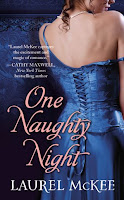
And since I am feeling contest crazy today, I am having one here at the Riskies! I have two brand-new shinny ARCs of my next Laurel McKee book (One Naughty Night, not out until June!). I will give away one copy to a commenter on today’s post!
Here are a few fun history-geek facts I found out about Valentine’s Day…
–Historians trace the origin of Valentine’s Day to the ancient Roman festival of Lupercalia, a holiday on February 14th to honor the goddess Juno (among other things the patron of women and marriage, though maybe Venus might have been a better Valentine’s Day choice!). On the following day, February 15th began the fertility festival called ‘Feast of Lupercalia,’ which often turned into a big, wild party.
An interesting custom of the Feast of Lupercalia was to bring together young men and women who otherwise were strictly separated. On the eve of the festival names of young Roman girls were written on a slip of paper and placed into jars. Each young man drew out a girl’s name from the jar and was paired with the girl for the duration of Lupercalia. Sometime this pairing lasted until the next year’s celebration, and sometimes the couple would fall in love with each other and marry.
–But it was actually due to the Christian priest and martyr St Valentine that today’s holiday got its name. The story goes that during the reign of Emperor Claudius, Rome was involved in several bloody and unpopular wars. Recruting new soliers was hard because a lot of men didn’t want to leave their wives and families to take part in such hopeless campaigning, so Claudius canceled all engagements in Rome. Saint Valentine defied Claudius’s orders. and performed secret marriages. When his defiance was discovered, Valentine was brutally beaten and put to death on February 14, about 270 AD and later became a saint.
Around 498 AD, Pope Gelasius declared February 14 as St. Valentine’s Day to honor the martyr Valentinus and to end the pagan celebration. By the Middle Ages, Valentine became a heroic and romantic figure in England and France, perfect for the cult of chivalry. Valentine’s Day Cards are even said to have originated in medieval France. Charles, Duke of Orleans is said to have written the first Valentine’s Day card. He was captured at the Battle of Agincourt in 1415 and wrote a poem or ‘Valentine’ to his wife while locked in the Tower of London. This letter is still in the collection of the British Library in London, England.
–There was a popular belief in Great Britain and France during 14th and 15th century that birds begin to mate on February 14, halfway through the month of February. In the Paston Letters, Dame Elizabeth Brews writes thus about a match she hopes to make for her daughter (spelling modernize), addressing the favored suitor:
And, cousin mine, upon Monday is Saint Valentine’s Day and every bird chooses himself a mate, and if it like you to come on Thursday night, and make provision that you may abide till then, I trust to God that ye shall speak to my husband and I shall pray that we may bring the matter to a conclusion.
–Unmarried girls in Britain and Italy used to wake up before sunrise on Valentine’s Day. They believed that the first man they glimpsed on Valentine’s Day (or someone who looked like him!) would marry them within a year. Girls would wake up early to stand by their window and wait for the right man to pass by. Shakespeare mentions this tradition in Hamlet (1603). Ophelia sings:
Good morrow! ‘Tis St. Valentine’s Day
All in the morning betime,
And I a maid at your window,
To be your valentine!
What are your plans for the holiday?? What are some of your favorite romantic reads for the day?

 Maybe I shouldn’t admit this, but I’m kind of lukewarm about the covers put on the old Regency anthologies.
 I have mixed feelings about the Christmas anthology covers that seem to imply that the season itself somehow guarantees a happy ending. But a lot of Christmas novellas don’t actually use the holiday as a gimmick. In fact, the title of this one, with Risky Amanda as one of the contributors, actually refers to paranormal elements in this anthology. Much more fun.
 I’ve only participated in one anthology myself, HIS BLUSHING BRIDE, with Alice Holden and our good friend and occasional Risky guest, Regina Scott. When I first saw the cover, I knew that though the Valentine-y treatment wasn’t my thing, it would appeal to a lot of readers. (The book sold pretty well.) Still, I went for a different look for the cover for the reissue of my story from that anthology, The Wedding Wager.
 What do you think? Do you go for anthologies or novellas with the cute covers, or are there other types of covers you prefer?