Back to Top

Monthly Archives: April 2013

wrw-logoThis past weekend I attended Washington Romance Writers Retreat, In the Company of Writers, where, in Winchester, Maryland, we listened to speakers, attended workshops, played the always raucous Romance Jeopardy, talked endlessly with other writers, and raffled off gift baskets. It was a glorious time even if our beautiful Spring weather, lately in the 60s and 70s, dipped to the uncharacteristically cold 50s.

I was trying to think of a connection between the Regency and the Retreat and suddenly slapped my forehead. Of course! It was obvious!
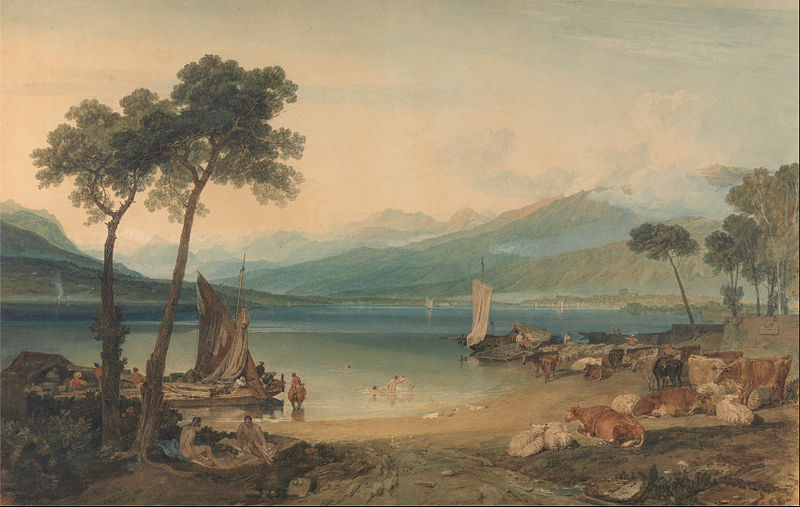
Joseph_Mallord_William_Turner_-_Lake_Geneva_and_Mount_Blanc_-_Google_Art_ProjectIn the summer of 1816, Lord Byron, his physician John Polidori, Percy Bysshe Shelley, Mary Shelley, and her step-sister, Claire Clairmont (who was chasing Byron) were summering in Geneva. Like at our Retreat the the weather turned on them, although Byron et. al. suffered rain and storms, which we didn’t, but it meant that they were all stuck for several days in the Villa Diodati, the villa Byron rented which once had once housed MiltonRousseau and Voltaire had also stayed nearby, so this was a place where writers gathered, albeit one at a time, until this summer of 1816.

Their stormy and cold weather was due to the 1815 eruption of a distant Indonesian volcano, creating (along with other atmospheric and meteorological events) the Year Without A Summer.

History will tell us whether our little cold snap was due to climate change or simply the way it is sometimes in the Mid-Atlantic region.

But I digress….

On June 16, in order to pass the time the group read German ghost stories aloud. Byron was seized with the idea that they all should write a ghost story. Shelley and Byron, after producing forgettable or incomplete results, soon tired of the idea. Polidori began a story that became The Vampyre, the first modern vampire tale. One might say that was the genesis of vampire romances…

Mary Shelley took the challenge seriously, but was distressed when no story idea came to her. (Certainly at our Retreat, discussion of writers block came up once or twice!) Mary stewed the next couple days.

The weather improved enough for them to take a boat trip around the lake during which they discussed whether scientists would bring a corpse back to life. Later Inspiration came to Mary in a dream (as romance writers we are used to inspiration coming in various ways), an image of a scientist looking down upon his creation and being horrified. She eventually  expanded this story idea into the book, Frankenstein; or, The Modern Prometheus.

758px-Gustave_Courbet_-_Le_château_de_ChillonOn that trip they also visited the medieval Château de Chillon. It had been a political prison in the 16th century and Byron and Shelley were enthralled by a visit to the dungeon where a prisoner had been chained to a pillar for six years. This visit seems to have inspired Byron’s poem The Prisoner of Chillon and sparked Shelley to work on his Hymn to Intellectual Beauty.

I figure that this 1816 group of writers (all except Claire Clairemont, who seemed to be there only to pursue Byron) used coming together to inspire themselves to further writing. As happens in the Retreat, some inspirations lead to writing success and some do not. Polidori and Mary Shelley persisted after the the writing challenge was made. Each produced stories that live on today. Byron and Shelley found inspiration elsewhere to produce lasting work.

At our Retreat Kathy Gilles Seidel and Pamela Regis led a writing workshop that had each of us working on our own stories. I came away from that with a story idea that I hope to make into a novella. There were other equally inspiring moments during the Retreat. Jane Porter‘s Pacing Workshop, for example.

I figure that when one is In The Company of Writers, whether it be in 1816 or 2013, creativity blossoms and great things may come from that…but only if one persists.

I have no photo from the Retreat, but I must tell you another thing about it. Years ago WRW devised a game they call Romance Jeopardy, based on the long-running TV game show and in the same style. This year we were all asked to wear something Scottish, producing some very clever costumes or some more mundane like my Scottish kilt. One of the categories was Gretna Green and the “answer” was “A penniless lord and a penniless lady marry in Gretna Green…” I’m thinking, “Who would write that story?”

Well, turns out the “question” was “What was The Wagering Widow by Diane Gaston?”

Let me tell you, the roar of laughter at my missing that question was deafening!!!

Come to my Diane Gaston Blog on Thursday to hear about how my workshop went. I spoke on What Downton Abbey Can Teach Us About Writing Historical (And Other) Romance.

Has a writing (or any kind) of retreat inspired you in certain ways? Did you persist? Will you persist?

This week–whoa. What a week.

It’s weird, when there’s huge national news and you’re supposed to keep working and try not to let things interfere with what you’re doing. But it’s inevitable. I know that it’s meaningless, in terms of current reality, but I grew up in the Cambridge, MA area, my mom worked at MIT and I went to the same high school the currently missing Boston Marathon bomb suspect went to. My dad and I and assorted friends would go each Patriots’ Day to watch the Boston Marathon. Many of my friends are still there, or at least have family there.

It’s a darn good time for escapism and happy thoughts, if you’re not actively involved in helping (and if you are–wow. You are a hero).

So I’m going to grab a romance, have some tea, and listen to my favorite song*:
*Yes, I know it’s a Rihanna cover, but I prefer this version SO MUCH MORE.

Posted in Frivolity, Music | Tagged | 2 Replies

Susanna here, rejoicing that it’s Friday at last. I’m hard-pressed to think when I’ve been more eager to see a week come to its end.

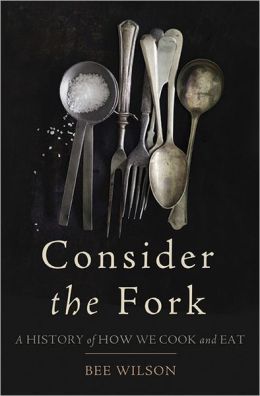
I’m currently reading Consider the Fork: A History of How We Cook and Eat, by Bee Wilson. It’s a fascinating look at the history not of food, but of the implements we use to cook and eat it. I’m only about a third of the way through, but I’ve already learned so much. For example, 19th century vegetables weren’t anywhere near as overcooked as you’d expect based on the long cooking times advised in early cookbooks, because cooks were advised to simmer vegetables rather than cook them at a fast boil, and also because they’d pack a lot of vegetables into a small saucepan rather than a smaller amount in a larger pot like we do today.

Consider the Fork

And here’s another fact that surprised me tremendously: You know how most people have a natural overbite, and if you don’t, your orthodontist will work to give you one? Apparently that’s a recent development in human history, and isn’t the result of a genetic change–it’s developmental, based on how we eat. When you look at older skeletons, you generally see incisors that meet edge-to-edge. The overbite starts to emerge 200-250 years ago in Europe, but 800 to 1000 years earlier in China. In both cases, the change happened first among the upper classes.

The probable explanation? Forks and chopsticks. Once people started carrying food to their mouths already bite-sized rather than tearing it apart with their teeth, their incisors started to grow in differently.

I’ve long been fascinated by culinary history, and I’m starting to incorporate it in my writing. In my July release, A Dream Defiant, my heroine is a naturally gifted cook. She’s a commoner, an ordinary English village girl following the drum in Spain with her soldier husband, and her dream for after the war ends is to take over the inn in her home village, which has a reputation for dreadful food, and turn it into a place all the travelers on the Great North Road will stop to linger over their dinners. And I have an unfinished manuscript I’m thinking of dusting off where one of the characters is a French chef I created to contrast with every fussy, melodramatic French chef ever written. The manuscript in question is a paranormal, so if you picture Anthony Bourdain, Vampire Hunter, armed with garlic and cleaver, you wouldn’t be far off.

What delicious things are you hoping to taste this weekend? I’m planning to bake cookies for the first time in ages.

Here’s an excerpt from something that may or may not ever be written. (Warning: there is a flashback that may injure the tenderhearted)

Time passing.

Ben spent a lot of his life watching time pass, looking interested or uninterested as they talked on about their concerns or business. He’d learned long ago that they didn’t necessarily expect an answer and sometimes not even a response, but a look of quiet concern and interest would do the trick.

And when an upward inflection indicated an agreement was necessary, the words came automatically. “Very true, my lord. Exactly so, sir. Indeed.”

And meanwhile his mind would wander where it would as his hands dealt with buttons and folds and all the niceties of milord’s dress.

Time passed. He waited for the time when his life, his real life would begin, a life that had started some twenty years ago, when first he met Marie.

He, wasting time (they’d say) or exploring (he’d say) his lordship’s library, with the buzz of a bee against the mullioned windows, the comforting rich smell of leather and beeswax, shafts of light with dust dancing like he was in church. But this was better than church, and with the added excitement of getting caught. Running his hands over the spines of leather books, daring to take one down and open it to pictures of strange lands and creatures, and row upon row of words. Or this, spinning the great globe, watching continents and seas blur into brown and blue and green, the surface smooth beneath his fingers, sunlight dancing off the golden bonds that held it in place..

Another hand, small and clean, reddened by daily immersion in soap and water, stilled the globe.

“That’s where you come from, Ben.” Pointing to a great brown mass like a pear upside down.

“No, t’aint. I come from here. I always been here.”

“No you don’t. Here. Africa. That’s what they says in the kitchen.”

He looked at their hands together on the globe, hers so pale and his dark, dark as the ink that named the continents and countries and cities and that he couldn’t read.

“I always been here,” he repeated. “I was born in this house, I was.”

“Silly,” she said and she touched his hand with one of her delicate fingers. The globe shifted at the movement.

The globe revolved again at her touch, and she moved it just a little more, and more again, halfway round the world.

“Here,” she said. “Here’s London. That’s where I was born.”

He looked at the familiar triangle of Britain. Yes, London. He could read that. You watched it on the milestones when milord and milady traveled to town with the servants and where he saw all sorts of people, strangers and foreigners and some even like himself.

“I’ll go back to London.” She tossed her head and removed her hand from the globe to take some of the weight of the folded linens she carried. “When I’m a grown woman, I shall be maid to a great lady and dress as fine as she, and eat meat three times a day.”

He darted in and kissed her rosy cheek. “And I’ll marry you.”

She shrieked and giggled and ran off, shoes slapping on the wooden floor, her fair hair tumbling out from under her linen cap. Her shoes were a little too big for her, just as her gown was a little too faded and short.

Posted in Writing | 2 Replies
cherry blossoms

**Cherry Blossoms in Washington, DC

Myretta entertained and educated us about some of the odd taxes that existed in and around “our” period. But today is Income Tax Day here in the US, so I went looking for some connection between income tax and the Regency.

There was an income tax during part of the Regency, it turns out.

An income tax was first introduced in 1799 by Prime Minister William Pitt the Younger, in order to pay for weapons and equipment for the impending Napoleonic War. It was a graduated income tax, levied at 2 pence a pound in incomes over 60 pounds, increased to 2 shillings per pound on incomes over 200 pounds.

The tax was on income from land, from public securities, from trade, professions, vocations and employment, income from interest, foreign income, and casual income (gambling winnings).

Although Pitt hoped that the tax would raise 10 million pounds, its actual amount for 1799 was 6 million. Later tax on dividend income was added.

Pitt’s income tax was abolished in 1802 when Henry Addington took over as Prime Minister (Pitt had resigned over Catholic Emancipation) and the Treaty of Amiens temporarily ended hostilities with France. Addington reintroduced the income tax a year later when the war started again. It was abolished in 1816, one year after the Battle of Waterloo.

There is another connection between Income Tax and the Regency. The first income tax proposed in the United States was during the War of 1812, which, of course, was with with England during “our” period. Ironically, the US income tax proposal was based on the British Tax Act of 1798. It was never levied, however, because the war ended before it came up for vote.

So….Have you complete your taxes yet? Or are you going to be in line at the Post Office minutes before 12 Midnight?

We did our taxes early this year. We sent them off yesterday!

(**I couldn’t find an Income Taxes image, so enjoy a glimpse of DC’s Cherry Blossoms!)

Posted in Regency, Research | Tagged | 4 Replies
Follow
Get every new post delivered to your inbox
Join millions of other followers
Powered By WPFruits.com