Back to Top

Monthly Archives: April 2013

So, tomorrow I have to go in for a small surgery (luckily outpatient, and I am stocked up on pudding cups and Jane Austen movies for recovery…), but it made me think again how grateful I am for modern surgery!  Especially anasthetics and painkillers.  And when I looked around for something to talk about on the blog today, I found out that ether was first used in March for surgical purposes (though I couldn’t find an exact date!).  Also nitrous oxide played a very important role on last weekend’s episode of Call the Midwife

So here is a very short look at the history of some surgical painkillers….
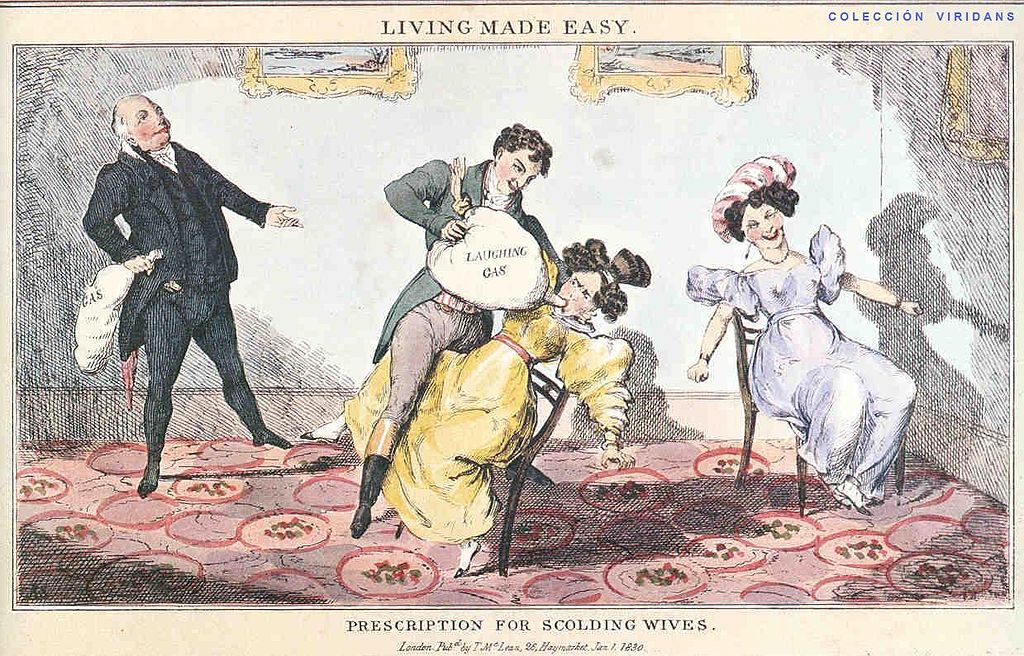
LaughingGasNitrous oxide (laughing gas) was first synthesized by English  and chemist Joseph Priestly in 1772.  He called it phlogisticated nitrous air and published his discovery in the book Experiments and Observations on Different Kinds of Air (1775), where he described how to produce the preparation of “nitrous air diminished”, by heating iron filings dampened with nitric acid.  The first important use of nitrous oxide was by Thomas Beddoes and James Watt, who discussed it in their book Considerations on the Medical Use and on the Production of Factitious Airs (1794). James Watt also invented a new machine to produce “Factitious Airs” (i.e. nitrous oxide) and a novel “breathing apparatus” to inhale the gas.

The machine to produce “Factitious Airs” had three parts: A furnace to burn the needed material, a vessel with water where the produced gas passed through in a spiral pipe (for impurities to be “washed off”), and finally the gas cylinder with a gasometer where the gas produced, ‘air,’ could be tapped into portable air bags (made of airtight oily silk). The breathing apparatus consisted of one of the portable air bags connected with a tube to a mouthpiece. In the town of Hotwells in 1798,  Thomas Beddoes opened the “Pneumatic Institute for Relieving Diseases by Medical Airs”. In the basement of the building, a large-scale machine was producing the gases under the supervision of a young Humphry Davy, who was encouraged to experiment with new gases for patients to inhale. In 1800, Davy published his  Researches, Chemical and Philosophical where he notes the analgesic effect of nitrous oxide and its potential to be used for surgical operations. (But another 44 years went by before doctors attempted to use it for surgery. The use of nitrous oxide as a recreational drug at “laughing gas parties” became a trend beginning in 1799. While the effects of the gas generally make the user appear “stuporous, dreamy and sedated,” some people also “get the giggles” and probably say some pretty embarrassing stuff….

The first time nitrous oxide was used as a surgery anasthetic was when Connecticut dentist Horace Wells demonstrated on a dental extraction on Dec. 11, 1844.  But this new method didn’t come into general use until 1863, when Dr. Gardener Colton successfully started to use it in all his “Colton Dental Association” clinics in NYC.  Over the next three years, Colton  successfully administered nitrous oxide to more than 25,000 patients.

Today nitrous is most often used in conjunction with local anesthetic in dental surgery. Nitrous oxide was not found to be strong enough for use alone in major surgery in hospital settings.  Sulfuric ether came into use in October 1846, along with chloroform in 1847.  (Queen Victoria was a great advocate for the use of chloroform in childbirth).  When Joseph Clover invented the “gas-ether inhaler” in 1876, it became a common practice at hospitals to initiate all anesthetic treatments with a mild flow of nitrous oxide, and then gradually increase the dose with the stronger ether/chloroform. Clover’s gas-ether inhaler was designed to supply the patient with nitrous oxide and ether at the same time, with the exact mixture being controlled by the operator of the device. It remained in use by many hospitals until the 1930s.   (Modern machines still use the same principle launched with Clover’s gas-ether inhaler, to initiate the anesthesia with nitrous oxide, before the administration of a more powerful anesthetic.)

What medical advances are you grateful for today??  And what movie would you recommend I watch to make me feel better?

Cartes_postales_poissons_d'avril_-_1What is the origin of April Fools Day?

No one knows for sure, but it is speculated that it came about when the French calendar was reformed in the sixteenth century, moving the start of the year from March to January 1. Some people who clung to the old calendar and continued to celebrate the New Year from March 25 to April 1, had tricks played on them. The pranksters would stick paper fish on their backs. Thus they were called Poisson d’Avril, ‘April Fish,’ the name the French call April Fools even today.

April fools jokes have continued through the years. Near “our” time period a clever one was pulled off.

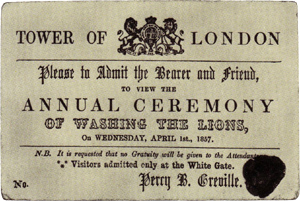
Washing_of_the_LionsIn 1860 a postcard was sent to several people admitting two to the Tower of London to view the annual ceremony of washing the White Lions on April 1. The invitees were instructed that they would be admitted only at the White Gate.

On April 1, several cabs were driving around Tower Hill looking for the White Gate—which, of course, didn’t exist.

April Fool!!

What was the best April Fools joke you played on someone or one someone played on you?


Posted in Research | Tagged | 2 Replies

This weekend, I forced myself to take a look at my jungle-cave of a garage (seriously, there is barely room in there for me to pull in my car AND get out of it!).  There are boxes of out-of-season purses and shoes, Christmas decorations, gardening stuff, and of course mostly books.  Books I’ve stored, and back copies of my own books, which have gotten out of control.  So I am having spring-cleaning giveaways over the next few weeks on my blog to find some of those copies new homes.  This week–One Naughty Night, the first in my new Laurel McKee “The Scandalous St. Claires” series.  (I said on my blog 10 copies, but I found another stash so I have more to give away…and if you like it and leave a review on Amazon, I will send you a copy of the sequel too!!)  I am determined to get organized and make room for more books!!!

Visit my blog and leave contact info to enter…

(And if any of you authors know who might take foreign language copies, let me know…)

This is what I store things in:

PlasticBox

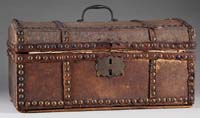
If I lived in the Regency, things might be a little more elegant.  I could use a leather trunk:

LeatherTrunk LeatherTrunk2

Or an oak trunk (this one is French):

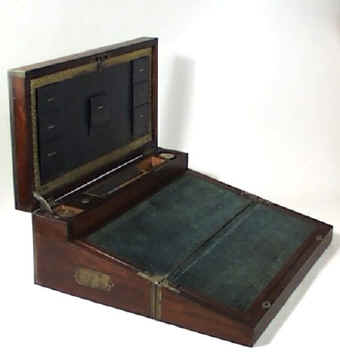
OakTrunkOr a portable writing box: (for a great story about Jane Austen’s almost-lost portable writing desk, go here…)

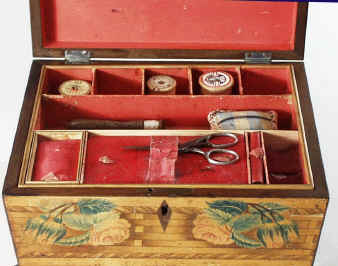
WritingBoxOr a sewing box:

SewingBox

Or an armoire:

Armoire

What are your favorite organizational tips??

Okay,  not death.  But let’s talk about taxes since most of us  in the U.S. are getting pretty near the deadline for submitting our annual tax returns.

While we’re never happy about paying taxes, I thought it might be a good time to think about the taxes we’re not paying that our heroes and heroines probably faced during the Regency.

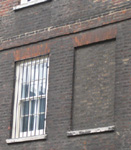
window-taxOne of the most widely known taxes during our period was the window tax. The window tax was introduced in 1691  and lasted until 1851.  That’s a lot of windows.   The tax was imposed upon every inhabited dwelling house in England (and Wales),  except cottages. That is,  houses not paying to church and poor rates in a parish.  By 1792, the rates ran from 6 shillings and 6 pence for houses with six windows or less to houses with 180 windows or more for which the charge was 93 pounds 2 shillings and 6 pence, with 3 shillings charged for every window over that number.  As you might imagine, this led to a lot of bricked-up windows.

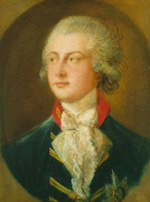
Another interesting tax – and one we don’t have to worry about – is g14powderthe tax on hair powder, introduced in 1795.  After May 5 of that year, very person in Great Britain using hair-powder was required to enter his name at one of the stamp offices and to take out an annual certificate which proved he had paid the tax of one guinea (One pound plus one shilling).  exemptions to the tax included the royal family and their servants; clergymen with an income under £100 a year, officers in the navy under the rank of commander, subalterns, non-commissioned officers, and privates in the army, artillery, militia, marines, engineers, and fencibles.  Exemptions were also made for families with large number of ladies. A father with two or more unmarried daughters could obtain a certificate for any numbers of hair-powder users in his household, provided he paid for the use of the powder by two people.  The government hoped that the tax would raise a revenue of £200,000 per year.  Instead, people stopped powdering their hair and, in the first year, it raised only £210.136.

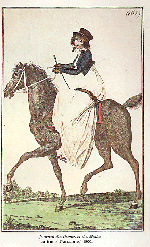
sidesaddle1The tax on “establishments of horses ” was introduced in 1784. It exempted, at first, horses used for agricultural purposes and was imposed only upon  “pleasure horses kept for amusement.” For every horse kept and used “for the saddle” or for “driving in a carriage” (which again, another taxable item) a tax of 10 shillings per year was levied.   1805 the taxation had been increased considerably. For one horse kept for pleasure the tax imposed was 2 pounds 17 shillings and 6 pence. For two horses, 4 pounds,14 shillings and 6 pence (that is 9 pounds 9 shillings for two), and so on along a sliding scale to an establishment of 20 or more horses where a tax of 6 pounds and 12 shillings was charged for every saddle or carriage horse.  The result of this was not that people stopped keeping pleasure horses but that, frequently, they rode horses meant for agricultural purposes.  See, for example, Mrs. Bennet co-opting Mr. Bennet’s farm horse to send Jane to Netherfield in the rain in Pride & Prejudice.

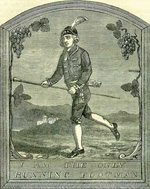
running_footmanIn 1777,  an annual tax of a guinea per man was imposed on male servants.  According to Pamela Horne in The Complete Servant, “Although originally intended to help finance the war of American Independence, it was retained in modified form until 1937. In addition between 1795 and 1869 a tax on hair powder was levied and this, too, added to the cost of employing footmen and coachmen in full regalia.”

These are just a sample of the taxes in existence during our period.  You might also like to investigate the tax on the home consumption of pepper. Or how about raisins?  Or the tax levied from 1784 to 1811 on men’s hats.  Pitt the Younger seemed to be the driving force behind many of the more interesting taxes.

Posted in Regency, Research | 2 Replies
Follow
Get every new post delivered to your inbox
Join millions of other followers
Powered By WPFruits.com