Back to Top

Monthly Archives: June 2013

Following Diane’s report on Threads of Feeling earlier this week I’m recycling a blog post from a couple years ago to share news of an exhibit on Betsy Bonaparte at the Maryland Historical Society in Baltimore, MD: Woman of Two Worlds: Elizabeth Patterson Bonaparte and her Quest for an Imperial Legacy.

I began with a shout out to blogger Madeleine Conway at That Reading/Writing Thing who had some very nice things to say about my Regency chicklit A Most Lamentable Comedy, including this statement:

… her cast of secondary characters, however improbable, also have that unmistakeable air of coming from some research that amply demonstrates that old cliché about truth, fiction and strangeness.

Quite often here at the Riskies I like to explore the oddities of history that I’ve discovered and I was inspired to dig into the scattered and messy files of my memory to write about Betsy Bonaparte (1785-1879), Baltimore girl who made good–for a time. She was a rich merchant’s daughter who married Bonaparte’s younger brother Jerome Bonaparte in 1803. (Applause and cries of “Didn’t she do well!”)

Big brother, who had his eyes on further conquest of Europe through his siblings’ significant marriages, was not amused and ordered Jerome back to France–without his blushing bride. Poor Betsy, pregnant and alone, took refuge in London where she gave birth to their son Jerome Napoleon Bonaparte aka Bo. Big cheese Napoleon, not particularly bothered by such trifling matters as bigamy, married his troublesome younger brother off to a German princess, Catherina of Wurtemburg.

Betsy and baby Bo returned to Baltimore where she was notorious for her European connections and her fashion, which was a bit much by federal American standards. Rosalie Calvert, mistress of Riversdale House, Maryland, met Betsy Bonaparte in 1804 at a party hosted by Robert Smith, Jefferson’s secretary of the navy, and commented that she

…was wearing a dress so transparent that you could see the color and shape of her thighs and more! Several ladies made a point of leaving the room and one informed the belle that if she did not change her manner of dressing, she would never be asked anywhere again.

Another guest gave a similar account:

She [Madame Bonaparte] has made a great noise here, and mobs of boys have crowded round her splendid equipage to see what I hope will not often be seen in this country, an almost naked woman. An elegant and select party was given to her by Mrs. Robt. Smith; her appearance was such that it threw all the company into confusion and no one dared to look at her but by stealth.

Betsy was finally granted a pension by Napoleon, but never the title she wanted so much, and in 1815 a divorce by the state of Maryland. She set her hopes on Bo making a grand European marriage. Bo was not interested, becoming a lawyer and marrying a local heiress. Mama was not pleased.

It was impossible to bend my talents and my ambition to the obscure destiny of a Baltimore housekeeper, and it was absurd to attempt it after I had married the brother of an emperor. . . . When I first heard that my son could condescend to marry anyone in Baltimore, I nearly went mad. . . . I repeat, that I would have starved, died, rather than have married in Baltimore. . . .

In 1855, when the Bonapartes were again in power in France, Bo was offered the title of Duke of Sartene. He turned it down. Ironically, her widowed sister in law Marianne Patterson married Richard Wellesley, the older brother of the Duke of Wellington. Poor Betsy, surrounded by family members either turning down or effortlessly achieving the greatness she craved!

Betsy, uncharmed by Charm City, disillusioned and alone (she never remarried), spent the rest of her life amassing money and at the time of her death, having outlived Bo by nine years, had an estate worth $1, 500,000. She’s buried in Greenmount Cemetery, Baltimore. Her life inspired a play, Glorious Betsy, by Rida Johnson Young, which was made into a movie in 1928 and again as Hearts Divided (1936).

What are your favorite examples of truth being stranger than fiction?

Posted in Research | 1 Reply

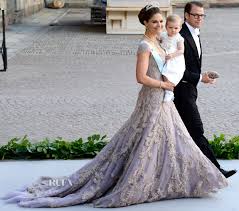
I feel sort of silly following Diane’s lovely post on the “Threads of Feeling” exhibit (which sounds wonderful and heartbreaking!) with a frivolous pic-heavy meringue, but I am on vacation and haven’t much time!!  (plus I do love a wedding, especially a royal one…)  Last weekend Princess Madeleine of Sweden (who really has had a sad, romance novel-heroine-ish life before) married NYC banker Christopher O’Neill, and there were tiaras and gowns aplenty.  Let’s take a look and judge!  (and for more info and images, this is a great blog….)

First, the beautiful bride in her Valentino gown!

MadWedding1Swedenwedding2 The wedding of Princess Madeleine of Sweden and Christopher O'Neill hosted by King Carl Gustaf XIV and Queen Silvia at The Royal PalaceMadWedding4MadWedding5

I think she looks lovely/ethereal/summery/princessy!  I have to be a bit judge-y on that weird dust ruffle thing on the bottom (which was totally unnecessary!), and I was kinda hoping to see the stunning Cameo tiara (which once belonged to Empress Josephine!), but instead we got her everyday fringe tiara.  (I wish I had an everyday tiara…).  But really pretty.  And I will take those earrings now, ok, thx.

For me the day was stolen by Crown Princess Victoria (older sister of the bride) and her stunning lavender-ish gown and Princess Lilian’s tiara.  (for more about Princess Lilian’s bittersweet, romantic story, this is a good place to look)  Plus I squee with happiness every time I see that little Princess Estelle.

What do you think about Madeleine’s gown??  How does it compare to your all-time favorite royal wedding looks?  (My all-time greats would be Princess Margaret, Crown Princess Victoria, maybe Kate…)

9780955180859Janet first told us about the Threads of Feeling exhibit on display at the Foundling Museum in London in 2011, and a year later, that it was coming to Colonial Williamsburg. I was so excited I marked my calendar. The chances were great that I’d get to see the exhibit–my in-laws live in Williamsburg.

This weekend was my chance. We visited the in-laws and I made it a priority to go to the DeWitt Museum where the exhibit will continue until May 27, 2014.

In 1739 philanthropist Thomas Coram received a royal charter from George II to create a foundling hospital for “the maintenance and education of exposed and deserted young children.” It was intended to address the problem of babies being abandoned in the streets or killed because their mothers could not care for them.

Foundling_HospitalAt the Foundling Hospital (more like we would consider an orphanage), mothers were asked to provide a token to be kept with the baby’s registration as a way to help match baby to mother, if the mother came to reclaim her child. The tokens left were overwhelmingly swatches of textiles. The exhibit displays book after ledger book, each opened to a page showing a baby’s registration and the token left by the mother.

Babies that were left there were only a few days old to two months or so. Initially the hospital only accepted babies under six months of age. Later the age was raised to twelve months. Some of the babies had been named, but all received new names given to them by the hospital. Not all were illegitimate; some married couples gave up their babies because their poverty was so extreme they could not care for them. Some mothers left notes.

It is evident from the tokens that the mothers thought very carefully about what token to leave. Swatches of printed fabrics were cut to show a butterfly or a bird or some other symbol of hope. Some left ribbons of all colors or designs. At that time, ribbons were considered love tokens.

Other tokens were created specifically for the purpose. Hearts were cut out of fabric. Names were cross-stitched. Some swatches were decorated with primitive attempts at embroidery. Others had beautiful crewel work.

One had the overwhelming sense that these babies were loved and that the mothers’ situations were so desperate that giving the baby away to the hospital was the best they could do for them. Their baby would be fed, clothed, educated and apprenticed.

Even though the Foundling Hospital was a popular charity (which continues to this day as Coram), supported by wealthy patrons such as the Duke of Bedford, Hogarth and Handel, it could not afford to care for every baby brought to its doors. From 1749 to 1756, 2,808 babies were brought to the hospital, but only 803 were accepted.

The hospital used a lottery system to decide which baby got in. The mother reached into a bag of balls. If she picked out a white one, her baby could stay. If she picked out a black one, she and her baby were turned away.

This heart breaking policy changed in 1756 when the Foundling Hospital became funded by Parliament and all children up to 12 months old were accepted. The numbers of admissions rose from 200 a year to 4000 a year.

Of those babies accepted, two thirds would die. This horrifying death rate was only a bit higher than the norm of fifty per cent. If a child survived past one year old, chances were great that the child would survive until grown.

The tokens left by the mothers revealed, not only their love for their child, but also the best record available as to what ordinary people wore. Clothing of ordinary people was rarely preserved. Before discovering the tokens, it was assumed that the clothing of the poor was drab. The tokens show that the poor wore colorful clothing, printed fabric, and decorative ribbons.

Most of the fabrics were cotton; most were prints. It was surmised that the demand for cotton, for the masses is what drove the fabric industry to mass produce cloth.

Out of 16,282 children admitted to the Foundling Hospital between 1741 and 1760, only 152 were reclaimed by their mothers.

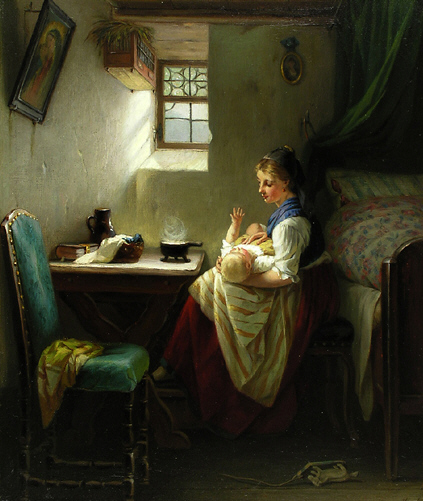
August_Müller_Interieur_mit_Mutter_und_KindAs I went through the exhibit, reading every page shown, the spirits of the mothers seemed to reach out to me, showing me what an agonizing choice they were forced to make.

Can you imagine how it must have been? To nurse your baby for two months. To fashion some sort of token as the only communication of your love for the child. To finally make the decision to give up your baby because you loved it so much, then reach into a bag and pick out a black ball.

What did those mothers do then?

Here is a lecture about the Foundling Hospital.
Here is a podcast with John Styles, the man behind the exhibit and the museum book.

Try to visit Williamsburg to see these Threads of Feeling. It is worth it.

Posted in Research | 19 Replies

In my second book, Just Say Yes, the hero participates in a village festival in which all the able-bodied men move a large stone in the village center in order to bring the village continued good fortune.  This is something that actually took place annually in an English village.  I ran across this odd activity in a book of English festivals, but I’ll be darned if I can find it now to give you the reference.

I was reminded of this recently when the wonderful Loretta Chase mentioned Hone’s Every-Day Book on her Two Nerdy History Girls Blog.  This book describes itself as an “Everlasting Calendar of Popular Amusements, sports, pastimes, ceremonies, manners, customs, and events, incident to each of the three hundred and sixty five days in past and present times.”  In short, it’s the ideal place to look for an interesting tidbit to spice up your story.  The 1827 edition comes in two volumes of which I only have the first (but remain hopeful for obtaining the second half of the year).

Bartholomew Fair 1825

Bartholomew Fair 1825

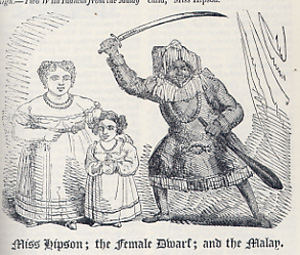
It’s a delight to just page through the book and pick out an event.  For example, on September 5, there is a long description of a visit to Bartholomew Fair in Stowe (or Smithfield as they appear to be interchangeable in this account) in 1825.  The description encompassed many shows including the Largest Child in the Kingdom when young, the Handsomest Child in the World, The Persian Giant, The Fair Circassian with Silver Hair, The Female Dwarf, Two Feet Eleven Inches High, Two Wild Indians from the Malay Islands in the East… I could go on (and on).

You might learn that March 5 is St. Piran’s day (there are a lot of saints in this book, most described as “Romish”). St. Piran is, apparently, an Irish hermit who moved to Cornwall, had a grave made and then died in it.  His day is reported to be a favorite with tinners as tradition has it that some secrets regarding the manufacture of tin was given by St. Piran.

The Every-Day Book covers everything from the laying of the first stone of London Bridge to Bastille Day.  I can hardly wait to get my hands on volume 2.

More concise and focusing more on festivals, but less forthcoming about actual years in which they were celebrated is Yearbook of English Festivals.  This might be where I got the stone moving ceremony, but I can’t find it right now.  My copy of this one was published in 1954 and features some of the more esoteric festivals celebrated in England.

Modern-day well-dressing

Modern-day well-dressing

According to the Yearbook, well-dressing, or well-flowering, is observed in many English villages in the summer, particularly in Derbyshire and Staffordshire.  This event involves decorating wells or springs with flower petals, allegedly to give thanks for its purity.  No one seems really sure where it originated. I love it nonetheless.  And, it’s still going on today. Welldressing.com has an extensive calendar.

I heartily recommend these fascinating compendia of yearly events and festivals.  Not only are they great sources for settings and scenes, they’re a lot of fun just to browse.

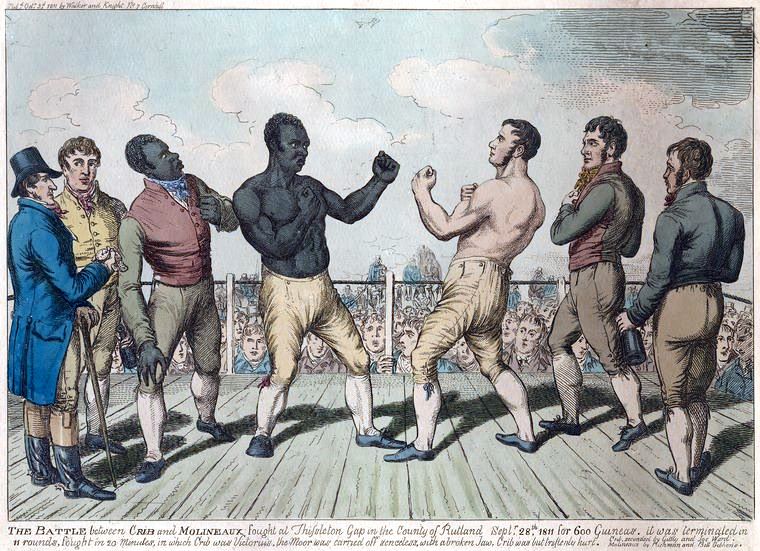
Boxing_1811_Crib_&_MolineauxI’m so happy to be back again, blogging with the Riskies!! Thank you, gracious friends! I’ve been thinking about the subject of manly pastimes a lot recently as I work on my new book. (Yes, I am finally back working on it!) As I write this, my husband is downstairs watching the Bruins play hockey on the TV, providing a very fitting background of excited man-crowd sounds, punctuated by his own loud exclamations. Our Regency gentlemen had a wide range of diversions to amuse themselves and test their mettle, and just like men today, especially enjoyed the chance to compete with one another. In our beloved fictional Regency world, our romance heroes indulge in all sorts of activities, from gaming and watching horse races to the more athletic pastimes –riding, hunting, shooting, driving, fencing, wrestling, archery, rowing, skating, and, of course, fighting. I did one hero whose passion was sailing. I’m sure you can think of more.

What I wonder is, and I hope you’ll jump into the conversation, are any of these pastimes problematic for you as a reader formulating an image of the coolly elegant, romantic Regency man? The hero in my current work-in-progress is known to be one of the better card players in London, a big man who dresses well and does not make waves. He has another side to him, however –he excels at bare-knuckle fighting and is a member of a private fighting club made up of five aristocratic fellows who essentially have surpassed what Gentleman Jackson’s establishment can offer them. He is a character who first showed his face in one of my books ten years ago, but at that time I hadn’t realized he would someday claim his own story.

Boxing-Cribb_vs_Molineaux_1811The vivid brutality of the fighting contrasts so sharply with the elegance that was also so admired in this era, I find sometimes I can’t wrap my brain around it. Is it too violent to be in a Regency romance? We know that historically, fighting, or “pugilism”, was extremely popular in the Regency period. But in our fantasized version of the Regency, is there room for both “bucks” and “bruisers” among our heroes? Would a hero who is both work for you?

As so often happens, there suddenly seem to be a number of authors who are all going in this direction.

Delilah Marvelle created quite a stir with her trailer for Forever a Lord (January 2013). If you didn’t see it, here it is:

I haven’t read it yet –looking forward to it, so discussion is fine but no spoilers please!

Sara MacLean –just mentioned at a workshop I attended last week that her upcoming book –I think it’s No Good Duke Goes Unpunished (coming November? 2013) –is about a hero who does bare-knuckle fighting.

(Sigh.) But we know they will all be quite different from each other. Have you read others? Or written them? Let’s get a conversation going in the comments. I’d really love to know what you think!

rakesmistakeI will give away (by mail) a mint paperback copy of my 2002 release, The Rake’s Mistake, to one lucky poster. To be entered in the giveaway, you must give your email address and let me know you want to be entered! I’ll contact the winner to get a mailing address.

Gail
www.gaileastwoodauthor.com

Follow
Get every new post delivered to your inbox
Join millions of other followers
Powered By WPFruits.com