Back to Top

Monthly Archives: July 2013

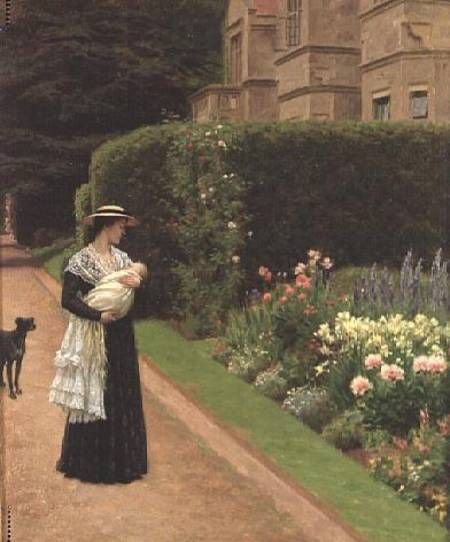
Edmund_Blair_Leighton_-_The_Lord_of_the_ManorVery short blog today, my wonderful friends, because I am in the midst of an experience of pure joy!

My son and his wife are the proud parents of a healthy baby boy, born just two days ago, but, let me tell you, the grandparents are even prouder! I’m in raptures!!! I held him for two hours the first day!

I don’t believe in posting photos of children in public places so this print will have to do. It is called “Lord of the Manor” by Edmund Blair Leighton (1853-1922), because this first grandchild is one very special little guy, the lord of my world, at the moment.

If you meet me in person – at the Romance Writers of America annual conference in Atlanta, for instance – I will be MORE than happy to show baby pictures!

P.S. I’m over the moon!!!

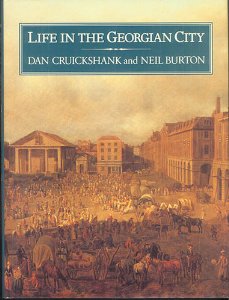
LitGCToday, I’m turning to my library again.  I’ve pulled out Life in the Georgian City by Dan Cruickshank and Neil Burton.  This is a wonderfully detailed book, covering city streets and their buildings, including construction and maintenance, people and services.  Naturally, it doesn’t have everything you would need to know.  But it’s a darned good place to start.  It also has tons of great illustrations.
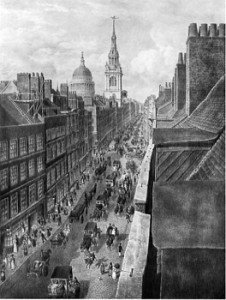
Cheapside 1823

Cheapside 1823

As an example, Chapter One starts out with “The Image of the City,” invoking how the architecture (particularly the newly constructed and prolifically built terrace house) “not only determined the way in which life was organized inside the home but also had a profound influence on the way the city was perceived.” The book quotes Louis Simond, the American who visited London in 1810, as typical of the way visitors saw the smoky Georgian city.  Another visitor called the city “an enormous murky lump of brick.”

The book then goes on to discuss the coal fires that gave the city its murky quality, followed by a discussion of street paving, cleansing and lighting.
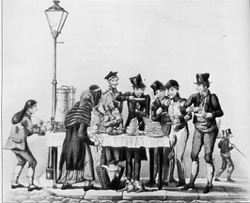
breakfastBut the book does not focus solely on the city’s architecture and streets, it also takes a look at the lives of the people who lived there.  There’s a wonderful illustration of workmen, procuring breakfast from a street vendor.  Something that is so like something we would see today in almost any largish city. Discussion includes daily life, work, entertainment, meals, street hazards, transportation, before moving on to the town houses themselves.

The “Common House” chapter of the book includes floor plans and descriptions of each floor in a typical London town house as well as the services needed to keep in running. including fuel, water supply, and drainage.  There is a chapter on Construction and Speculation, detailed descriptions and pictures of details of the house, including dados, architraves, skirtings, mouldings, and paint colors.

back-garden-islingtonIn 1700 few small town houses had anything but paved yards. The fourth chapter covers the growth of town gardens with probably less  attention to detail than that given to the city and houses.  This is likely because there was not as much written on the subject during the period.  We have section of Richard Horwood’s map showing the large number of London town gardens in the late 18th century, apparently given early manifestation on the Grosvenor Estate in Maryfair, behind the fashionable houses that were built in the 1720s and 1730s, intended for the more well-to-do who would also have a country estate.   There is also discussion of poorer, upper floor residents trying some container gardening with pots on their windowsills.

The book concludes with appendixes that include case studies of four locations.

Are you looking for a telling detail to lend authenticity to your city setting?  This is the book for you.

Posted in Regency, Research | Tagged | 4 Replies

Last weekend, I dropped my oldest daughter off at a summer youth program. It’s not the first time she’s been away from home. She’s been to a week-long residential science camp through the local university and the Kopernik Observatory. But this time it’s three weeks in a big city with people she’s never met before. Her first phone call back was pretty heart-wrenching (not a dry eye around) but she is settling in and everyone’s stress level is leveling off. I keep reminding myself that this is a good preparation for all of us for next year, when she heads off to college.

It’s a balancing act—being supportive while also letting go—and I suspect it’s never really over.

At least we don’t have to do it in historical fashion.

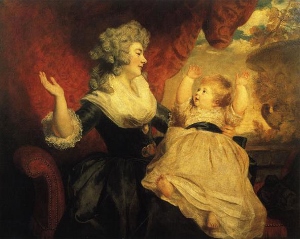
GeorgianaIn the 18th century, it was a custom for well-to-do families to foster their babies out to wetnurses when they were several months old, having them return at age two or three. Jane Austen’s parents fostered her and her siblings out this way, but the practice was already dying out. Even before the Regency, even fashionable aristocratic mothers were expected to take a greater role in caring for their babies. Georgiana, Duchess of Devonshire insisted on breastfeeding her first baby, a girl, despite pressure not to do so because everyone wanted her to get back to the business of producing an heir.

Even if babies were cared for at home, they often had to leave at an early age. Boys were sent to Eton or Harrow at about eight. I’ve never researched boys’ schools in detail, but what I have read makes it seem like there was lots of bullying and little supervision. Scary.
Boys could also be sent into the army or navy at relatively tender ages. By the Regency, one was not supposed to be able to buy ensign’s commissions in the army for boys younger than 16, although I’ve read this rule wasn’t always followed strictly. Boys entered the navy as young as 11. Here’s the trailer for Master and Commander: The Far Side of the World (based on the novels of Patrick O’Brian) showing some of those young officers.

It breaks my heart to think of their mothers. I’m sure it was hard for them to let their sons go at such young ages, even if it was considered normal in their society.

If the goal in raising boys was to toughen them up as early as possible, the opposite seems true for upper class girls. They could be sent away to school, but they were often educated at home, either by a governess or by their mother, depending on family circumstances. Here again I have a problem. Since there were so few acceptable occupations for ladies, girls were prepared to be good wives and mothers or, if they didn’t marry, a comfort to their aging parents.

Much as I will miss my daughters when they leave—they really are so much fun to have around!—I’m glad I have the opportunity to raise strong, independent women.

I don’t know how I would handle being a mother during the Regency. How about you?

Elena
www.elenagreene.com
www.facebook.com/ElenaGreene

Happy 4th!

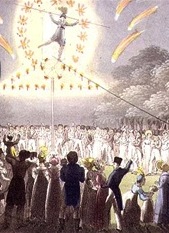
Although firework displays were common throughout the Georgian period I tend to associate them with pleasure gardens.  Here’s a description of  the famed Madame Saqui (1786-1866) in 1816 who walked the highwire at Vauxhall Gardens Descent of Madame Saqui, surrounded by fireworks, published by Thomas Kelly (fl.1820-55) London, 1822 (aquatint)while fireworks exploded all around:

Suddenly a bell rings, the music ceases, away runs the whole party, you follow, unknowing why or whither. But in spite of the tumult and chattering you shortly arrive at the end of one of walks and perceive that fireworks are about to be let off. In a moment the whole air is ablaze, crowns, hearts, initials and various figures show themselves in meteoric flashes and disappear, attended by sudden flashes which gleam on all sides through the wreathing smoke and culminate in a terrifically grand spectacle: the heroine of the piece [Saqui] appears as a rope-dancer, ascends the cord which at a considerable angle is rigged to a height of seventy or eighty feet. Through the smoke and flames she rapidly climbs the blazing pinnacle to the top where rockets seem to graze her in her course, exploding above, beneath, around her and spangling her flimsy dress with their scintillations. Every moment you expect to see the rope severed, to see her precipitated from the dizzy height. But still she supports herself like those fabled Elves which ride upon the storm.

Have a great holiday. Are fireworks tonight in your holiday plan?


Posted in Research | 1 Reply

Last weekend I got to take a fun trip to the hospital again and explore the world of kidney stones!!!  At least I had a clean ER, and a nice morphine drip to get me through (and now that I’m home, lots of cranberry juice and a pile of Jane Austen DVDs to take my mind off it all!).  I decided to take a look at what it was like to pass a kidney stone in the olden days.  Much as I suspected, it was not much fun, but I have a lot of company, going back to ancient Egyptian mummies….

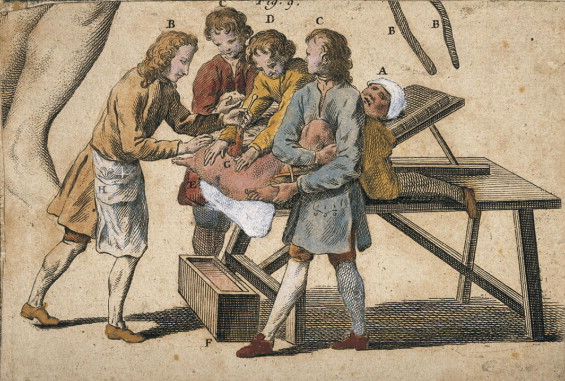
KidneyStonePepysSir Arthur Sullivan of Gilbert-and-Sullivan fame suffered from stones for years, which I am sure explains the scene in one of my favorite movies Topsy Turvy where he is screaming, falling down, injecting himself with morphine, and still insisting on climbing up on the podium to conduct.  Michelangelo suffered from stones, and may have died from the obstruction.  Composer Giovanni Gabrieli also died from the ailment in 1612.  Napoleon III of France was distracted from the Franco-Prussian War by stones, and Napoleon I was at the Battle of Borodino in September of 1812 (one source says “This condition may help explain his unoriginal tactics during this battle”).

Michel de Montaigne wrote “I am at grips with the worst of all maladies, the most sudden, the most painful, the most mortal, and the most irremidiable.”  James I was found to have stones in his bladder and kidneys after death, as did Samuel Pepys, who famously underwent pre-anaesthesia surgery and then carried around the stone with him to show anyone who would look (his post-mortem found “a nest of no less than seven stones” in one kidney).  Peter the Great suffered from them in 1725, and Empress Anna of Russia in 1740.  George IV had them (which is no surprise–what illness did the guy not have??), and probably Henry VIII.  So did George Eliot.

Oliver Cromwell, his doctor wrote, “being much troubled with the stone, he used sometimes to swill down several sorts of liquor, and then stir his body by some violent motion…that by such agitation he might disburden his bladder.”  (Drinking copious amounts of alcohol seems to have been the number one treatment, along with “blistering with cantharides”.  I was tempted to down some vodka to make it feel better, but blasting the stones into sand-like bits then washing them out with a saline drip seemed to work better…)

KidneyStoneDootErasmus, Caesar, and Pilgrim Myles Standish (who died “in dolorous pain”) also had stones.  And, famously, there was a Dutch blacksmith named Jan de Doot who had his portrait painted in 1651 with a stone he removed from his own perineum with a kitchen knife.  Ugh.

Now that I have made myself feel so much better with this research (not!) I am going to watch some more Pride and Prejudice and drink my lemon water.  RWA is coming up in just a couple of weeks, after all, and I need to feel 100%!  What is your favorite historical surgery story?  Any kidney stone prevention tips I can use in the future?

Follow
Get every new post delivered to your inbox
Join millions of other followers
Powered By WPFruits.com