Back to Top

Monthly Archives: March 2014

Megan[4]Last Friday, I turned the finished final manuscript of The Duke’s Guide to Correct Behavior in to my agent. It is due to my editor on April 1 (quick plug: it’ll be out November 25 of this year from Avon, in both print and digital).

It was both arduous and delightful to write, if that makes any sense, since it was often hard to keep moving forward, but once I really got to know my characters, the words just poured out.

I don’t know how many changes it will undergo once it’s been revised, but this is my heroine’s first viewing of the hero:

He was tall, and very, very, very handsome. Extremely male. No, entirely and absolutely virile. That was the word. Virile with all of its connotations that brought the pink to her own cheeks. At least she better matched the room.

Goodness. She’d seen pictures of gods and soldiers and kings and other leaders of men, but she’d never actually felt the impulse to follow one of them anywhere.
This one, though, she might consider following, even though that way led to things that a young lady should not be thinking of. Especially a respectful governess who needed to make a good impression.

He had dark hair, straight, brushing his collar in an unkempt way that nonetheless looked utterly dashing. His eyebrows were straight black slashes over his eyes, dark brown, which were intently gazing at her as though he could see to her soul.

And if he could, he knew what she was thinking about him, so that could be problematic.

The sharp planes of his chiseled face were further accentuated by the stubble on his cheeks, giving him an even more dangerous look. The Dangerous Duke sounded like a character from a gothic novel. And he looked like just the sort of man who would lure women to do Dangerous Things.

And I got a new author photo, above, where I look both sorta like myself and yet also not too blotchy and hideous (thank you, photoshop!).

While I wait for revisions, I’ve been reading (as usual), and cleaning, and taking care of things that totally fell by the wayside while I was writing. I am so looking forward to Spring! And plotting out the next book…
Megan

I was crazy about horses growing up, a passion I never really got the chance to put into practice. I’ve ridden a few times at friends’ houses, and on vacation two summers ago my daughter and I went on an hour-long trail ride, but that’s it.

But one of my favorite parts of writing historical romance is getting to be that horse-crazy child again. For my Regency heroes and heroines, horses provide basic transportation. And most of the time, my love for horses finds its way into my characters to one degree or another. James in A Marriage of Inconvenience breeds Arabians. Will and Anna in The Sergeant’s Lady both get a chance to ride a beautiful Spanish mare named Dulcinea.

My current WIP is set in America in 1815, so I did a little research into whether familiar American breeds of today like the Quarter Horse, the American Saddlebred, the Tennessee Walker, and the Morgan existed yet. And for the most part the answer was yes, although they weren’t yet firmly codified with breed standards and closed stud books.

Henry, my hero, is an accomplished horseman, fit and athletic. Over the course of my plot, he needs a horse that’s steady and enduring for a long journey, but also fleet-footed and nimble when needed for an action scene. So I decided to put him on a new American horse bred from a mixture of Spanish Barbs and English stock, including Thoroughbreds–a practical, sturdy horse good for everyday riding, but also speedy over short distances. In other words, a Quarter Horse, or as they were known at that early date, a Quarter Running Horse. (The name comes from the short quarter-mile races these horses excelled at.)

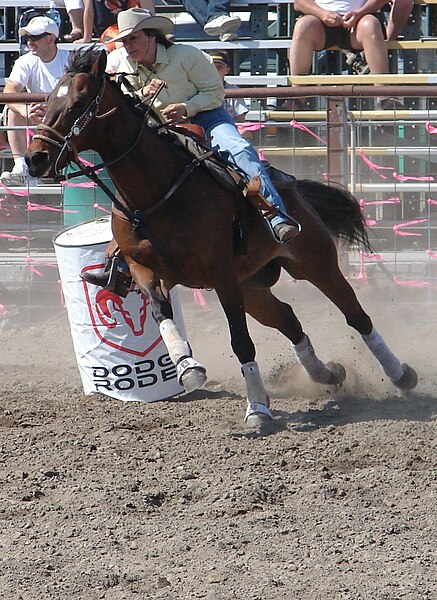
The modern Quarter Horse runs the gamut from a beefy, muscle-bound creature shown for looks in halter classes to slender racehorses who greatly resemble Thoroughbreds. I’m picturing Henry’s horse as something like this barrel racer–wiry, compact, and nimble.

barrel racer

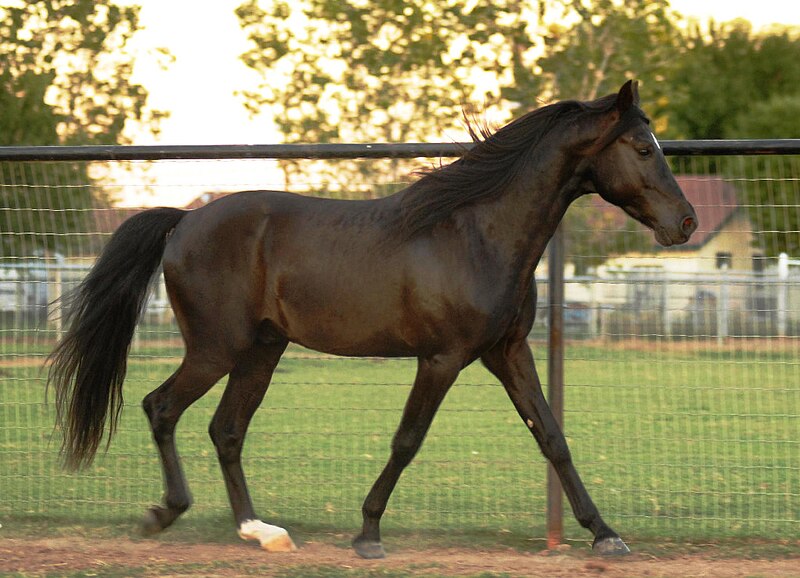
My heroine Therese, on the other hand, had neither the necessity nor the opportunity to learn to ride before she has to when called upon to escape cross-country for the “road romance” portion of my plot. So she needs a horse that’s above all else gentle, good-natured, and smooth-gaited. Fortunately for her, there was a horse around in the early 19th century known simply as the “American Horse” noted for its smooth “ambling” gaits. Its modern descendants include the Tennessee Walking Horse, the American Saddlebred, and the Missouri Fox Trotter, so I imagine Therese’s horse as looking a bit like this Fox Trotter:

Fox Trotter

Are you a horse lover? If you found yourself living in the Regency era, what kind of horse would you ride? Or would you stick to carriages and leave the driving to your trusty coachman?

I went off to brainyhistory.com today to see what happened today a couple hundred of years ago, and the answer is, not much, or at least not much that interested me. A lot of obscure composers were born on this day. There are always a lot of obscure composers having birthdays.

Turning to the letters of Jane Austen–yes, good idea, let’s talk about Jane Austen–March was not a big letter writing month for her. Her letter of March 9, 1814 to  Cassandra contains this sisterly gem:

If Cassandra has filled my Bed with fleas, I am sure they must bite herself.–

Cassandra got busy with the scissors on a letter of March 21 2014 to (maybe) Francis Austen but allowed this to remain:

Perhaps before the end of April, Mansfield Park by the author of S&S–P&P may be in the World.–Keep the name to yourself. I shd. not like to have it known beforehand.

Ah, those were the days. You could be all secretive about your impending release and even about your own identity. No facebook. No twitter. No wall to wall squeeing promo. Heaven.

I’ve been having a Jane Austen-ish time recently, doing what I swore I’d never do because there are too many polluting the world, experimenting with a P&P-based book. More about this darling child, maybe, later. I also went out to Minneapolis for a very short trip–Minneapolis in March, not so good–to talk to their JASNA chapter about Austen and servants. Fun, fast, furious, the weather cooperated, whew.

I also read S&S again. I’ve always thought that one of the wonderful things about Austen is that the books change for you every time, and sure enough, it was like reading a whole new book. I last read it in 2011 and this time I was very much aware of it being “about girls filling in their time waiting by the phone for unsatisfactory men who don’t respond in the right way.” (That was from a post I wrote in 2011 on the JASNA-AGM which was about S&S and hearing Andrew Davies talk about his Austen screenplays.) Because, sorry to say, other than being by Austen, it’s not a very good book. There are so many things in it that don’t work, principally Marianne, Elinor, and Edward.

JenningsBut Mrs. Jennings. Oh gosh, I love Mrs. Jennings. This time around she was the heroine of the book for me.  She’s fun. She’s lively. She isn’t afraid to tease Marianne about Willoughby while everyone else tiptoes around her, not daring to ask whether she’s engaged to him or not. And above all despite the meddling, grasping the wrong end of the stick (considerable), and gossip, she’s kind and loyal and sensible. She knows Marianne will get over Willoughby, and ultimately, get over herself.

Let’s hear it for Mrs. Jennings. Here’s a bit of video for you to enjoy–I love the pained expressions of everyone else while she and Sir John Middleton guffaw away idiotically.

Have you been surprised by a minor character when rereading a book? Do share!

blockprintdress2

Block Print c.1800

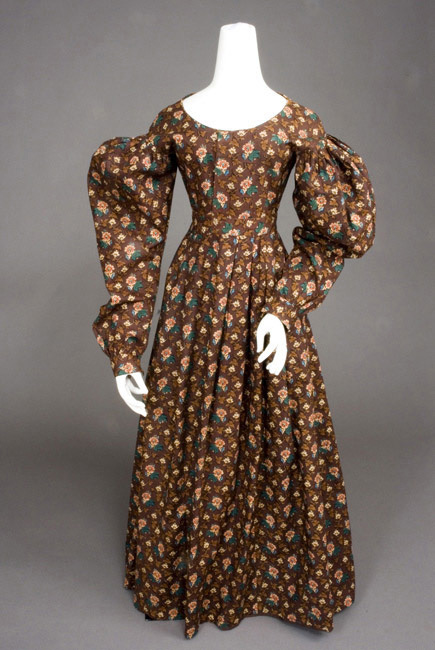
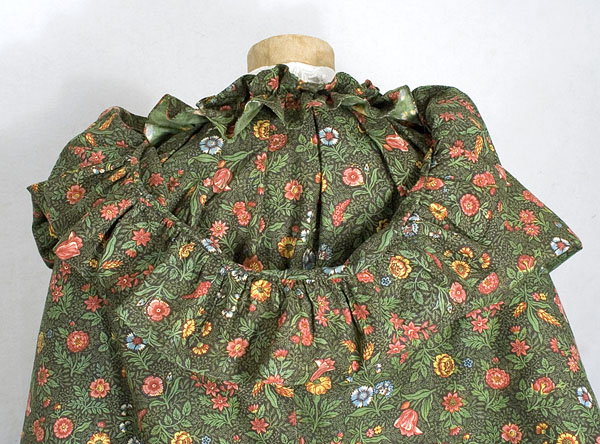
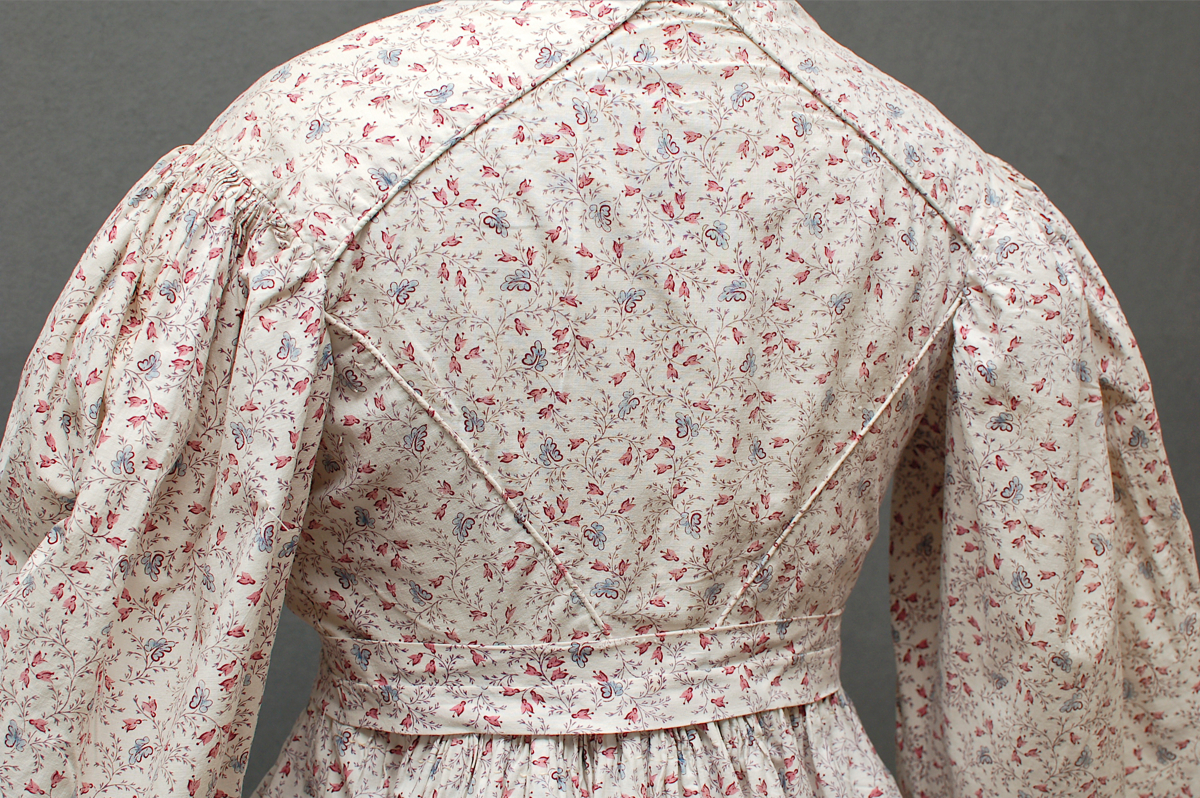
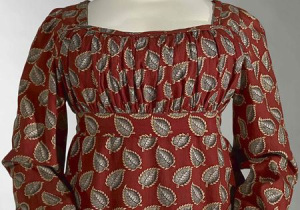
Today’s post is going to be more of a gallery. I want to build on my last post (The Colorful Regency) and highlight print gowns. The two methods of printing were block and roller (which are exactly what they sound like). Block predates roller, which was invented in the late 18thC and really came into its own in the 1820s.

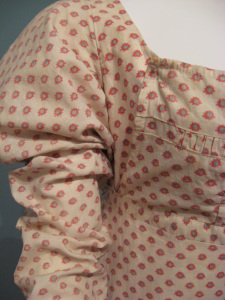
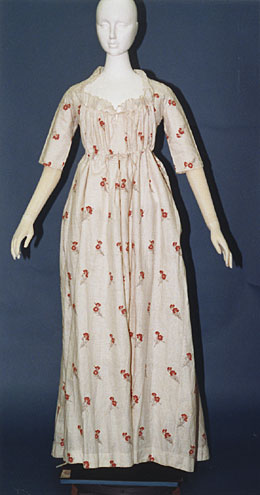
It was common to see “penciling” combined with block printing. What this means is that the blue part (and sometimes the yellow part) of the design was painted on after the main pattern or “springs” were printed (yes, that’s what “sprigged muslin” means, printed with a small repeating design).

An unusual method of printing that was period was “chine”. The fabric was printed on the warp before weaving, resulting in a blurred design. I couldn’t find one from the Regency, so there’s an 18thC example in the pictures below, but it WAS used throughout the Georgian period (including the Regency) and Victorian era and beyond.

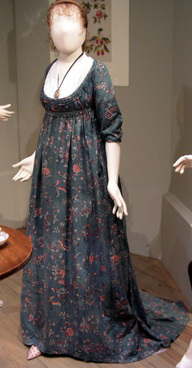
teal-chintz-regency-gown1

Print Gown c. 1800

A bit about terminology: Calico is a general catch-all term for medium-weight cotton fabric of Indian origin (heavier than muslin). Chintz is calico which has been printed or painted. Many sources state that chintz was also glazed (note: glazed fabrics can’t be laundered!), but this clearly does not seem to be true of all chintz. These fabrics were commonly used for day dresses throughout the entire Regency period.

Indiennes was the term applied to French imitations of Indian chintz,, the most famous of which were produced in Jouy (such as the copperplate printed scenes we now call “toile,” which were only used for furnishings in the 18th and 19th centuries, so don’t dress your heroine in them).

As you’ll see below, white and cream backgrounds were common, but so were da

rk backgrounds in any color you can think of.

Jane Austen’s World has a nice post on this topic with more examples that are worth looking at when you’re done here.

english-printed-cotton-day-dress-circa-1810

Orange “Sprigged” Gown c. 1800-1810

drawstring dress 1800 1810 detail

Blue “Sprigged” gown c. 1800-1810
blockprintdress10

Sprigged Gown c. 1795-1805

1830s dress brown

Brown Printed Gown c. 1830

1820 roller printed dress bodice

Roller Printed Gown c. 1820

1805 1840 green blockprint

Green Block Print Gown c. 1805-1810

1795 1800 hooded perline 3

Printed hooded perline c. 1795-1800

floral front fall back detail 1820

Floral Gown, 1820s

1808 close up of back

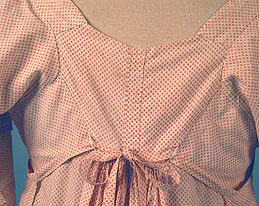
Tiny Red Dots 1805-1810


round-gown-1802-from-pinterest-ginger-scene-in-the-past

Printed Gown c.1800-1810

dress 1810 detail front

Woven Stripe w/printed sprig c. 1805-1810


Chine printed gown

Example of Chine printing, 18thC

Follow
Get every new post delivered to your inbox
Join millions of other followers
Powered By WPFruits.com