Back to Top

Monthly Archives: March 2009

Don’t get me wrong. I’m still shooting people. I’m just doing it with dueling pistols and muskets instead of MP5s and Sig-Sauers.

My life used to be so simple. I wrote modern-day romance, romantic suspense, and straight suspense. It was fun. It was satisfying. As a trauma nurse with a forensic background, it was relatively easy to research. Call a friend who’s a cop. Call a friend who’s a medical examiner. (Yes, I have good friends…) And if that wasn’t enough, I figured out a way to play with it. I took Police Citizen’s Academy, Death Investigation Training, and FBI Citizen’s Academy (site of my proudest achievement! Amid all the cop and military types, I won a blue ribbon in the MP5. I keep the medal hanging in my kitchen so my children never forget).

But for a long time, I’ve had this itch that SWAT training didn’t satisfy. I blame it on Melinda Helfer, legendary reviewer at RT. She saw I had developed a fondness for Regency romance, and said “Eileen, you need to write a Regency!” I laughed. You see, I long ago resigned myself to the fact that I suck at research. The kind you have to wade into books to get, since anybody who knew anything about it was already dead. I was a trauma nurse–I had no idea how to work in a library!

Not only that, I was finally diagnosed with ADD (I seem to be the last to know), which means organizing all that information and picking out the pertinent bits was way beyond me. So, there I was, happily decimating the population of St. Louis in a series of suspense stories under the name Eileen Dreyer, and this idea for a trilogy of Regency-era romances came to me full-blown (thanks, Melinda!). It wouldn’t leave me alone. It talked to me. The characters took shape. They demanded that attention be paid. But I kept saying, “No, no, later. I have things to do.”

Funny how that can be resolved. For me, the suspense market temporarily dried up. And my new heroines, who I had dubbed The Three Graces, said, “Really what you want to learn about is Waterloo. And early 19th century undergarments!” I protested fruitlessly. “But I can’t call anyone who was there! I’d have to read a book!”

And God said, “Let there be the Internet. And Wellbutrin.” (Which gave me the focus to actually read non-fiction books. My new favorite is Dancing Toward Waterloo by Nick Ffolkes). Clever, isn’t She? I can’t tell you how much fun I’m having. History really does fascinate me. Not only that, I’ve become a card-carrying member of the Anachronism Club, which means I pride myself on my acquaintance with Regency mores and habits.

And, since the first book begins the night before Waterloo, I still get to decimate populations. I still get to have suspense and sex, and the absolutely accurate research that is my hallmark over in Suspenseland.

And early 19th century undergarments.

How cool is that?
You can visit Eileen’s website (and learn more about her books!) here

And now, from the mad mind that brought you Austen Trek and Jane Austen’s Batman, we have

Jane Austen’s BUFFY; or, if Jane Austen had written Buffy the Vampire Slayer….


Mr. Giles turned his eyes on Miss Buffy Summers. “I can guess the subject of your reverie.”

“I should imagine not.”

“You are considering how insupportable it would be to pass many evenings in the presence of a vampire without being able to place a stake within his chest–and indeed I am quite of your opinion. I was never more annoyed! Their love of blood, and their eccentric dentistry–the villainy, and yet the arch dialogue of all those people! What would I give to hear your strictures on them!”

“You conjecture is totally wrong, I assure you. My mind was more agreeably engaged. I have been meditating on the very great pleasure which a pair of fine eyes in the face of a handsome vampire can bestow.”

Mr. Giles immediately fixed his eyes on her face, and desired she would tell him what vampire had the credit of inspiring such reflections. Miss Summers replied with great intrepidity:

“Mr. Angel.”

“Mr. Angel!” repeated the watcher. “I am all astonishment. How long has he been such a favourite?–and pray, when am I to wish you joy?”

“That is exactly the question which I expected you to ask. A watcher’s imagination is very rapid; it jumps from reluctance in killing a person to love, from love to matrimony, in a moment. I knew you would be wishing me joy.”

“Nay, if you are serious about it, I shall consider the matter is absolutely settled. You will be having charming relatives in Spike and Drusilla, indeed; and, of course, they will always be in Sunnydale with you.”

She listened to him with perfect indifference while he chose to entertain himself in this manner; and as her composure convinced him that all was safe, his wit flowed long.

“You are aware of his much-lamented past, I am sure,” said Mr. Giles. “And you must of necessity regard it with the greatest horror. To murder humans for one century, or two centuries, or three centuries, or whatever it was, above his head in blood, and alone, quite alone! What could he mean by it? It seems to me to show an abominable sort of conceited independence to chuse to remain soulless for so long–and then, at the last, to repent? And why?”

“The latter shows an affection for humans that is very pleasing,” said Buffy.

“I have a excessive regard for Angel, he is really very sweet (for a vampire), and I wish with all my heart he were well settled. But with such friends as Spike and Drusilla, and with his inexplicable love for hair gel, I am afraid there is no chance of it.”

Cara
Cara King, author of MY LADY GAMESTER and eternal geek

Posted in Uncategorized | Tagged | 24 Replies

I’m starting in on a new book, the second in my Three Soldiers Trilogy. The last book ended at Waterloo and this one begins there, in the battle itself.

The battle of Waterloo really had three parts: the fighting on the ridge; the fighting at La Haye Sainte, and the fighting at Hougoumont. La Haye Sainte and Hougoumont were farms positioned at strategic places.

So my first decision was what part of the battle to use.

Some limits were imposed by just where in the battle my hero’s regiment would be, but I solved that problem. I first selected La Haye Sainte and read up on that part of the battle. The problem was, La Haye Sainte fell to the French right at the end of the battle and that didn’t work for me, so I started reading about Hougoumont.

I found some very interesting sites about Hougoumont.
Project Hougoumont, which aims to restore the site
A very detailed model of Hougoumont
Summary of the whole battle
Detailed timeline of the defense of Hougoumont, including how Victor Hugo got it wrong in Les Miserables.

Still not enough….
I started pining to watch Waterloo, the epic 2 hour movie starring Rod Steiger and Christopher Plummer. I had a VCR copy but no working VCR. So I ordered the DVD.
I discovered another DVD about Waterloo, a documentary I’d seen on the History Channel. I ordered that, too (only to discover that I’d ordered it before…)

Then I hit on the idea to look on YouTube (Note to Everybody: you can find anything on YouTube). Sure enough they had clips of the movie Waterloo, enough to fill me with the sounds and sites of the battle.

I also ordered a book on Hougoumont. Hougoumont: The Key to Victory at Waterloo by Julian Paget and Derek Saunders (I always order some reference book when I start a new book)

I also poured through some of my relevant reference books on my bookshelves and braved falling over the clutter to get to them. Because they are shelved two (or three) deep, this was much like an archeological dig.

After all that I finally was able to write the opening scene of Chapter One.

Book One of my Three Soldiers Trilogy is scheduled for release in 2010, so who knows when this Book Two will come. Chances are I’ll be blogging about researching this book again!

How do you go about researching a scene or a topic? Have you found any other helpful things on YouTube?


Visit Diane’s website for a sneak peek of her eShort Story, The Unlacing of Miss Leigh, and her novella, Justine and the Noble Viscount, in THE DIAMONDS OF WELBOURNE MANOR. Diane’s contest is still on, too!

Nicola Cornick rejoins the Riskies today, with tales of traveling from the Scotland of her newest release from Harlequin Historicals, Kidnapped: His Innocent Mistress, to the American West! Nicola, welcome back, and tell us about Kidnapped and your latest US holiday…

It’s so lovely to be back here at Risky Regencies and to be talking about books, travel, and inspiration! What better combination could there be?

So to Scotland first and I think I must be one of the luckiest people in the world because I go there every year to visit family. Under the circumstances it’s surprising that I’ve never set a book there before because it is one of my favorite places and I love reading historical romances set in Scotland. Kidnapped: His Innocent Mistress is inspired by all the places I love to visit in Wester Ross in the Highlands. The village of Applecross, which is Catriona Balfour’s home at the start of the book, is a very special place, accessed by only two roads, one of which is a high mountain pass with views across the sea to the Outer Hebrides. The Gaelic name for the Applecross Peninsula is “a Chomraich,” which means “The Sanctuary.” The site of the old abbey at Applecross, built in AD 673 by Irish saint Maelrubha still has one of the most peaceful and inspiring atmospheres that I have ever experienced.

Further along the coast is Sheildaig, a village that was originally to raise and train sailors to fight in the Napoleonic Wars. Grants were given for boats, and 2700 pounds was spent building the three main streets, which these days are neat and whitewashed and very pretty. From there the road turns inland between the high mountains of Torridon and this is the route that Catriona takes in my story as she travels to her new home in Glen Clair. The old house at Glen Clair is another place inspired by a real location–the Coulin Estate. In a spectacularly beautiful setting in the mountains, Coulin is somewhere we return to year after year. It was in the ownership of the MacKenzie family of Gairloch from the 16th century and in the Regency period the tenants suffered eviction in order to make way for sheep farming. This was of course the fate of many Highland families during the 18th and 19th centuries. These “Highland Clearances” forced many families to the coast, the Scottish Lowlands, and abroad to countries including Australia and Canada.

At Glen Clair my heroine Catriona becomes embroiled in the illegal whisky distilling business! There were many illegal stills hidden in the mountains, in caves that were away from the prying eyes of the excise men and in remote glens. The euphemistically-named “teahouse” at Coulin really did provide illegal refreshment for drovers crossing the mountains and it is still there though these days it is used as a mountain bothy rather than a place offering alcoholic beverages! Just as smuggling was condoned or even encouraged by many of the gentry in England, so many of the Scots would turn a blind eye to what was going on. Ministers of the church were even known to hide the whisky in coffins to deceive the excise men!

From Scotland to the US, and when Kidnapped arrived in the US bookstores at the beginning of March, I was thrilled to be there to see it! It’s no secret I love visiting the US and this time our holiday started in San Diego with a trip to the historic waterfront, taking in the 1863 ship the Star of India and the HMS Surprise, a replica of an 18th century Royal Navy frigate that was used in the filming of Master and Commander: The Far Side of the World. That was my treat, and afterwards we visited the USS Midway as a treat for my dh!

Our ten-day whale-watching holiday down the coast of the Baja Peninsula and into the Sea of Cortes might not seem to have the most obvious of historical connections (though it was spectacular in itself) but I had read up on Baja history and legends and devoured the stories of pirates and buccaneers, coming back with what I hope will be a wonderful plot for my next HQN book! From Mexico we flew back to Phoenix and travelled to Monument Valley and the Grand Canyon, finally driving back to Los Angeles via the historic Route 66. On the way we stopped off in Oatman. What a place!

Oatman began over 100 years ago as mining tent camp and quickly became a flourishing gold-mining center when in 1915, two miners struck a $10 million gold find. The mining boom was short-lived. In 1921, a fire burned down many of the smaller shacks in town, and 3 years later the main mining company, United Eastern Mines, shut down operations for good. Oatman survived by catering to travellers on Route 66. But in the 1960s, when the route became I-40, Oatman almost died.

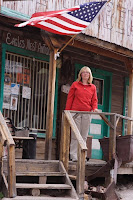
Oatman was such a fun place to visit. I’d never been to an old Western town, and I loved the tame burros roaming the streets begging for carrots and the gunfight staged by the ghostrider gunfighters! My dh loved all the photo opportunities presented by the old buildings including the Oatman Hotel, where Clark Gable and Carol Lombard honeymooned and Gable allegedly played poker with the local miners!

We came home with some amazing memories and some equally spectacular photographs, and for me some inspiring story ideas. It doesn’t seem to matter where I travel–seeing new sights, talking to people and reading up on the history always seems to inspire me with ideas for my writing.

What is you favorite setting for historical romances?? And which places particularly inspire you?

Info on Nicola’s latest release can be found at her website! And there are still a few days left to enter Nicola and Amanda’s contest while you’re there…

Nicola will give away two copies of Kidnapped to lucky commenters on today’s post!

Follow
Get every new post delivered to your inbox
Join millions of other followers
Powered By WPFruits.com