Back to Top

Monthly Archives: June 2009

This time last year we all blogged about Waterloo for a week (I wrote about the ordinary soldiers), and so since June 18 is the exact anniversary of the battle I thought I’d find some material we didn’t cover then.

In 2004 the European community made the decision to restore the battlefield, providing a visitor center and other amenities to honor the site and attract visitors. Like many battlefields, it’s spread out over a large geographic area. Here’s the official Waterloo site.

There’s also a site for the official reenactment of the battle, which takes place every year, with some beautiful photographs, all under copyright and in a flash format, of reenactors–Napoleon and Wellington among them. And yes, this year’s reenactment is going on right now!

If you happen to be going over to London, there’s a celebration at Apsley House, the home of the Duke, with special events this weekend.

And if you’re not planning to travel this weekend, you can play the Battle of Waterloo game (no, I haven’t tried it out, and don’t blame me for the timesuck this undoubtedly is).

Restoration of the battlefield continues, the most recent effort being the restoration of Hougoumont Farm, where a strategically important part of the battle took place. The current Duke of Wellington, now in his 90s, is an enthusiastic supporter of Project Hougoumont. The opening of the Farm is timed for the two-hundred anniversary in 2015.

For a modern perspective on the first Duke and his descendents, Lady Jane Wellesley wrote a book published last year, Wellington: A Journey Through My Family. There’s a review here with this quote:

I reflect on the indiscriminate, humbling power of war, and its aftermath, the way it plays havoc with people’s destiny.

Further proof that there are still treasures to be found hidden away in old houses, the Scotsman reported last year that Walter Scott had done some souvenir hunting at the battlefield:

Larry Furlong, custodian of the trust, said the banners – one French and three British – had been stored in a cupboard between Scott’s study and his library.

It is believed only a handful of people have been aware of their existence since they were brought to Abbotsford.

Have you visited Apsley House or Waterloo, or are you saving pennies for 2015? Do you enjoy reenactment activities, as participant or spectator?

SSP in fine print: New website and contest. Check it out.

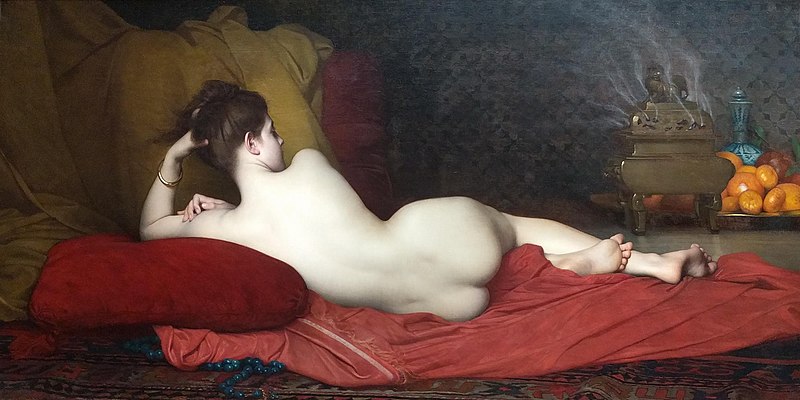
Today’s post is a bit, well, risque, so if you’re offended by art depicting nude women, I suggest you click away now. Also, I am NOT an art historian. The commentary is all mine and surely lacks any professional insights that would make this more coherent and detailed. But that never stopped me from forming an opinion!

Nevertheless, I think it’s quite plain that these paintings say more about the painter and the targeted observer than they do about life in a harem at any time. One can certainly extrapolate — women sequestered from men, expected to sexually service a single man. For the European man whose religion officially limited him to one wife and, culturally, to a single mistress, the thought of having a (cough) harem of women in service to him at his very male whims, must have been quite beyond titillating. I have no doubt some men disapproved. But the paintings suggest a good many were fascinated…

These women are all youthful, I found no pictorial mention of women who had lived past the state of desirability. And the majority of men with harems did not have a whole city of woman at their beck and call — they were perhaps a few women, but I suspect it depended upon the man’s rank and wealth. The Sultan was another matter; he did have thousands of women in the Seraglio.

From all the accounts I read, Caucasian women were preferred for the harems. There seems to have been some discomfort about what was, in effect, the sexual slavery of social cohorts. Slavery is for Others, after all. Turks and Arabs routinely raided Eastern Europe and into Spain for women to sell. This “White Slavery” did stop, officially, by the very late 1700’s.

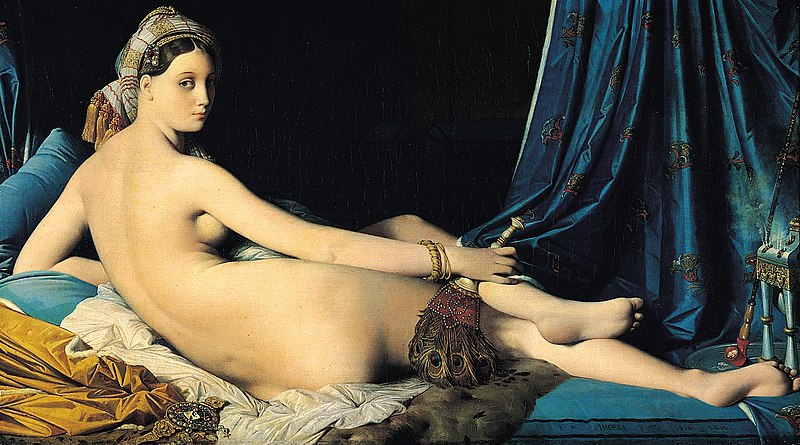
Ingres
You’ll notice that this Ingres painting features two extremely pale women. The servant standing in the background is dark skinned and, in this image, not identifiable as female. If this is a man, he is a eunuch. And since he is in the presence of women, his penis has been removed entirely. Eunuchs who worked in the harem but outside the women’s quarters had their testicles removed or damaged beyond fertility but retained, generally, the rest of the package. Note, too, that the more naked the woman, the paler the skin. What does that suggest about notions of what and who was sexually desirable? Is there some racial anxiety here?

Odalisque

Of course, this is not a real Odalisque. Again, note the pale, European skin. A real Odalisque would have been a servant. European notions of the harem, and anxieties, not completely unfounded, about Caucasian women in the harem, about women and their sexuality are subtly expressed here. Remember, this is not a factual depiction, but rather a depiction of the European conception of Caucasian women whose sole purpose was the sexual pleasure of a man.

Ingres
A very famous Ingres painting I’m sure you all recognize. Same remarks as above.

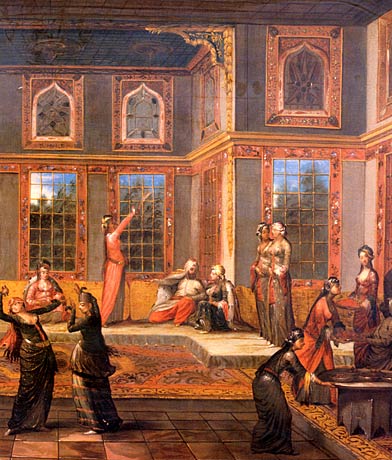
Gentleman in his Hare,
This painting shows a gentleman being entertained by the ladies in his harem. He is seated in the right corner of the divan, this was the place of honor, as it were. Servants and lower ranking individuals would not be permitted on the divan, they would sit on the floor. He is as you can see, with (presumably) his favorite at his side whilst he is entertained by other women. There are some quite lovely architectural and furniture details — the divan, which runs the perimeter of the room, the high windows and beautiful scroll work and filigrees. The table to the right is quite authentic as well.

Interior of a Harem

This sketch shows the interior of the Seraglio. They had to be efficient in order to house so many women!

Sultan's seat
Ah, one can just imagine the Sultan being entertained by his very accomplished concubines. To the right is a fountain, very much like you’d see in one of the baths.

Concubine in the Hammam

This woman (again, note that the naked woman is very pale, the servant is not…) is in the hammam, the Turkish bath. She is wearing pattens on her feet so she doesn’t fall and break her neck. European notions of rank, sexuality and desirability once again in full display.

Harem Beauties
Lest you come away thinking that all the woman painted as members of a harem were white, they weren’t. Here’s a woman of color. Though I feel compelled to note she is arranged in an inferior position, with the paler woman plainly the focus. After looking a dozens of such pictures the commonality was pretty obvious.

The women are typically depicted as sitting around with nothing much to do but wait for the Male (and not any old male, but The Male to have sex with her.) Again, this says more about the state of mind of the (male) painter than it does about actual life in the harem.

Posted in Uncategorized | Tagged , , | 12 Replies

I always love reading biographies of independent-minded women writers in history! (Austen, the Brontes, George Eliot, George Sand, Emily Dickinson, etc–it’s very inspirational). This weekend I read Brad Gooch’s new biography of Flannery O’Connor. O’Connor was one of my favorite writers in high school, but aside from a class called “The American Short Story” in college I haven’t re-read her as much as Austen and the Brontes (which I re-read almost constantly!). This biography, though almost strictly about her life and with very little literary commentary, was fascinating and inspired me to take my volume of her short stories off the shelf again.

Flannery O’Connor, like almost all those other favorite authors I listed, was something of an eccentric, solitary soul, deeply devoted to her work and her own strange interior world. She had a relatively short life, dying at 39 of lupus in 1964, and the last 14 years of her life were spent mostly on the remote family farm in Georgia, but she was a writer of immense genius and originality. She wrote 2 novels, Wise Blood and The Violent Bear It Away, and 2 short story collections, A Good Man Is Hard to Find and Other Stories and Everything That Rises Must Converge (which won a posthumous National Book Award). My college textbook says “(the) texts usually take place in the South and revolve around morally flawed characters.” They could loosely be called “Southern Gothic,” in the vein of her contemporaries Faulkner and Welty, but they are unique and deeply flavored with O’Connor’s own devout Catholicism and struggles with illness.

For a writer of historical romance fiction like myself, O’Connor isn’t such a direct influence as Austen and the Brontes. Though she declared “Hawthorne said he didn’t write novels, he wrote romances; I am one of his descendants,” they are ‘romances’ in a very different sense (more in the grotesque, fantastical way of Frankenstein). But as I re-read her most famous story, “A Good Man Is Hard to Find,” I realized O’Connor is a great teacher of craft. Nothing could be added or subtracted from this story; the visual details and rhythm of the dialogue paint a whole world. And the sense of sustained foreboding is equaled only (maybe) in James’s Turn of the Screw. It never falters. The same can be said of stories like “Good Country People” and the gorgeous “Revelation” (written partially from her deathbed. Determined to finish her Everything Rises… collection even as her body failed her, she set up a typewriter on a table by her bed, and would sleep for an hour and write for an hour until it was done. A lesson in artistic determination!).

There’s a great website on O’Connor’s work here, and her home at Andalusia is open to visitors, and I would love to visit there someday! (I would also love to visit Haworth Parsonage and Chawton, in hopes of soaking in some inspiration. Maybe we need to get together an international writers’ tour…)

Who are some of your unexpected influences and favorite writers? Whose life story do you find intriguing?

(BTW, on my own blog yesterday’s “Hottie Monday” was a Mr. Darcy edition! Be sure and stop in to vote for your favorite Darcy…)

In writing Book 2 of my Three Soldiers Series, I’ve again read Waterloo Days on Google Books. The complete title:
Waterloo Days: The Narrative of an Englishwoman Resident at Brussels June 1815 by Charlotte A. Eaton

(Waterloo Days is one of three memoirs from the Waterloo Campaign included in Ladies of Waterloo)

Charlotte Eaton traveled to Brussels with her brother and younger sister, arriving in the the city 194 years ago today. Her narrative of this trip was first printed two years later and again in 1852. It remains a vivid account and an exciting story, with such immediacy it could have been written yesterday.

This week is the anniversary of the Battle of Waterloo, the grand battle that finally ended the reign of Napoleon, so it seemed fitting for me to address what it was like in Brussels on June 15, 1815, three days before the battle.

Here, are Charlotte’s words:

We had not entered the hotel many minutes, and had not once sat down, when we recognised our pleasant compagnon de voyage. Major Wylie, standing in the Place Royale below, encompassed with officers. He saw us, took off his hat, and, breaking from the people that surrounded him, darted in at the door of the hotel, and was with us in a minute. Breathless with haste, he could scarcely articulate that hostilities had commenced! Our amazement may be conceived: at first we could scarcely believe him to be in earnest.

“Upon my honour,” exclaimed Major Wylie, still panting, and scarcely able to speak, from the haste with which he had flown up the hundred steps, “it is quite true; and the troops are ordered to be in readiness to march at a moment’s notice; and we shall probably leave Brussels to-morrow morning.”

In answer to our eager inquiries, he then told us that this unexpected intelligence had only just arrived; that he had that moment left the Duke of Wellington’s table, where he had been dining with a party of officers ; and that, just as the dessert had been set upon the table, a courier had arrived, bringing dispatches from Marshal Blucher, announcing that he had been attacked by the French, but although the fighting was hot, it seemed to be Blucher’s opinion that it would most probably be nothing more than a mere skirmish.

While the Duke was reading the dispatches, the Prince of Orange, General Mufflin, and some other foreign officers had come in. After a short debate, the Duke, expecting that the blow would be followed up, and believing that it was the enemy’s plan to crush the English army, and take Brussels, immediately ordered the troops to be in readiness to take the field at a moment’s notice.

“And when did all this happen? when was this attack made?” we anxiously inquired.

“It took place this afternoon.”

“This afternoon !” I exclaimed, in astonishment, and, I suppose, with looks of consternation, which drew a good-natured smile from Major Wylie, for we had not been used to hear of battles so near, or fought the same afternoon.

“Yes, it happened this very afternoon” said Mayor Wylie ; ” and when the express came away, they were fighting as hard as ever, but after all, it may prove a mere trifling affair of outposts nothing at all.”

“But are the French in great force? Where are they? Where are the Prussians ? How far off do you suppose all this fighting is?” were some of the many questions we asked.

The fighting was in the neighbourhood of Charleroi, about half a day’s march from Brussels; nothing certainly was known of the force of the French. In fact, nothing at all was known, except that the French had this very day attacked the Prussians, when they were totally unprepared, at a short distance from us.

“However, after all, this may end in nothing,”said Major Wylie, after a pause; “we may have to march to-morrow morning, or we may not march these three weeks, but the Duke expects another dispatch from Blucher, and that will settle the business:”

And so saying, Major Wylie went away to dress for a ball. Yes, a ball ! For the Duke of Wellington, and his aides-de-camp, and half of the British officers, though they expected to go to a battle to-morrow, were going to a ball to-night, at the Duchess of Richmond’s; and to the ball they did accordingly go. They seemed to say, or to feel, with the Scottish Chief in Douglas:

Tills night once more
Within these walls we rest; our tents we pitch
To-morrow in the field. Prepare the feast!
Free is his heart who for his country fights:
He on the eve of battle may resign
Himself to social pleasure: sweetest then,
When danger to a soldier’s soul endears
The human joy that never may return.

Would you like to have been in Brussels on June 15, 1815?
What do you think it would have been like to attend the Duchess of Richmond’s ball?

Visit my website and enter my contest! Next prize (to be chosen today!) is my RITA winner, A Reputable Rake. So hurry.

Posted in Uncategorized | Tagged , | 15 Replies
Follow
Get every new post delivered to your inbox
Join millions of other followers
Powered By WPFruits.com