Back to Top

Monthly Archives: May 2011

The Shameless Self-Promotion Portion of This Post

I have put out another of my backlist titles. Stolen Love is my second book, published by Harper-Collins in 1991. It’s not quite old-skool but almost. I’m not the same writer as I was in 1991 but I’ve put the book out pretty much exactly as it was published — because today I would write a totally different book and any editing would inevitably be a total re-write and then STILL no one would be able to read the original unless they got their hands on a paper copy.

I made one change because I realized later my editor was right, my hero would call his valet by his last name only. So I removed all the Mr.’s for that character. That’s it.

Nicholas Villines is the heir assumptive to a viscount. His father left him in dire straits, but he’s managed to recover the family fortunes and re-enter society.  His childhood friend Elizabeth is now in London, hoping to make a modest marriage, as she is a woman of very modest means. Not so her beautiful (and rich) cousin Amelia. Every agrees that Nicolas and Amelia would be a perfect match. As Elizabeth and Nicholas rekindle their friendship, society can talk of little but The Mayfair Thief, a mysterious and cunning person who has made off with a fortune in jewels and other valuable items. Just who is this mysterious thief, and has Elizabeth really guessed his identity?

Nicholas agrees that Amelia would be the perfect wife for him, but he can’t stop thinking about Elizabeth and the beautiful woman she’s become. Will he accept his feelings for her before it’s too late or will she marry his best friend?

Secrets Revealed

Stolen Love was written before the World Wide Web and when the Internet was mostly accessed via text based commands (gopher, anyone?). In those days, authors couldn’t do anything like the promotion we can do today.

I wasn’t able to tell anyone things like this:

  • The hero, Nicholas, was named after my sister’s dog.
  • The hero’s last name (Villines) came from an article I read about a General Contractor who had an embezzling employee.
  • I lived in Berkeley at the time, in an apartment that, unbeknownst to me, had absolutely ideal conditions for growing orchids. I had several Phalenopsis and a Cattleya that bloomed six months of the year. I believed I was an orchid genius and made my hero one, too. Because, like, what’s so hard about growing orchids? Then I moved to San Francisco and my orchids died or never bloomed again.
  • I set the book in 1844 because I thought the fashions then were killer. I HATED Regency gowns. The cover was pure Regency. There was no cover consult.
  • When on submission, the book was pitched as hardcover and even I, pretty much a total newbie, knew that book wouldn’t sell hardcover and I was brave enough to tell my agent that. It sold to a St. Martin’s Press editor who promptly left to go to Harper-Collins, which was starting a NY based Romance line that, eventually, morphed into Avon. She took my MS with her.
  • I didn’t know I was a pantser. I just wrote the dang story by reading what came before and seeing an interesting theme and going with it. (Oh hey! In this chapter, the hero’s best friend is in love with Elizabeth! Let’s go with that. . . )
  • My printer was a near top-of-the-line daisy-wheel printer and it took 9 hours to print out the entire MS.
  • At one time, I laid out all the chapters in piles on the floor and rearranged them. I used scissors and tape to move scenes
  • I did all my research in the UC Berkeley libraries or at any number of extremely fine used book stores in the area. During that period I acquired some great reference books.
  • I learned that about this time (1844-ish) there was an orchid craze. The Amazon and other fragile habitats were scoured for orchids to the point of destruction and/or extinction of the flowers. They believed all orchids required the same hot-house conditions — which was untrue as we now know –so there were some orchid species that never bloomed in captivity. Orchid collections were valuable and stealing of collections and plants was a threat.
  • In 1991, there was no such thing as email for regular people, but I had a fancy answering-machine. With a tape.
  • I was worried the sex came too late in the book so I tried to sex it up in other ways.

If you want to read a sample or just buy the book:

ISBN: 978-0-9833826-4-5

A Racy Offer

If you happen to read Stolen Love (or any of my backlist titles) and post an honest review on Amazon or B&N, I will send you the eBook of two erotic short stories I wrote. I have a pretty cover for it. One story is historical, the other contemporary and both, technically, involve demons. You have to be over 18 and not easily offended. 

Just post your review (You are not required to have liked the book) and send me the URL to it and let me know what format you’d like. I will then send you the stories in just about any digital format.

I am still running toward that June 1 finish line for a couple of projects, and I am also at the dentist today getting a root canal. Happy Tuesday to me! But May 19 marks the anniversary of the death of Anne Boleyn, one of my great heroines in history. So I am reposting a blog I originally published here in 2009….

“To us she appears inconsistent–religious yet aggressive, calculating yet emotional, with the light touch of the courtier yet the strong grip of a politician–but is this what she was, or merely what we strain to see through the opacity of the evidence? What does come to us across the centuries is the impression of a person who is strangely appealing to the early 21st century. A woman in her own right–taken on her own terms in a man’s world; a woman who mobilized her education, her style and her presence to outweigh the disadvantages of her sex; of only moderate good looks, but taking a court and a king by storm. Perhaps in the end it is Thomas Cromwell’s assessment that comes nearest: intelligence, spirit, and courage.” –Eric Ives, The Life and Death of Anne Boleyn

Today, May 19, marks the grim anniversary of the death of Anne Boleyn (1501 or ’07–1536). History geeks like me tend to have a list of “historical heroes and heroines,” people we would like to invite to our dream dinner parties, sit them down, serve them some drinks, and ask “So–what were you thinking there anyway?” Anne Boleyn is definitely one of mine. I’ve been fascinated by her since I was a kid and watched Anne of the Thousand Days on the TV at my grandmother’s house. I read everything I could find about her, and yet she still seems elusive. As Ives says, a woman of her own time but also so strangely modern, a woman of intelligence and ambition, pride and immense courage. Ives also calls her “the most influential and important queen consort England has ever had.”

I could write a post days long about her life and activities, but I’ll concentrate here on the end. After a crazed pursuit of 7 long years, Anne agreed to marry Henry on January 25, 1533–even though the Church and the Pope stubbornly persisted in insisting he was married to his wife of 20+ years Katherine of Aragon (who stubbornly insisted the same! For a man so set on his own way, Henry did marry so many proud and strong women…). On May 23, Thomas Cranmer, the new Archbishop of Canterbury (who was once the Boleyn family chaplain, the Boleyns being staunch Protestants) declared the marriage of Henry and Katherine void and the marriage of Henry and Anne valid. They were all thereafter excommunicated. But Anne was crowned queen in a lavish ceremony at Westminster Abbey on June 1, and gave birth to a princess, Elizabeth, on September 7. Elizabeth, of course, was destined to be her mother’s daughter in every way, even though she never knew her.

But the good times weren’t to last long. After many miscarriages, Henry got tired of her outspoken stubbornness, and in April and May of 1536 brought her to trial for high treason, via adultery and incest (and rumors of witchcraft). It was an utter travesty of a trial on charges everyone knew were trumped up, but Anne and her accused lovers (including her brother George) were declared guilty and sentenced to death. George was executed on Tower Green on May 17, as Anne waited for her fate in the confines of the Tower, where only 3 years before she had come in glory to wait for her coronation.

Anthony Kingston, the Constable of the Tower, wrote “This morning she sent for me…and at my coming she said ‘Mr. Kingston, I hear I shall not die afore noon, and I am very sorry therefore, for I thought to be dead by this time and past my pain.’ I told her it should be no pain, it was so little. And then she said, ‘I heard say the executioner was very good, and I have a little neck,’ and then she put her hands about it laughing. I have seen many men and also women executed, and they have been in great sorrow, and to my knowledge this lady has much joy in death.”

Around noon on May 19, 1536, Anne Boleyn died on a scaffold erected on the north side of the White Tower, in front of what is now called Waterloo Barracks. She wore a red petticoat under a black damask gown trimmed in fur and a mantle of ermine. With her ladies-in-waiting, she walked from the Queen’s House (which is still there), climbed the steps, and made a short speech to the gathered crowd as the French headsman waited.

“Good Christian people, I am come hither to die, for according to the law, and by the law I am judged to die, and therefore I will speak nothing against it. I am come hither to accuse no man, nor to speak anything of that, whereof I am accused and condemned to die, but I pray God save the king and send him long to reign over you. And if any person will meddle in my cause, I require them to judge the best. And thus I take my leave of the world and of you all, and I heartily desire you all to pray for me. O Lord Have mercy on me, to God I commend my soul.”

She then knelt upright in the French style of executions, said once more, “To Jesus Christ I commend my soul; Lord Jesus receive my soul.” Her ladies took away her headdress and jewelry, tied a blindfold over her eyes–and it was over in one sword-stroke. Cranmer said “She who has been the Queen of England on earth will today become a Queen in heaven.” Anne was buried under the floor of the Chapel of St. Peter ad Vincula behind the scaffold site, near her brother, where her grave can be seen today, and a few days later Henry married Jane Seymour. Following the ascension of her daughter as Queen Elizabeth, Anne was venerated as a martyr and heroine of the Protestant Reformation, and she’s an object of fascination (and movies and novels!) to this day.

There are lots of great sources on Anne Boleyn and her tumultuous times, but a few I like are: Antonia Fraser’s The Wives of Henry VIII; Eric Ives’s The Life and Death of Anne Boleyn; Joanna Denny’s Anne Boleyn: A New Life of England’s Tragic Queen; Retha Warnicke’s The Rise and Fall of Anne Boleyn–Family Politics at the Court of Henry VIII; and Karen Lindsey’s Divorced Beheaded Survived–A Feminist Reinterpretation of the Wives of Henry VIII.

See, I told you I could write about Anne Boleyn for days!!! When I visited the Tower last year, I actually started crying while standing at the scaffold site and reading the words engraved on the new memorial fountain there (at least it was early and not crowded yet! No one to see the crazy lady crying over stuff that happened 473 years ago). Who are some of your heroes? Have you visited sites that had significance for them? What did you think? Who are your “fantasy dinner party” guests??


Posted in Uncategorized | Tagged , | 5 Replies

What if you were asked What is a Romance Novel by someone who doesn’t read romance novels? A relative asked me this question. She’s an educated, well-read person, so I wanted to give her as good an answer as I could.


This is what I said:

Romance novels can be incredibly diverse, encompassing history (like me), suspense, elements of women’s fiction, comedy, paranormal, inspirational – you name it. They can also vary by tone from light “romps” to darkly emotional. But what they all have in common is that they are telling the story of a romance. The book is about the romance. The story is the romance–How two people fall in love and find their happily ever after. The happily ever after is essential. A romance is not about doomed romance or tragic romance. It is a celebration of successful romance.

What I mean is, an historical romance is not about the historical events; it is about how two people manage to find love together. Historical events might impact on them, but the story is about their romance. Same with Romantic Suspense- the story is not about—say—a murder mystery. It is about how two people find love together while impacted in some way by a murder mystery.

Because of the focus on two people falling in love, romance novels are basically character focused. And because nobody would read a book about a romance that goes smoothly from first meeting to the wedding day, there has to be conflict. There must be forces driving the couple apart as well as the attraction between them that make them fall in love.

The very best conflicts are internal ones, things about the personality or emotional characteristics of the hero and heroine that drive them apart. External conflict should also play a part. External conflict can often be what the hero and heroine think is keeping them apart, but really it is something inside them that they need to change in order to have their happy ending.

Romance novels today mostly have strong heroes and heroines. Gone are the victim heroines who must passively be rescued by the hero. Heroines need to act on their own behalf just as much as the hero. Characters must be three dimensional and must act in sensible ways or in ways that are understandably motivated.

The hero and heroine should not be “Dudley Do-Right” perfect; they should have flaws, ways they need to change in order to have their happy ending. The conflict should not be something that could be solved by a conversation. The hero, in my opinion, should be someone the reader will fall in love with; the heroine should be someone she’d like to be.

There are some “mostlys” we see in romance novels:

The hero and heroine mostly meet in the first few pages.
The hero and heroine are mostly together for most of the book
The plot is mostly fast-paced with a major turning point in the middle of the book and a “Black Moment” toward the end.
But none of these are hard and fast rules.
I also provided some links:

The best place to start is with Romance Writers of America. Here’s their take on what constitutes a romance novel:
Be sure to click on the link to the various subgenres as well.
Here’s a nice article from a respected romance review site where authors say what they think makes a romance.
Here’s another description – The essential elements of a romance novel according to Pamela Regis
Pamela Regis is an academic who has studied, taught, and researched the romance genre. She’s written a scholarly work on Romance Novels: A Natural History of the Romance Novel
Here’s a little summary:
And from my publishers, Mills & Boon, the UK branch of Harlequin- what constitutes a perfect romance

Okay….so, how did I do?

How would you have answered the question What is a Romance Novel?
What links would you have provided?
Speaking of romance novels, my cover of Chivalrous Captain, Rebel Mistress is still up for best Historical cover at Cover Cafe. (So is one of Amanda’s covers) Vote here if you haven’t already, but don’t forget to vote in at least three categories.
On Thursday at Diane’s Blog, my guest will be Colleen Gleason, talking about her new adventure in publishing!

Posted in Uncategorized | Tagged | 13 Replies

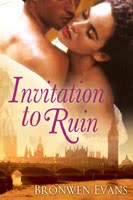
Anthony James Craven, the Earl of Wickham, is dubbed Lord of Wicked for good reason. He lives and breathes seduction – until he mistakenly beds the wrong woman and is forced to marry the sensible, reserved Melissa Goodly. He intends to offer Melissa security and position, nothing more. Once they marry, Melissa cannot understand why her devastatingly attractive husband does not come to her bed. The more he pushes her away, the more she is resolved to turn the tables and open her shuttered heart to love. And though Anthony tries to resist the sensual siren that his wife has become, his plans for a companionable relationship are unravelling in the most pleasurable way…

Today’s guest is Bronwen Evans who’s here to talk about her book INVITATION TO RUIN. Bronwen, congrats on your debut. Did you always intend INVITATION TO RUIN to be the first of a three book series, and what are the challenges of writing a series?

Thanks for having me over today. My INVITATION TO… series was always going to have at least four books, but I’ve had a few readers ask for Cassandra’s book – can I redeem her? That’s a challenge and I’m thinking about it. So maybe there will be five books. I’m only contracted for two, so we will have to wait and see how sales of book one go.

As a reader I love series romances, so it’s only natural that I wanted to write a series. Thankfully, I love plotting. Part of the fun of writing a series, for me, is plotting out the overarching story and then each individual book before I start writing them. I think that’s important because readers want to see all the characters continue on through the books, so you have to understand how they are going to interact and enrich the stories.

The challenge in writing a series is to have enough interesting and engaging secondary characters that make the reader want to read their story’s too. Stephanie Laurens (one of my favorite Regency authors) did this really well. The Cynster books are still my all-time favorite series. The secondary characters in each book were very compelling. They needed a book of their own.

Already I have fans wanting Rufus Knight, Viscount Strathmore, and Richard Craven, Anthony’s twin brother’s stories.

Tell us your “call” story.

It all seemed to happen fairly quickly. I finished INVITATION TO RUIN at the end of October 2009. It was my first completed manuscript. Although I had been trying to write for a few years, I had never finished a book before – loads of half completed books – would be writers, don’t do that – you can’t sell what isn’t finished! So I didn’t have any expectations for the book. I sent off a query letter to two editors who I thought might be interested in the book and three agents. I got a full request from all of them BUT in the mean time (there is a lesson here – don’t send out queries until the book is polished and ready) my critique partners suggested some changes (and they were right) to one chapter that meant re-writing the last five chapters.

So instead of sending the full, I sent the first three chapters, hoping nobody noticed. My reasoning was, why hurry the re-write if they weren’t interested. Blow me; four came back asking for the rest, one agent declined. It was now about 15th December 2009, and I was coming up for my Christmas break. I thought, I’ll finish the last remaining chapters in my break, and send in on 3rd January. However, Megan Records from Kensington rang me in New Zealand on the 20th December, chasing the rest of the book saying, “I think I want to buy it.” I could not believe it – I was so excited and nervous – three chapters do not make a book!

I came clean and told her the situation. She was happy to wait. On 1st January 2010 I sent the finished book to everyone and on 3rd January, Melissa Jeglinski at The Knight Agency offered me representation (she’d come to the RWNZ 2009 Conference and I’d pitched to her) and on 7th January 2010 I had a two book deal from Megan. It was a dream run and it happened so fast my head was spinning. I still can’t quite believe it.

Needless to say I’ve fallen on my feet with both Megan and Melissa. It gets confusing sometimes – Megan and Melissa. I call them my M&M’s – sweeties.

What is it that attracts you to the Regency?
I’ve always loved reading Regency. The vibrancy and vividness of the period is appealing. The customs, behavior, clothes, houses, peers of the realm, ballrooms, virgins, absurd rules which everyone loves to break, the rakes, the clever women who try and mold the world to their ends, even when all the rules are stacked against them. As an author all of the above makes it so much fun to write. The period is so stifled and yet so risqué. It’s a writers dream come true.

Besides, I think my voice suits Regency. At my very first RWNZ conference, Paula Eykelhof, (Senior Editor HMB) told me to write what I love reading. So I did. She was right of course.

What don’t you like about the Regency?

Well, I suspect the reality of the time period was nothing like fiction. War, disease, poverty, lack of personal comforts and the fact woman had very little, if any rights, would make it a terrible time to have lived. Especially for intelligent women. You’d have limited or no control over your life.

One of your subplots involves the abolitionist movement. Would you like to tell us about the research you did.

I remember watching the movie, Amazing Grace, about William Wilberforce and I thought it interesting that in all the Regency period books I had read, no one mentioned slavery, yet it went on in England. Also, I thought about women’s rights or lack of them during the Regency period, and thought it would be interesting to have a heroine understand the concept of slavery and how it applied in her case and to others. The next step was obviously to have a hero whose background was in slave trading.

The movie Amazing Grace talked about the about the Anti-Slave Trade Act that was passed in 1807, making it illegal for British ships to carry slaves. I did a lot more research through books etc The Act was a very astute political move. Keeping most happy. It made England look as though they were trying to halt the trade, yet still allowed slavery to continue. England didn’t abolish slavery until 1833.

Still, some information took a lot of digging. I found out the largest slave trading port was at Bristol. Some of the hardest information to ascertain, was things like the price of slaves in England.

Tell us about being a twin and how you use that in your books.
I don’t really know what it’s like not to be a twin. Leigh has always been with me and is always experiencing life at the exact same time as me. That’s good and bad. You always have someone to discuss issues with and to experience important events in your life.

I wondered what it would have been like having a twin, but not being with them while growing up. How would I be different, how would that affect our relationship. Hence, Anthony, my hero, is brought up by his evil father and looks like his father. Richard is brought up by his gentler mother and looks like his mother. As they didn’t understand genetic in those days, Anthony assumes that as he looks like his father, he must be evil too. While Richard, looking like his mother must be an angel.

RT’s review describes your book as having “…a tortured hero that will delight the reader as much as he delights the heroine. A strong heroine, some wonderful secondary characters and a villain who is truly evil …” Which of these characters did you most enjoy writing?

I loved writing all of them because each of them was integral to the story and the emotional journey of the hero and heroine. Writing Anthony was emotional. To have his upbringing, to have suffered like he has, yet still be capable of love – he was such a wonderful character. Melissa was the perfect woman to help him. Intelligent, compassionate, and she has such a big heart. Philip, the villain I made completely evil. I gave Philip the exact same childhood background as Anthony, to show how someone can overcome their upbringing if they are strong enough. Anthony turned his back on evil, while Philip embraced it.

Tell us a bit about the next book in the series and when it’s coming out.

INVITATION TO SCANDAL is Rufus Knight, Viscount Strathmore’s book. He’s Anthony’s friend who works for the Crown. In INVITATION TO RUIN, Rufus asks for Anthony’s help to stop a white slavery ring. In INVITATION TO SCANDAL, Rufus is trying to atone for his father’s past. His father died amid rumors of treason, and Rufus is determined to learn the truth by catching a French spy using a Kent smuggling operation. But when Rufus discovers the true identity of the smuggler, he faces his biggest conundrum, what’s truly important in life, love or honor? INVITATION TO SCANDAL is due for release in 2012. After that look out for Richard Craven and Madeline Knight – Rufus’s sisters – story.

Thanks for having me over at Risky Regencies, it’s been fun. Leave a comment or answer the following question and go in the draw to win a signed copy of my book.

Q: What is Anthony’s middle name? Hint – read the first chapter excerpt of INVITATION TO RUIN.

Reading Megan’s post on Breaking Rules last week and some of the comments it generated made me think about common tropes regarding romance heroines and their looks.

I’m not sure there’s a rule that heroines need to be beautiful, although it’s definitely a common trope. In my mind, it goes along with the billionaire or duke (depending on subgenre) hero—a fantasy that’s OK in moderate doses and not taken too seriously.

I do get put off by books that continually emphasize the heroine’s beauty, especially when in her own point of view. It grates on me when the heroine repeatedly tosses her red-gold hair and flashes her sapphire eyes. It’s clumsy writing and yet such books can be popular, maybe because some readers love that fantasy so much.

I want the knockout heroine to have some substance. It’s fun when she recognizes her assets and uses them (as in BEAUTY by Judith Ivory) or if she has to downplay them in order to be taken seriously (MISS WONDERFUL, by Loretta Chase). It is going too far if the heroine is completely unaware of her beauty (false modesty) or is too full of self pity because people don’t value her for anything else.

Then there’s the trope of the too-tall, too-thin, too-whatever heroine, or the one with a limp or a crooked nose or mismatched eyes, or just plain in some way. I think that appeals to many of us who lived through an awkward phase, or are insecure in some way about our looks. We may long for, and with luck find, someone who appreciates us as we are. (Hopefully, in time we learn to do that for ourselves.) There’s also the fantasy of being made over, which can be really fun.

This trope can fail if the heroine only thinks she is plain, i.e. she thinks she’s too thin or hates her red hair, but we know everyone else can see she’s gorgeous. Again, it’s false modesty, really a kind of narcissism. Other ways the trope fails is when it’s a gimmick to inspire sympathy, or the heroine dwells too much in self-pity.

Done right, the plain/odd heroine can be very cool, especially if the heroine and others learn to see her physical traits as part of a total package they appreciate. The classic example is JANE EYRE. Among modern historical romances, my favorite (perhaps one that spawned some bad imitations) is the tall heroine with mismatched eyes in Mary Jo Putney’s THE RAKE AND THE REFORMER.

I’ve also enjoyed the descriptions of several of Julia Ross’s heroines: one with a longish nose (NIGHT OF SIN) and another who is freckled (CLANDESTINE). Maybe these stories go where Janet and Amanda were suggesting: the heroine of ordinary looks who doesn’t have any hangups about it, and whose hero enjoys her physical quirks along with everything else.

What do you think about these common tropes regarding heroines and their looks? Any particular sorts of heroines you enjoy reading about, or would like to see more of?

Elena

Posted in Uncategorized | Tagged , | 5 Replies
Follow
Get every new post delivered to your inbox
Join millions of other followers
Powered By WPFruits.com