Back to Top

Monthly Archives: March 2013

476px-Edmund_Blair_Leighton_-_The_Windmiller's_GuestYesterday I went to an all day workshop with Bob Mayer, who had many good things to say about bringing your germ of a story idea to fruition into a full-fledged novel.

But he said one thing that gave me, as an author of historical romance, pause….

He said that the best way to do research was from the novels of successful authors in your genre. The best way. He mentioned a best-selling author of military thrillers who researched from other books in his genre.

Bob’s point was that readers have already shown that they like the world created by the best-selling author, so, even if it is inaccurate, it is what sells.

1815 019 no 2In fairness to Bob, he was talking about the sorts of books he writes, not Regency romance, but it made me think about our ongoing debate about the importance of historical accuracy in “our” books. Regency authors (like our marvelous Myretta Robens) love to discuss the pros and cons of historically accurate Regencies to “wallpaper historicals” to those who just get it wrong. And we’ve often talked about the tiny Regency inventions Georgette Heyer put in her books to catch the authors who were using her for their history.

To me part of the fun of writing historicals is to fit the real history into a story that (hopefully) will appeal to the modern reader, but that is not necessarily every historical author’s goal nor is it necessarily what every reader of historicals enjoys.

Bob did mention that the best way to research setting is to actually go to the place and see it for yourself. If that was not possible, he advocated using books, websites, videos, maps to get the setting right. He did stress the importance of getting time and distance correct, which is something that sometimes bugs me in historicals. When I read of characters sailing here and there or traveling by carriage here or there in modern rates of speed, it does pull me from the story and tempt me to throw the book against the wall.

But does even that bother readers?

What do you think? Does any of this matter to you?

Posted in Reading, Writing | Tagged , | 12 Replies

Don’t we all eventually end up in an English country house?  Today, I’m continuing the tour of my library with a look at some of the books I use when I’m writing about a country house – or just looking for a little escapist eye candy.  These books all touch on the physical layout, structure and design of the house.  What goes on in and around the house is a topic for another day.
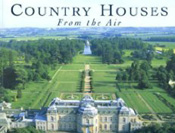
Country Houses from the Air

Country Houses from the Air

Let’s start with an overview.  Adrian Tinnswood’s Country Houses from the Air is just what it says.  Not relegated to a single era, this book still gives an excellent picture of the English country house within its environs.  Aerial photography and early architectural plans and prospects  combine to provide a look at the origins and current state of the houses under discussion.  The text provides some solid historical background and picks out notable features of the houses.
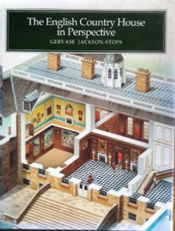
The English  Country House in Perspective

The English Country House in Perspective

While we’re airborne, let’s take a look at Gervase Jackson-Stops’s The English Country House in Perspective.  I love this book  It takes 12 country houses, provides a brief history and description, includes architectural layout of each house, some drawings or photos of the exterior and then – the payoff in this book, in my opinion – a cutaway view of the house showing the location and layout of various rooms in three-dimensional detail.  It makes it so much easier to move characters around the interior of one of these houses and to imagine the interactions taking place inside.
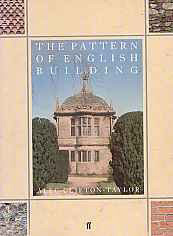
The Pattern of English Building

The Pattern of English Building

Before we go inside, however, let’s look at the exterior of the buildings.  In The Pattern of English Building, Alec Clifton-Taylor has written a detailed treatise on the construction materials used in various parts of England.  He links the geology of the country to the building in its various locations.  There is little in the book on the use of materials in the interior, but we can find that information elsewhere.  This book identifies the stone and other materials available in each area and includes a geological map showing the type of rock prevalent in each area.  This illustrates why it makes sense to have most of Bath built of that glorious Oolitic limestone that captures the afternoon light so beautifully, but also discusses how Bath stone was also among the first quarried stone to be shipped to other parts of the country.  This is a detailed and well-documented book with lots of photographs that are unfortunately in black and white in my paperback edition.

The Regency Country House

The Regency Country House

I have several books on country house interiors, but for this post have picked the sumptuously illustrated The Regency Country House   From the Archives of Country Life by John Martin Robinson.  This is the best kind of coffee table book, full of photographs of interiors and categorized into “The Palaces, The Nobelman’s House, and The Gentleman’s House.”  It includes photos of interiors, from grand stairways to tucked-away drawing room alcoves.  The furnishings in these photographs are not all of our period, but the book is worth looking at for a sense of the rooms.
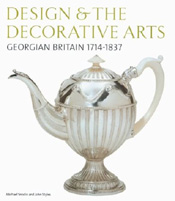
Design & The Decorative Arts - Georgian Britain 1714-1837

Design & The Decorative Arts – Georgian Britain 1714-1837

There are a lot of books on the interior design of the period.  One of the most exhaustive is Regency Design 1790-1840 by John Morley.  This book covers gardens. buildings, interior decoration, and furniture and weighs a ton.  It discusses the impetus behind changing fashion and contains period illustrations of each of the various elements on which it focuses.

If you want something a little more focused,  you might like Design & The Decorative Arts Georgian Britain 1714-1837 by Michael Snodin and John Styles.  Although this is book surveys a longer period, it includes many illustrations of fashion leaders, decorative arts. and fashionable living.

I find picking up any one of these books inspiring and invigorating.  There’s no telling where your next idea is going to come from.  And if inspiration is not quick in coming, these books are good places to spend a few secluded hours just enjoying the atmosphere.

Posted in Regency, Research | 3 Replies

Overall, I enjoyed this recent article in the Atlantic: Beyond Bodice Rippers: How Romance Novels Came to Embrace Feminism.  But is this really news?

The article quotes Beyond Heaving Bosoms: The Smart Bitches’ Guide to Romance Novels: “Bodice-rippers are typically set in the past, and the hero is a great deal older, more brutal, and more rapetastic than the heroine.”

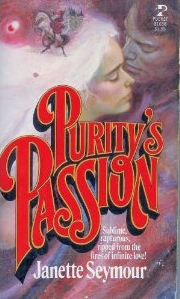
I never did read any books like this when they were coming out in the 70s and early 80s, but I’ve read some recent reviews of such. Here’s one that had my eyes rolling back in my head.  Feel free to indulge your morbid curiosity if you wish: Purity’s Passion by Janette Seymour, a Review by Redheaded Girl.

purityspassion

As a child, I read my mother’s Regency romance novels. I only started reading longer, sexier historical romances when I followed authors like Mary Jo Putney, Jo Beverley and Loretta Chase as they moved to writing longer books. Except for being set in the past, there’s no resemblance between their historical romances and the description above. The romances I like have heroes and heroines who worked through their conflicts emerging as equals, despite a historical backdrop where gender roles were more rigidly defined.

srainbows

So maybe I missed something but it seems to me that the romance genre has been moving away from the abusive hero/submissive heroine setup for decades and it isn’t a “new generation” of writers who are inventing this.

I’m woefully ill-read—life has done that to me—so I haven’t read most of the books mentioned. Did I miss another shift? The article implies that the new feminist romances subvert the stereotype. Does this mean heroines can now be as selfish and abusive as the heroes used to be? Actually, I doubt it, knowing some of these authors.

So help me out.  Is something really changing in the genre or is it a continuation of the shift to strong heroines and more equal relationships that began decades ago? And did you ever read of those Bad Old Bodice Rippers? If so, what did you think?

Elena

Johann Sebastian Bach was born on this day in 1685 in Eisenach, Germany but by the Regency period, his music was mostly considered hopelessly old-fashioned and pedantic, except by scholars and professional musicians. Even the music of his highly successful son Johann Christian Bach, former music teacher to Queen Charlotte, had died in poverty in 1782 in London, was out of favor with popular taste. It wasn’t until 1829, after a century of silence, that the St. Matthew Passion was revived and performed by the young Felix Mendelssohn. There’s a fascinating account of how it came about here.

Jsbwv244

There is so much material available on Bach online–here are just a couple of places you can search: jsbach.org and baroquemusic.org. There are many, many recordings of his music, ranging from brilliant to poor, and, as happens with a great artist, some just plain wacko. His music ranges from the gorgeously tuneful to the highly cerebral. If you can, search out a performance, preferably one that’s HIP (historically informed performance). If you’re in the Washington DC area, there’s a performance of the great B Minor Mass on April 28.

Occasionally when you read about Bach you find glimpses of the human being behind the legend. Here’s Bach complaining about his income (which he did quite a lot):

My present post brings in about 700 thalers, and when there are a few more funerals than ordinairement, the perquisites (tips) increase proportionately; but when the air is wholesome, on the contrary, they diminish, this last year my ordinaire perquisites for burials declined by more than 100 thalers.

He lived in an era when musicians were regarded as servants, often required to wear livery. He was able to give his sons the university education he lacked, ensuring that they would be further up the social scale, and indeed two of them served in royal courts–JC in London and CPE (Carl Philipp Emmanuel) in Sweden and Germany. He never left Germany and although he expressed the wish to meet Handel, the meeting never took place.

He was a geek who was interested in taking apart and reworking pipe organs, and there’s some evidence that he knew of the new pianos in production toward the end of his life. Certainly his sons JC and CPE were proponents of this new instrument.

But it’s the way he worked that I find fascinating–the reworking, rewriting, rearranging that he did all his life. His output was astonishing. About 250 of his Cantatas remain–he turned out a cantata a week at one period of his life. Originally there were twice that many. He wrote possibly five large scale works based on the gospels, and only those based on Matthew and John survive.

So happy birthday, Bach, and thanks.

Do you like Bach? What’s your favorite music?

Posted in Music | 2 Replies
Follow
Get every new post delivered to your inbox
Join millions of other followers
Powered By WPFruits.com