Back to Top

Monthly Archives: May 2013

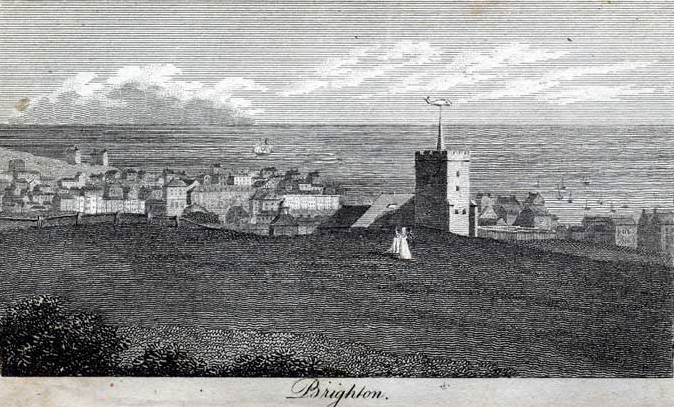
brighton-illus (1)Well, Lydia Bennet wanted to go to Brighton.  And by the time Pride & Prejudice was published, Brighton was a thriving seaside resort and, apparently, the location of some highly desirable soldiers – Lydia’s main reason for wanting to go.  As we approach the start of summer and those nice, lazy, seaside holidays, let’s take a look at Brighton.

Brighton was originally a fishing village, one of the flourishing ports along England’s south coast.  By 1740, however, it was pretty much in decline due to erosion of the town’s beach resulting in loss of buildings, several severe storms, and an ageing population.
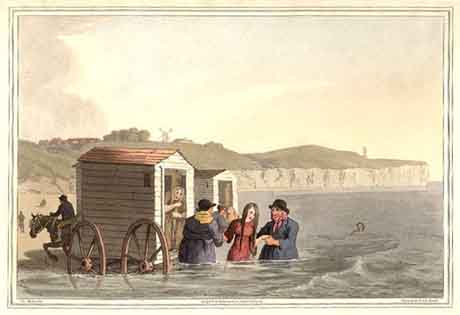
Bathing machine

Bathing machine

Fortunately for Brighton, during the late 18th century sea bathing came into fashion in a big way.  The growth in national wealth that resulted in large estates and grand manor houses, also caused urban centers to be more prosperous.  People who chose to live in towns had the means to travel outside them.  Seaside resorts offered something more than available in the towns or even the countryside.

Royal Pavilion

Royal Pavilion

Spas surrounding mineral springs, such as Bath and Buxton, had been frequented for health reasons from time immemorial.  The 18th century saw the advent of seabathing as another healthy activity.  The first resorts were located in declining coastal towns such as Brighton, Hasings, Margate, Scarborough, and Weymouth.

Brighton, in particular, benefited from its location in a densely populated region of England and its easy access from London. Moreover, failing economy in the area resulted in a surfeit of accommodation, providing places for visitors to stay.

Bathing dress

Bathing dress

Brighton was well-established as a seaside resort before the Prince of Wales (later George IV) took a fancy to it in  1783.  However, George’s visits and his Royal Pavilion, begun in 1786, certainly increased the draw, first as the place frequented by the Prince of Wales and, later by the Pavilion itself as a tourist attraction.

If you wanted a little seabathing in Brighton during the Regency, you did not have to wait for an invitation from the prince.  Brighton had plenty of hotels and guest houses from which to sally forth in your fetching bathing dress and rent a bathing machine for your dip into the channel.

So, do you want to go to Brighton?  Or do you have something other than a little seabathing in store for your holidays?

Recommended sources: Georgian Brighton by Sue Berry and Spas of England and Principal Sea-Bathing Places by A. B. Granville.
Posted in Regency, Research | 5 Replies

bond_beaus
…these are not. This picture is of some of the Prince Regent’s friends, several of whom are dukes and proof that “Duke=Hawt” is an invention of Romancelandia.

I’m thinking about this in the wake of all the good discussions we’ve had related to whether historical romance, especially Regency historical romance, is dead or deserves to be. If you missed any of this conversation, here are the links:

“Sick of the Regency?” by Diane

“One day after all the editors went home, the slush pile and an abandoned marketing research plan partied hard” by Carolyn

“In the Regency but not wholly of the Regency” by Susanna

My question is: do we need more variety in our heroes?

We’ve discussed dukes and their prevalence in the genre before: “Duking it Out” (by me) and more recently, a couple of posts from Carolyn: “The Case Against Dukes” and In Defense of Dukes”.

The hero who’s a wealthy and powerful lord is an immensely popular trope in historical romance, with dukes being the epitome of that trope. A while ago, I even heard of an editor telling an author her hero must be a duke. It makes me think of Georgette Heyer’s Frederica, in which the heroine’s little brother decides it’s OK for her to marry the hero, a marquess, even if he is a “second best nobleman.” Sheesh.

Anyway, at its weakest, this trope is about the fantasy of being cared for and living a life of leisure. But don’t we want heroines who are strong women, useful rather than merely decorative?

One of Carolyn’s posts on dukes provided a good answer:

The hero is powerful in all the things that will offer a heroine safety during a time when women were dependent on men for their safety. He’s Prince Charming and his heroine is going to democratize him (emphasis mine).

The ending in which she can be a partner to him and help him use all that wealth and power wisely makes this trope satisfying, for me at least. Bring on the dukes, just write them well. But I’m very happy when writers tackle stories about different heroes, such as younger sons who have a different set of challenges.

sharpeThen there are heroes not born into the aristocracy. Rare but they exist. I know at least some of us find that type attractive.

I’m especially intrigued by Janet’s recent excerpt and by Susanna’s description of her upcoming release A Dream Defiant. Unless I’ve missed something (admittedly I haven’t read everything out there) writing black heroes is ground-breaking for the genre.

More variety in heroes ought to strengthen the genre. Not that I think anyone should force herself to write something just to be different, just that she shouldn’t feel constrained by the popular tropes if she wants to do something different.

The publishing environment supports greater variety now than ever, although that comes with other issues. The stories you want to read may be out there, but finding them can still be a challenge. Certainly we will talk about some of them here.

What do you think? Are there types of “risky” heroes would you like to see more of?

Elena
www.elenagreene.com
www.facebook.com/ElenaGreene

Posted in Reading, Writing | 5 Replies

Sad to say I have caught a cold from my nearest and dearest. I am so glad that I do not live in the  Austen household in Chawton where dear Martha Lloyd would have dosed me with this concoction, courtesy of a certain Dr. Twiton:

Take volitile salt of ammonia 32 gms– salt of Petre 40 gms. Put them in a marble mortar to a fine powder, then add one oz of Syrup of Balsam and on oz of oyl of sweet almonds, add 6 ozs of pump water. The whole of the above will make four draughts, one of which should be taken three times in 24 hours and to the night one add one dram of paragoria.

I don’t even know what most of this stuff is, but then I look at the ingredients of my over the counter cold med and am equally mystified.

Hannah Glasse (The Art of Cookery, 1747) has this recipe for making lozenges which sounds a little more palatable although I’m not sure whether they’re meant to be eaten or burned to make the air more healthy:

Take two pounds of common white loaf-sugar, beat it well in a mortar, dissolve six ounces of Spanish liquorice in a little water; one ounce of gum-arabic dissolved likewise; add thereto a little oil of anise-seed; mix them well to a proper consistence, and cut them into small lozenges; let them lie in a band-box on the top of an oven a considerable time to dry, shaking the box sometimes.

More strange recipes at Travels and Travails in 18th-century England and The Cookbook of Unknown Ladies.

smallcoverAnd some good writing news: Hidden Paradise has finaled in both the Golden Quill and Booksellers’ Best Awards!

What are you up to?

(Amanda will be back with her regularly scheduled Tuesday post next week!  In the meantime, her friend Kae Elle Wheeler has agreed to visit the Riskies again with a look at her new release, The English Lily!  Comment for a chance to win a copy…)


EnglishLilyLady Kendra has led a long fruitful life. But as a young woman, and in a major turning point of her life, her time with Charles Thomas was cut remarkably short. To ease her mind, she sends him a heart-filled note.

Dear Mr. Thomas,

I realize it is most inappropriate for me to send you this letter, but rest assured I have my husband’s utmost approval. It has been many years since I last saw you, and the memory still haunts my dreams I fear. I thought if I could enlighten you to my situation we might each finally move forward, where ever that might be for you now.

Since that most fateful day aboard the Cecilé, I married Joseph. True, he was a most successful magician, but I am pleased to say he has proved an even more devoted husband and father. We have four beautiful children. Our eldest and heir to Yarmouth named Charles for you, my dear friend. You would be most proud of Charles, for he is a brilliant scholar and benefactor of The School for the Poor and Unfortunate. The others fell closely in his footsteps in their efforts to realize your dreams. Aaron, our most athletic is an avid hunter and horseman. Our girls, twins, mind, Julia and Jane, followed in their father’s way with his magic. Oh, not that Joseph would allow them to tread the boards! But he taught them all of his silly parlour tricks on which the two took to perfecting and creating with havoc of their own.

For many years, I kept in very close contact with your mother, to her very end. I am proud she called me Friend. Finally, you will be most happy to know my husband reads a beautiful poem or story to me each and every night when we retire, and on occasion, I find I quite enjoy reading one to him as well.

I hope this note will offer you the peace that is descending on me as I pen it.

Yours forever, most devotedly so,

Kendra Frazier, Lady Yarmouth


From the back cover:  Lady Kendra Frazier is devastated. The love of her life just married another, and now all she desires is to be as far away as possible. Viscount Lawrie, Joseph Pinetti Gray, is facing financial ruin and needs a wealthy heiress. Luckily for him, Kendra’s impetuous nature has handed him the fortuity he requires to save his family’s downfall. But Joseph’s carefully cultivated plans come to a grinding halt when he finds himself falling in love for what should have only been a marriage of convenience. And how can an old cursed doll help?

The Oklahoma Romance Writers of America, through The Wild Rose Press, have a series of books. Each Tales of the Scrimshaw Doll book must meet a certain criteria. This criteria includes a tie to Oklahoma in some fashion, portraying the curse of the doll accurately, must be romance and the hero/heroine cannot have been married to one another previously.

http://kathylwheeler.com

http://klwheeler.com

http://facebook.com/kathylwheeler

http://twitter.com/kathylwheeler


Kae Elle Wheeler has a BA degree from the University of Central Oklahoma in Management Information Systems that includes over forty credit hours of vocal music. As a computer programmer the past fifteen years, she utilizes karaoke for her vocal music talents. Other passions include fantasy football, NBA and musical theatre season tickets, and jazzercise. Because to quote Nora Roberts to a one time question, if she worked out? Her reply, “You have to get off your ass.”

Kae began has been a member of the Oklahoma Chapter of Romance Writer’s of America and the RWA since March of 2007. She grew up in the Dallas area and definitely considers herself a city girl. She does not limit her travels to Writer Conferences in San Francisco, Washington DC, Seattle, Dallas, New Jersey, New York City and Atlanta because Jazzercise has fun conferences too (Denver, Palm Springs and Orlando). You can’t keep her at home!

She is a member of several RWA Chapters, including DARA, The Beau Monde and Passionate Ink. She has held several positions in the OKRWA Chapter, currently serving as Programs Director. As an avid reader of romance and patron of theatre, her main sources of inspiration come from mostly an over-active imagination. She currently resides in Edmond, Oklahoma with her musically talented husband, Al, and their bossy cat, Carly.

I have had such a busy couple of weeks with a family reunion in California and my daughter’s college graduation (Yay!) that release day of A Reputation for Notoriety has sneaked up on me. It is tomorrow!

In honor of release day, I’m giving away one signed copy of A Reputation for Notoriety to one lucky commenter chosen at random.

The back cover blurb of A Reputation for Notoriety

Raising the stakes…

As the unacknowledged son of the lecherous Lord Westleigh, John “Rhys” Rhysdale was forced to earn a crust gambling on the streets. Now he owns the most thrilling new gaming establishment in London.

Witnessing polite society’s debauchery and excess every night, Rhys prefers to live on its fringes, but a mysterious masked lady tempts him into the throng.

Lady Celia Gale, known only as Madame Fortune, matches Rhys card for card and kiss for stolen kiss. But the stakes are raised when Rhys discovers she’s from the very world he despises…

The Masquerade Club.
Identities concealed, desires revealed…

The first review!

4 Stars! “…It’s passionate, intense and seductive. The characters are lively with pulsating sexual tension and there are enough secrets, scandals and complications to make a lady swoon with glee!” — Maria Ferrer, RT BOOKReviews (read the whole review)

I wanted to write a gaming hell story and a story about a bastard son. Thus A Reputation for Notoriety was born. The question for me was what kind of gaming house did I want? I certainly did not want my hero to run a disreputable gaming house and I wanted one that society ladies could attend. The only way I could think of that a lady could attend would be in a mask, but I’d already used that idea in The Wagering Widow. I couldn’t repeat that idea.

Or could I? I decided to use the same gaming house that appeared in The Wagering Widow and to use the hero’s memory of the wagering widow as the idea for his house. I suppose this “proves” that all my Regency people really do live in the same “world.”

I like to think of it that way. I like to think that they all really existed and lived the lives I imagined for them. I like to think that they might pass each other on a Mayfair street or choose the same books from Hachards. While characters in one book are enmeshed in conflict, I like to think that others are living their happily-ever-after.

The latest of my Regency people will begin their story tomorrow. Look for A Reputation for Notoriety on bookstore shelves tomorrow or for sale from online vendors. The ebook version will appear June 1.

Do you like to imagine the people in books are real? What has been keeping you busy these days? Comment for a chance to win a signed copy of A Reputation for Notoriety.


Follow
Get every new post delivered to your inbox
Join millions of other followers
Powered By WPFruits.com