I’m late for an important date! I finally got around to drawing a winner for a signed copy of The Runaway Countess! It’s…Barbara Elness! Congrats, and I hope you enjoy. Email me your address at amccabe7551 AT yahoo….

I’m late for an important date! I finally got around to drawing a winner for a signed copy of The Runaway Countess! It’s…Barbara Elness! Congrats, and I hope you enjoy. Email me your address at amccabe7551 AT yahoo….

Marianne & Elinor
Well, who are you? I’m of the belief that we’re all one of Jane Austen’s characters and, heaven knows, there are enough online quizzes to bear this out. Only Sense & Sensibility, however, gives us two heroines from which to choose, and they couldn’t be more different. I think that we all have a little bit of either Elinor or Marianne in us (or possibly both). Literary criticism, in general, has signed the traits of sense and sensibility to Elinor and Marianne, respectively.
The cult of sensibility was a late 18th century social construct that was characterized by the exaggerated expression of emotion. So Marianne. The Marianne whom we first meet in Sense & Sensibility is all sensibility. After Willoughby leaves Allenham, Marianne indulges in every symptom of sentimentality associated with sensibility.
When breakfast was over, she walked out by herself, and wandered about the village of Allenham, indulging the recollection of past enjoyment and crying over the present reverse for the chief of the morning.
The evening passed off in the equal indulgence of feeling. She played over every favourite song that she had been used to play to Willoughby, every air in which their voices had been oftenest joined, and sat at the instrument gazing on every line of music that he had written out for her, till her heart was so heavy that no farther sadness could be gained; and this nourishment of grief was every day applied. She spent whole hours at the pianoforte alternately singing and crying; her voice often totally suspended by her tears. In books, too, as well as in music, she courted the misery which a contrast betwen the past and present was certain of giving. She read nothing but what they had been used to read together.
Such violence of affliction indeed could not be supported for ever; it sunk within a few days into a calmer melancholy; but these employments, to which she daily recurred, her solitary walks and silent meditations, still produced occasional effusions of sorrow as lively as ever.
Elinor, on the other hand, is all sense, the embodiment of early 18th century rationalism. It is Elinor who takes charge when the Dashwoods must leave Norland and gets them moved and settled at Barton Cottage while Marianne mourns the loss of “dear, dear Norland.” It is Elinor who worries about Marianne’s emotional attachment to Willoughby and who tries to talk sense into both Marianne and her mother. It is Elinor who confronts Willoughby when he calls during Marianne’s illness. And, although Elinor is also nursing a broken heart, she never wallows in melancholy, but gets on with what must be done.
The conversation that, perhaps, best exemplifies these two personalities occurs in Chapter 16:
“Dear, dear Norland,” said Elinor, “probably looks much as it always does at this time of year. The woods and walks thickly covered with dead leaves.”
“Oh!” cried Marianne, “with what transporting sensations have I formerly seen them fall! How have I delighted, as I walked, to see them driven in showers about me by the wind! What feelings have they, the season, the air altogether inspired! Now there is no one to regard them. They are seen only as a nuisance, swept hastily off, and driven as much as possible from the sight.”
“It is not every one,” said Elinor, “who has your passion for dead leaves.”
 A few weeks ago I went to the New York State Fair. It’s become something of a ritual for my family; there are things we must do every time we go.
We eat lunch and dinner at the International Building, each getting different things and sharing. Sushi, falafel, pierogies…yum.
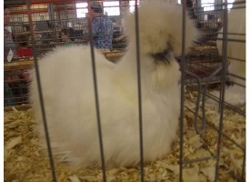
We always visit the Poultry Barn, where my youngest and I play a game she started as a toddler. Can we buy a (chicken, duck, bunny, racing pigeon)? My answer is just “No.”
 We catch a little of whatever is going on in the equestrian arena in the Toyota Coliseum. This year it was six hitch Belgians and later, Percherons driven “unicorn” fashion (two behind, one in front). Gorgeous beasts, all of them.
Besides those things, we wander the various exhibition halls and watch whatever performers happen to be on, check out the sand and butter sculptures, etc… We end the day watching the parade and eating funnel cake.
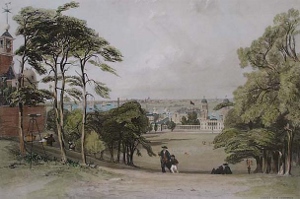 Fairs in England started out as agricultural events: opportunities to buy and sell livestock. Entertainment was also important, but by the late eighteenth century it was a major focus of the “Fringe Fairs” around London, which included Greenwich, where I had the hero of Fly with a Rogue do a balloon ascension.
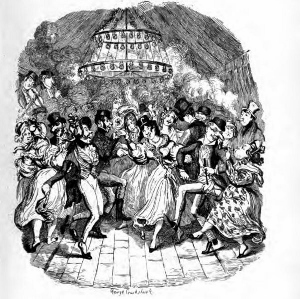
Here are some descriptions of Greenwich Fair from Sketches from Boz, Chapter 12 by Charles Dickens, 1836. According to other sources, his descriptions were valid for the Regency. He describes the entertainment, which included itinerant theatres, Wild Beast Shows, exhibitions of dwarfs and the like, and dancing at the Crown & Anchor.
Imagine yourself in an extremely dense crowd, which swings you to and fro, and in and out, and every way but the right one; add to this the screams of women, the shouts of boys, the clanging of gongs, the firing of pistols, the ringing of bells, the bellowings of speaking-trumpets, the squeaking of penny dittos, the noise of a dozen bands, with three drums in each, all playing different tunes at the same time, the hallooing of showmen, and an occasional roar from the wild-beast shows; and you are in the very centre and heart of the fair.
And here’s a bit on the food:
The entrance is occupied on either side by the vendors of gingerbread and toys: the stalls are gaily lighted up, the most attractive goods profusely disposed, and unbonneted young ladies, in their zeal for the interest of their employers, seize you by the coat, and use all the blandishments of ‘Do, dear’—‘There’s a love’—‘Don’t be cross, now,’ &c., to induce you to purchase half a pound of the real spice nuts, of which the majority of the regular fair-goers carry a pound or two as a present supply, tied up in a cotton pocket-handkerchief. Occasionally you pass a deal table, on which are exposed pen’orths of pickled salmon (fennel included), in little white saucers: oysters, with shells as large as cheese-plates, and divers specimens of a species of snail (wilks, we think they are called), floating in a somewhat bilious-looking green liquid.
I remember the hero of Georgette Heyer’s Fridays’s Child taking the heroine to a fair, but off the top of my head, I can’t remember other fairs in Regency romance. It wasn’t an especially proper thing to do, and could get a bit rowdy. Not to say that people of the gentry or aristocracy couldn’t go, but they’d plan accordingly.
Do you enjoy county or state fairs? What’s your favorite thing to do (or eat) there?
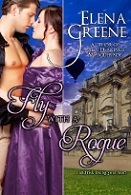 But before we discuss, here are the winners of the paperback version of Fly with a Rogue:
Bonnie
Kathy
Stella
Sheila C
Mary C
Please send your snail mail address to elena @ elenagreene.com. Thanks for visiting!
Those two words, plus Let’s Pretend… are part of the essential writer’s toolbox (or those of the average six-year-old, meaning that writers haven’t quite grown up yet).
So I like to play a game where I try to translate everyday life into the Regency, partly to amuse myself and partly as research or background building. Take getting up in the morning, for instance. Now my routine is pretty simple. I can get myself up and out of the house (usually with clothes on the right way out and right way around although there have been notorious lapses), with time to check e-mail, in about forty-five minutes.
But in the Regency… first I’d need someone to lace me into my stays, unless I was fortunate enough to own a pair of front or side lacing stays, rare in collections, but they did exist. And chances are there would be people around, because people did not live alone, and I’d have a servant or someone to help. In fact there might be rather too many people around. Let us pass over the bathroom issue, but assume some washing might well take place.
Choosing something to wear would probably be quite easy because either I’d opt for morning dress (i.e., slopping around the house wear), or I’d put on the clothes I wore yesterday and every other day except Sunday. I really have trouble, as you may have noticed with the aristocracy, or imagining myself living as one.
 Next, the urgent need for a cup of tea. If I was unlucky the fire might have gone out, although I hope I would not have been so slatternly as to forget to bank it the night before. I might have to pump water. If I had someone to boil the water I’d still be the one to make the tea because I’d have the all-important tea caddy and its key. Someone would also have to look out in the street for the milkmaid and her cow so I could have milk in my tea.
 As for breakfast itself–assuming there was anything to eat in the house with the price of bread at an all-time shocking high–if I were higher up the social scale I’d have toast or cake. All more labor intensive than you might think, certainly more fiddly than putting an English muffin (yes, there were things called muffins in England, but the English muffin is neither English nor a muffin) in the toaster. No peanut butter either.
I suppose the equivalent of e-mail would be reading a newspaper (although possibly several days old, passed on by someone I knew) or receiving the day’s post.
 And leaving the house for work?–chances are I’d stay home doing piecework, and trying to keep my grandchildren out of the fireplace (note to daughter: this is not a hint). Or I’d leave to clean someone else’s house.
Think of what you’d do at any given time of day. What do you think you’d be doing if you lived in the Regency? What would you miss most? What do you think you’d enjoy most?
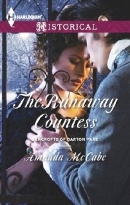 I’ve been so busy the last few weeks (trying to get ahead on the WIP, packing my 50 boxes of books for a move, taking care of a sick cat who has suddenly become very, very picky about his food….) that the beginning of September completely passed me by! And with the beginning of September I had a new book release. So I am talking about it today! Better late than never, right???
Wed to wickedness
In Society’s eyes, Hayden Fitzwalter, Earl of Ramsay and Jane Bancroft have the perfect marriage. But what can’t be seen are the secrets hidden behind closed doors. Believing Hayden will never renounce his dissolute ways, Jane flees to her family’s dilapidated estate in the country.
Years later, Hayden now longs to win back the only woman who has ever touched his heart. But first he has to convince her that this rogue is ready to be tamed….
BANCROFTS OF BARTON PARK …Two sisters, two scandals, two sizzling love affairs
This story felt very risky to me when I was writing it. I had never tried a “marriage in trouble” story before. My stories have always followed the general romance outline–meeting (or re-meeting), liking or hating, getting to know each other, falling in love, marrying. Maybe a villain or evil plot or two along the way! This time there was no meeting/falling (though I show glimpses in flashbacks, another risky thing for me, but I really wanted to show how happy they were at first, and what went wrong). This was a couple married in a time when marriage was nearly impossible to get out of, but who couldn’t bear to be together any longer. They felt broken. It almost broke MY heart, because I always want the best for my characters!!! It’s hard for me to be mean to them, even when it’s for their own good….
Unlike many historical romances, the bulk of the book is not centered on the couple winning each other into matrimony but on the healing of a struggling marriage, the revelation of their pasts (particularly Hayden’s) and how difficult it is to change even when that change is fervently desired. Add the mystery and danger of a hidden treasure and a truly distasteful man and McCabe has created an enjoyable romance with a different focus than most…I am eagerly awaiting book two. –Fresh Fiction
But honestly, Jane and Hayden needed to learn their lessons. It’s a story that’s common even now–they married young, in the first flush of new passion, naive and impulsive. Jane didn’t know how to be a countess; she had grown up in a ramshackle country house with an unconventional, scholarly family, taking care of her little sister Emma. Hayden saw no need to give up his wild life just because he had a wife. A few miscarriages drove them even further apart, until they had to separate. But a few years later, they’ve both grown up a lot, and can see the enormity of what they’ve lost.
I admit it–I cried a bit when they started to get back together. They were meant to be together, darn it!! They just needed to figure that out…
Hayden and Jane were truly a couple who belonged together. They simply did not know how to handle a marriage. Jane tried to explain what she needed, but Hayden had only his parent’s example and could not understand. As a result, thw two must face the question is love enough? Find out in The Runaway Countess by Amanda McCabe. A little maturity and a lot of love can make a difference. Amanda McCabe has penned an amazing historical romance with just the right touch of suspense, some surprise revelations and a highly romantic ending. –Cataromance
It was also a risky story for me in that I wanted to try an Austen-esque setting. Not in the style of Austen; I would never, ever be brave enough for that!! But a small village, where everyone knows each other and small-seeming concerns become large, where family relationships are important, and the house is a character in itself. (I wanted to go live at Barton Park, spend my days puttering in the garden and sewing by the fire…) I ended up having lots of fun with it, though I missed my Gothic storms and poison plots.
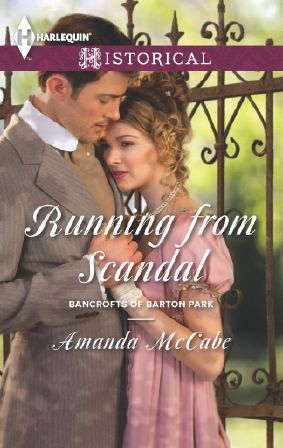 The life of Barton Park continues in December, with Emma’s story, Running From Scandal. She has to learn to grow up a bit, too–and might end up with a man she would never have dreamed of ever thinking about before, LOL.
The book is available on Amazon
And my own website has excerpts and more info…
I apologize in advance, you are going to be hearing a lot from me in the next few months! I have releases every month until the end of the year. October brings the debut of my Elizabethan mystery series, written as Amanda Carmack, Murder at Hatfield House! I am sooooo excited about these books. November will bring a Christmas novella, A Very Tudor Christmas. And December Emma’s book. Whew!
In the meantime–do you like “marriage in trouble” stories?? What kind of dream house would you want, if you could choose any? (I am torn between a beach bungalow and an English country house. Or a Paris apartment with a view of the Eiffel Tower…) Comment for a chance to win a signed copy of Countess!!!