Back to Top

Monthly Archives: August 2014

The_Duke_of_Wellington_(1839)_by_George_HayterOne of the stops on the Duke of Wellington tour (only 3 more weeks and I’ll be in London!) will be the Tower of London. I’m very excited about this because I’ve never visited the Tower of London.

What, you ask, does the Tower have to do with the Duke of Wellington? The duke was Constable of the Tower from 1826 to 1852.

The Constable of the Tower has always been a prestigious one. Although now the role is largely ceremonial, in Wellington’s time the Constable was the man in charge of the Tower, and, typical of Wellington, he set about to make improvements.

rb_fight1. He closed the Royal Menagerie.
The Royal Menagerie had been at the Tower since the early 1200s and had housed all sorts of exotic animals, like ostriches, elephants, lions, tigers, kangaroos, etc. The waste from the animals drained into the moat, creating disease and noxious odors, plus there were some vicious animal attacks, including a fight between a Bengal tiger, tigress and a lion, ending in the lion’s death. The animals were moved to the London Zoo at Regent’s Park.

2. He drained the moat.
The Surgeon General at the time described the moat as ‘impregnated with putrid animal and excrementitious matter… and emitting a most obnoxious smell.’ The moat was blamed for several soldier’s deaths and for cholera outbreaks. The Duke drained the moat and created a dry ditch or fosse that visitors see to this day.
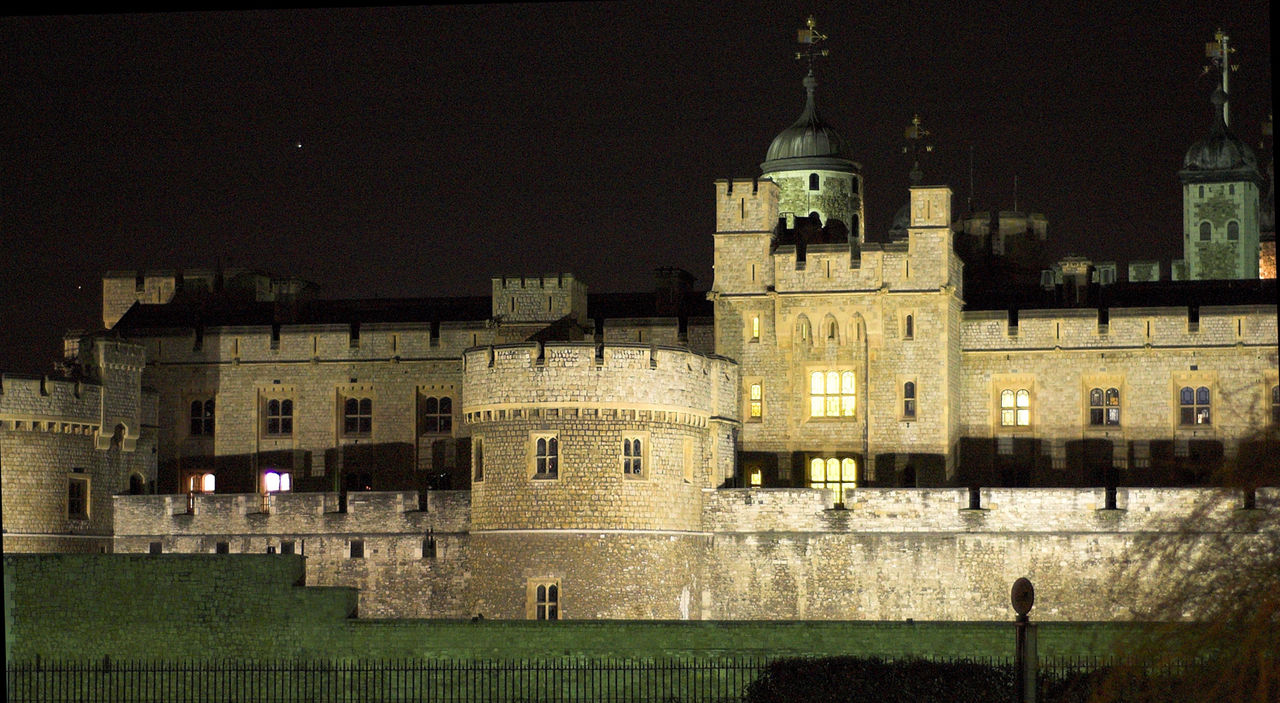
Tower_of_London_at_night23. He build the Waterloo Barracks.
To adapt the Tower for modern warfare and a professional army, he closed the Tower pubs, instead creating an army canteen and an officer’s mess. He built the Waterloo Barracks to house 1,000 soldiers. The Waterloo Barracks is also where the Crown Jewels are kept.

4. He made the awarding of Yeoman Warder to be based on distinguished military service.
Before Wellington’s time as Constable, the post of Yeoman Warder could be purchased for 850 guineas or even inherited within families. The Duke brought these practices to an end.

5. He oversaw the rebuilding of the Tower after the fire of 1841.
After the fire, Wellington strengthened the Tower, making it secure from potential civil unrest.

6. He increased the number of visitors to the Tower.
Under the Duke, tourism at the Tower increased–much to his displeasure. Wellington did not approve of public visiting the Tower. He felt them a nuisance and a threat to security.

The Tower will have a special exhibit of the Duke of Wellington’s influence during his time as Constable of the Tower on the newly opened North Walk. I can’t wait to see it!
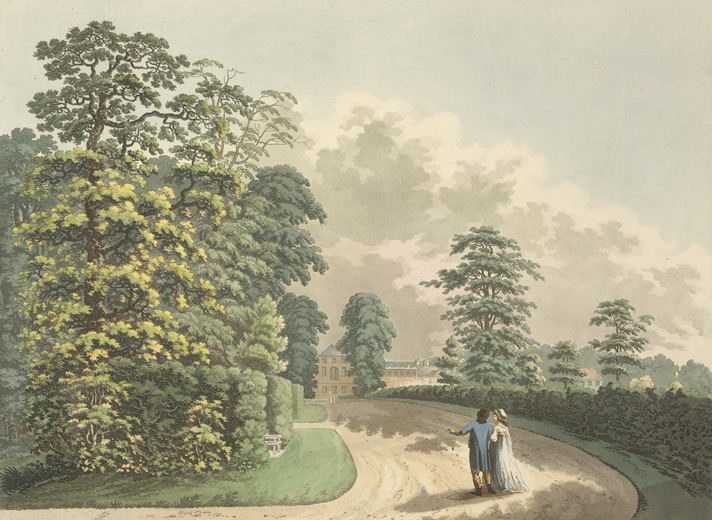

 

Kensington Gardens, 1798

Kensington Gardens, 1798

In the late 18th Century, landscape architect, Lancelot “Capability” Brown, diverged from the rigidly formal gardens favored at the time and designed naturalistic landscapes, breaking up the gardens with “follies, cascades, lakes, bridges, ornaments, monuments, meadows and wood.” (The Omnipotent Magician: Lancelot ‘Capability’ Brown, 1716-1783 by Jane Brown).

One of his legacies appears to have been a nice collection of shrubbery into which my characters keep disappearing. Early in the manuscript on which I’m working, the hero takes the heroine off the beaten path in Kensington Gardens and into a rather lovely shrubbery during which stroll they are, alas, interrupted. But don’t worry. There will be other shrubberies.

Unfortunately, my hero finds himself in a shrubbery with the wrong woman during a morning party at a London estate. Fortunately, he is rescued by the hostess. Today, I thought I’d share the rescue with you.

Simon was dumbstruck. It wasn’t that he was unaware of his sister-in-law’s wishes and he would have to be blind and deaf to miss Lady Margaret’s blatant overtures. He had not, however, expected such a flagrant bid for a proposal. He knew he shouldn’t have gone near the shrubbery.

As Simon stared in amazement at the woman clinging to his arm, and searched his mind for an appropriate response that would not land him in front of a parson, he was saved by a party led by Lady Frampton. The hostess was ostensibly leading a group through a tour of her gardens. From the conversation, it seemed as though she had just run them through the parterre and hustled them into the shrubbery where she claimed to have the largest Hawthorne in Middlesex County. Simon smiled. Perhaps Lady Frampton had found her missing sheep. The group stopped abruptly in front of Simon and Lady Margaret.

“Join us?” Lady Frampton asked.

“We were just returning to the garden,” Simon said, on a sigh of relief.

“Very well, then. Off with you.” Lady Frampton nodded, and Simon could have sworn, winked again. 

And so, having shared this with you, I return to the manuscript. I am very near to reaching the ultimate shrubbery.

Posted in Regency, Writing | 3 Replies

steelsongSo here I am on Friday morning, and unusually for me, I did not have my post written in advance. From unpacking and catching up from my two week vacation, I’ve moved into Trying-Not-To-Panic Mode while getting ready to send off my oldest to college. So maybe I’ll talk some more about things I enjoyed during vacation—with a tiny bit of Regency interest thrown in.

One thing I love about vacation is having more time to read. One of the many books I enjoyed over break is Steel and Song, the first in a new steampunk series by Ani Bolton. I’ve been intrigued by the idea of steampunk but hadn’t actually read anything before this. I was caught up by the world-building and the compelling characters.

Poseidon_Exhibit_CardAfter the Club Med interlude, I spent a few days in Orlando with my husband’s family and visited two museums. Among the offerings at the Tampa Museum of Art was an exhibit on “Poseidon and the Sea: Myth, Cult and Daily Life” .  I saw some lovely and intriguing ancient objects and realized how much my daughters knew about the mythology (their interest sparked by Rick Riordan’s Percy Jackson and the Olympians series). Some of the depictions of ladies in the exhibit reminded me again of the influence of the classics on the Regency. Not only did Regency ladies often wear classically-inspired clothing and hairstyles, the way they were depicted in fashion prints–that straight line from forehead to nose–resembles ancient depictions of women.

Greek_Eros_vase

Reg_fashion_print


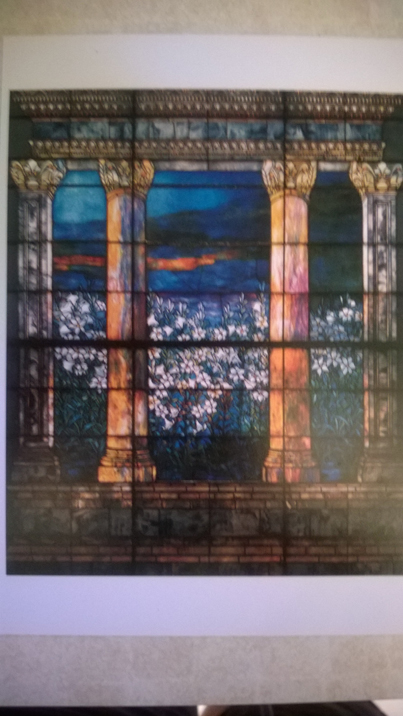
Morse_Museum_CardLater, I visited the Morse Museum in Orlando, which houses “the world’s most comprehensive collection of works by Louis Comfort Tiffany (1848–1933)”. It was a feast for the eyes and I highly recommend it for anyone who loves art and/or needs a break from theme parks.

So what have you enjoyed this summer?  Any good summer reads?

Elena
www.elenagreene.com

Outlander has been a long time coming and it’s finally arrived–you can watch the first episode online here even if you’re not a Starz subscriber. I thought I’d share my thoughts on this first episode. Whatever its faults, I don’t believe there is one careless frame–even the (eeew) field surgery scenes are beautiful in their way. There’s a whole lot of very effective playing around with light and filters–the present day (immediately after WW2) sequences, for instance have a sepia, historic feel to them–and it all looks amazing.

outlander_62462The camera lingers on Caitriona Balfe’s stunning face. Most often she’s gazing at her husband Frank, who is not looking much at her. In fact I liked the scenes with Frank better than the scenes with the Scotsmen, where she comes over as predominantly sulky and stone faced. Maybe she caught it from Sam Heughan, who plays Jamie imageswith a limited repertoire of expressions–I think I counted about three variants on stoic bearing of pain–although there are a couple of flashes of manly thigh. I wait to be impressed.

There is a huge amount of historical filth and grime–the first appearance of a Scotsman suggests a walking collection of rags in the land of bad haircuts. The countryside is gorgeous. The horses are nice.

So what’s not to love? Well, the pacing is off, off, off. Those of us who’ve read the book(s) know that Claire will be going through the stones. Does she get there in episode 1? Eventually, yes. Compared to the brief, brilliant flashback that shows the young Claire on an excavation (lighting a cigarette for her archaeologist uncle, tsk tsk–what, children smoking???–a nice touch) the setup goes on and on and on. I wonder whether it would have been possible to have Claire going through the stones as the end of episode one.

And when she does go through … well, surely this is the Big Moment. We get a black screen. Good. Then … oh dear, flashback to car wreck which is what Claire compares it to, although not I believe in the book, pulling us right out of the moment (and I rarely meets a flashback I don’t like). Bad. I was really hoping for a sort of Hitchcockian Vertigo moment here, lots of wobbly camera effects and panic. Maybe a Blair Witch moment.

Really, all in all, there’s a lot that happens in this first episode but it doesn’t feel that way on the small screen. It’s both disjointed and repetitive. Claire swears, Scotsmen and/or English officers threaten her, she runs, she gets a bit more dirty, performs first aid, rinse and repeat.

I have the greatest admiration for Diana Gabaldon, whose episodic technique was a revelation to me when I heard her speak about twelve years ago: that you can skip onto a scene that you’re dying to write or even a scene that seems to have no particular place to go (yet). Reading her now, I find myself thinking, this scene is great, but really, what are we doing here? Do we ever meet this character again? Do we have to remember him/her? I suspect the TV series will have too many moments like this as well, and it’s too bad.

But, yes, I’ll be watching. Will you, have you? What did you think?

Do you know the scene in Mary Poppins where Mary, Bert, and the children jump into one of Bert’s chalk paintings on the sidewalk? Something similar happened to me last weekend, though there were no dancing penguins involved nor any chalk drawings. Nevertheless, I suddenly found myself walking through the setting of a long-time favorite novel of mine.

Now, I have visited Britain often enough to know that strange feeling of familiarity that overcomes you when you walk through Burlington Arcade or take a peek into that seventh heaven of bachelorhood of the Regency period, Albany, or visit one of Britain’s numerous country houses: as a reader of historical romance, you’re bound to recognize these places from the novels you’ve read.

But what happened to me last weekend was a bit different, more visceral, probably because it was so unexpected: as a lover of Rosemary Sutcliff’s books set in Roman Britain, you don’t really expect to be easily transported back to that time by any place given that most of the remains of the Roman empire are mere ruins. Even Hadrian’s great northern frontier wall in Britain has been reduced to a mere stubble of its former existence.

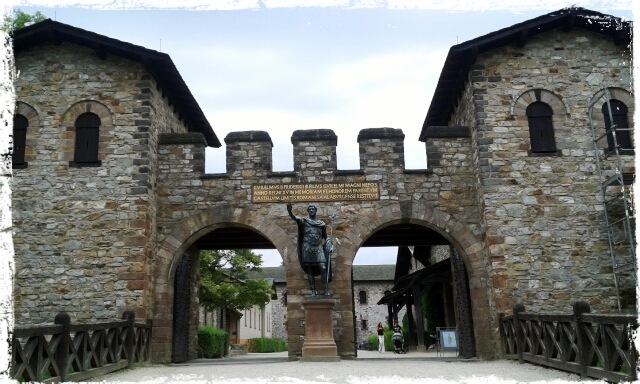
I live near the lines of another of these great Roman frontier walls, the Germanic Limes, and a mere 40-minute drive from my town lies a reconstructed Roman fort, the first of its kind, re-built in the late 19th century.

a picture of the main gate to the Saalburg

Saalburg: Porta Praetoria (the main gate)

And as I was walking amongst the reconstructed houses, past the reconstruced barracks, I suddenly remembered a passage from one of Sutcliff’s novels, about how each Roman fort looks the same no matter where you are in the empire. They might not have looked exactly like the Saalburg (all the walls would have been white – something that historians back in 1900 didn’t yet know), but still I felt this sudden, keen connection to Sutcliff’s characters.

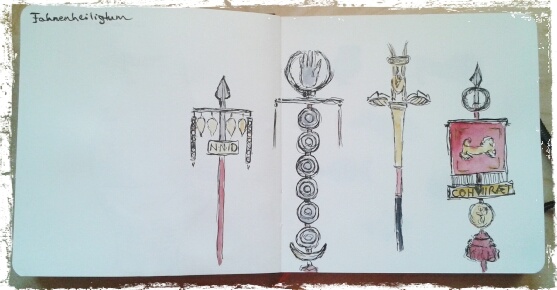
Indeed that feeling was so strong, that the sight of the eagle standard nearly made me burst into tears because I was so touched. (Alas, the Saalburg eagle not only is a fake, but it is also anachronistic, for these forts were manned with auxiliary troops rather than legions, and the auxiliaries didn’t have eagle standards. However, Kaiser Wilhelm II, who commissioned the building of the Saalburg museum, insisted on the eagle.)

a sketch of the military standards at the Saalburg

The military standards at the Saalburg

What I always find so fascinating about visiting museums and all those British country houses is that, for me, it is always the small things, the everyday items, that makes me feel a connection to the people of the past who used them. Amidst the exhibits in the Saalburg, you can also find pretty Roman shoes (which would make perfect summer shoes!), pretty dishes and vessels (have I already mentioned that I have this thing about tea sets?)….

a sketch of a small Roman vessel

A small Roman vessel from the Saalburg

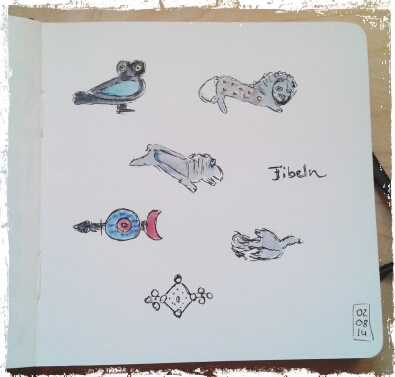
…as well as pretty fibulae, Roman brooches. These come in all shapes, including cute, colorful animals:

a sketch of Roman brooches found at the Saalburg

Roman brooches from the Saalburg

You can just imagine a gruff Roman soldier buying such a pretty brooch for his sweetheart. (And then you start to imagine all kinds of things, and all at once your Muse is yelling into your ear how wonderful it would be to write a novel set here at the old Roman frontier, and then she forces you to buy all kinds of research books and… Oh gosh, I don’t just have a tiny problem in regard to tea sets, but also in regard to research books! *blushes*)

a picture of a pile of research books

My Muse made me do it

Now let’s hear it: Which setting of which novel or film would you like to visit? Pemberley, perhaps?

Follow
Get every new post delivered to your inbox
Join millions of other followers
Powered By WPFruits.com