Back to Top

Monthly Archives: May 2015

There are a handful of events that for good or ill (more often for ill, unfortunately) are unforgettable. I’ll never forget where I was when I heard about the Challenger disaster–I was in 9th grade, and they announced it over the intercom during 4th period Alabama History.

I found out about the 9/11 attacks when I was awakened by a phone call from my parents, who were supposed to be flying into Seattle for a visit later that day. Mom said, “All flights have been canceled.” Assuming she meant all flights out of Birmingham, I asked if there’d been some kind of storm or problem at the airport. She told me there had been a terrorist attack and to turn on the TV.

And most recently, a few years ago I was waiting for dinner at Red Robin with my husband and daughter. Mr. Fraser and I were checking Twitter on our phones, as internet addicts are wont to do, when tweets started to buzz with the news that President Obama was about to “address the nation.”

It sounded ominous, so we speculated about possible war with Iran or North Korea. I also worried that it might be something like a hideous cancer diagnosis for either the President or the First Lady, and that he might be stepping down and handing the reins to Vice-President Biden because of it–ever since I lost both my parents to lung cancer, my mind goes to the C-word in a hurry.

Instead, of course, the big news was the death of Osama bin Laden. We’d figured it out from Twitter before one of the TV feeds in the restaurant switched from sports to the news–which was neither captioned nor audible in the noisy restaurant, so Mr. Fraser and I leaned over the booths to tell our fellow diners what was happening as soon as we heard their baffled concern. Eventually, the headline at the bottom of the screen said something like, “Bin Laden death confirmed,” and the line cooks, most of whom would’ve been in junior high on 9/11, started cheering and stomping their feet.

We were home by the time the president actually spoke, so Mr. Fraser and I stood together our den–somehow it seemed too solemn a moment for lounging on the couch–and listened.

Chelsea pensioners

In the time period I write about, there was plenty of momentous news, though of course it rippled through the world much more slowly. I imagine if I’d been born in 1771 instead of 1971, I’d remember where I was when I heard about the French Revolution and Trafalgar and Waterloo, to name a few. So, when I read a collection of first-hand accounts of Waterloo in The Hundred Days (compiled and edited by Antony Brett-James), I was intrigued to find a chapter about how the news reached France and Britain. I was then flabbergasted by the following account by Mrs. Boehm, the woman hosting the ball the Prince Regent was at when Wellington’s messenger arrived:

That dreadful night! Mr. Boehm had spared no cost to render it the most brilliant party of the season; but all to no purpose. Never did a party, promising so much, terminate so disastrously! All our trouble, anxiety, and expense were utterly thrown away in consequence of–what shall I say? Well, I must say it–the unseasonable declaration of the Waterloo victory! Of course, one was very glad to think one had beaten those horrid French, and all that sort of thing; but still, I always shall think it would have been far better if Henry Percy had waited quietly till the morning, instead of bursting in upon us, as he did, in such indecent haste; and even if he had told the Prince alone, it would have been better; for I have no doubt his Royal Highness would have shown consideration enough for my feelings not to have published the news till the next morning.

…After dinner was over, and the ladies had gone upstairs, and the gentlemen had joined them, the ball guests began to arrive. They came with unusual punctuality, out of deference to the Regent’s presence. After a proper interval, I walked up to the Prince, and asked if it was his Royal Highness’s pleasure that the ball should open. The first quadrille was in the act of forming, and the Prince was walking up to the dais on which his seat was placed, when I saw everyone without the slightest sense of decorum rushing to the windows, which had been left wide open because of the excessive sultriness of the weather. The music ceased and the dance was stopped; for we heard nothing but the vociferous shouts of an enormous mob, who had just entered the square, and were running by the side of a post-chaise and four, out of whose windows were hanging three nasty French eagles. In a second the door of the carriage was flung open, and, without waiting for the steps to be let down, out sprang Henry Percy–such a dusty figure!–with a flag in each hand, pushing aside everyone who happened to be in his way, darting up stairs, into the ball-room, stepping hastily up to the Regent, dropping on one knee, laying the flags at his feet, and pronouncing the words “Victory, Sir! Victory!”

The Prince Regent, greatly overcome, went into an adjoining room to read the despatches; after a while he returned, said a few sad words to us, sent for his carriage, and left the house. The royal brothers soon followed suit; and in less than twenty minutes there was not a soul left in the ballroom but poor dear Mr. Boehm and myself.

Such a scene of excitement, anxiety, and confusion never was witnessed before or since, I do believe! Even the band had gone, not only without uttering a word of apology, but even without taking a mouthful to eat. The splendid supper which had been provided for our guests stood in the dining-room untouched. Ladies of the highest rank, who had not ordered their carriages till four o’clock a.m., rushed away, like maniacs, in their muslins and satin shoes, across the Square; some accompanied by gentlemen, others without escort of any kind; all impatient to learn the fate of those dear to them; many jumping into the first stray hackney-coaches they fell in with, and hurrying on to the Foreign Office or Horse Guards, eager to get a sight of the List of Killed and Wounded.

I first read that account years ago, and it still boggles my mind. I can understand that it would suck to put down the kind of money it would take to throw a ball for the highest of London’s elite and have it all go to waste. But to still resent it, years later (her account is from 1831), when it was abundantly clear just how important Waterloo was? And the way she seems to focus on breaches of propriety above all else–Henry Percy was dusty, and he shoved people out of the way in his haste to reach the Prince Regent. One might almost think he was bearing critical news for his country’s acting head of state or something! Not to mention those ladies running out in their muslin gowns and slippers, with or without escort, all because they had brothers or sons or sweethearts with the army and wanted to know if they were still alive. How shocking! And lest you think her reaction is somehow typical of her time, the behavior of her guests belies it. Also, all the other accounts sound remarkably like what happens now in those moments we all remember–normal social barriers breaking down, everyone turning out into the streets to talk it over, etc.

We’re now just a month away from the bicentennial of the Battle of Waterloo. I’ll be away from the Riskies in June and July because of my family’s trip to Europe, which will include attending the battle reenactment. When I get back I’m sure I’ll have many stories to share!

(The painting illustrating this post is David Wilkie’s Chelsea Pensioners Reading the Waterloo Dispatch, which the Duke of Wellington commissioned at a cost of 1200 guineas. I think it’s a more typical reaction than Mrs. Boehm’s, don’t you?)
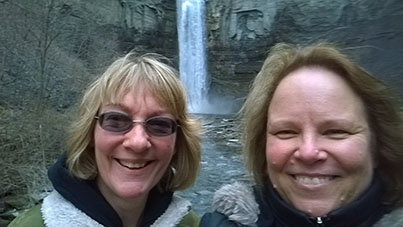
Elena_Laura_T_FallsI recently went on my annual writers’ retreat, and it was wonderful as usual. Here I am with one of my friend writers, the lovely and talented Laura J Bear, who’s working on her next book. Laura’s debut women’s fiction novel, Where the Heart Lands, came out in March and deals with the relationship between two intriguing and troubled female characters.

The basic formula for retreat success is the same every year: an idyllic lake house, a group of caring, supportive writer friends, lots of good food, wine and chocolate, romantic films to watch in the evening, and lots of time and space to write.

What could go wrong?

For many people, not much. If you’re a well-adjusted, happy person who can be spontaneous and creative without guilt, the above is more than enough to ensure a happy, productive weekend.

If you are a neurotic, self-flagellating nut sensitive soul who has at times been made to feel guilty about her creative life, it’s also important to bring the right mindset.

The challenge of having a perfect setup is that it creates a lot of pressure to be productive. It would be very easy for me to set crazy-high productivity goals. Such goals work well for people who are sane enough to be happy when they achieve say, 75-80% of their target. For me, setting the bar too high can make me choke, or at least to feel disappointed if I don’t manage to clear it.

There can also just be pressure to make every moment count. Being as starved for free time as I am, sometimes when I get some I worry about how best to use it. (OK, maybe “neurotic nut” is the right term.) I could also easily fall into the extreme of self-indulgence: too much chocolate, too much wine, too much watching videos into the night. Followed by guilt over not having achieved anything regarding the writing.

The key, I’ve found, is to aim for a happy medium between rigorous discipline and wild self-indulgence, and to focus on the process rather than the output.

This year in particular, I’m grappling with personal issues. Since I couldn’t write before the retreat and knew I wouldn’t be able to write for some time afterwards, I decided to use the retreat as a traveler through the desert uses an oasis: a place to refresh, renew hope, and gather energy for the next part of the trip.

Lakehouse_Sunrise_2015I made sure to spend some time every morning doing the complete wellness routine I wish I could do every day. This includes journaling, yoga, and meditation. I also made sure to exercise, either hiking and/or taking a kayak out for a paddle. I allowed myself to enjoy all that good food and the wine, neither bingeing nor denying myself.

Instead of striving for wordcount, I used my writing time to brainstorm new stories. I now have a lot of detailed notes that will be very helpful when I’m ready to start writing again. Just as importantly, the retreat reminded me of how good–and very right–it can feel to be creative.

Do any of you do retreats of any sort–writing, spiritual, crafting, etc…? Any particular tips and tricks that help you get the most out of them?

Elena
www.elenagreene.com

[My apologies for this late post. After coming home from university, I spent the late afternoon recording a video of me reading bits of my new book to you lovely people (this involved an accident with the retractable desk and making faces at the camera and checking whether “lamp” is really pronounced with a “p” or not). Then I spent the early evening editing the video, watching the software crash, editing the video again, finally starting the process to upload it to YouTube only to be told it would take 900 minutes to upload this lovely 5-minute video. At which point I nearly broke down and cried. After four hours, I eventually abandoned all hope & decided to do this post without a reading. *sigh*]

sketch of the Saalburg, by Sandra Schwab

The main gate of the Saalburg, a reconstructed Roman fort

When you’ve been reading and writing Regency-set historical romances for more than a decade, chances are that you’ve become quite familiar with the conventions of the genre, including the way the genre fictionalizes the Regency period. In other words, you know how the construction of this particular romantic fantasy works: the characters are typically from the upper classes (with an abundance of dukes *g*); the stories are typically set in London during the Season and / or on a lavish country estate; the hero is often tall, dark, and dangerous and might be a rake, but doesn’t suffer from syphilis; everybody has excellent teeth; nobody has any fleas nor lice. You also know exactly what kind of things are typically not touched upon: e.g., child labor, the massive economic problems after the Napoleonic Wars, the often dire situation of domestic servants.

You know this framework inside out, you know exactly what does and doesn’t work and what needs to be tweaked to fit the fantasy.

And then somebody on Twitter talks you into writing a romance novel set in ancient Rome.

And thus, you find yourself, for the most part, without any kind of framework.

For me this was certainly one of the most difficult parts of writing my Roman romance. It didn’t help that during the first few weeks I kept comparing my work to that of Rosemary Sutcliff, whose books I’ve adored since I was eight years old. No, this didn’t help at all. Instead it threw me into full-blown panic mode. How preposterous of me to think I could even begin to imitate Sutcliff’s work!

It took me a few days to realize that of course I wasn’t imitating Sutcliff’s novel. I was creating my own version of the Roman period, which in turn forced me to consciously think about how to fictionalize the past — something I hadn’t really done in years because I am so very familiar with the Regency period and the Victorian Age.

But suddenly I was forced to think about things like

  • How do you write about a world with completely different religious principles? (Funnily enough, my Roman hero ended up being the most religious character I have written to date.)
  • How do you write about a city that, for the most part, no longer exists? (The perfectionist part of me had a little melt-down over this.)
  • How do you write about slavery? How do you convey the full horror of slavery while at the same time making it part of the everyday life of your characters?
  • How do you explain an understanding of sex that was in many ways radically different from our own?
  • And why the heck wasn’t the Colosseum called Colosseum?!!?!? (This came up during a frantic bout of last-minute research last weekend.)
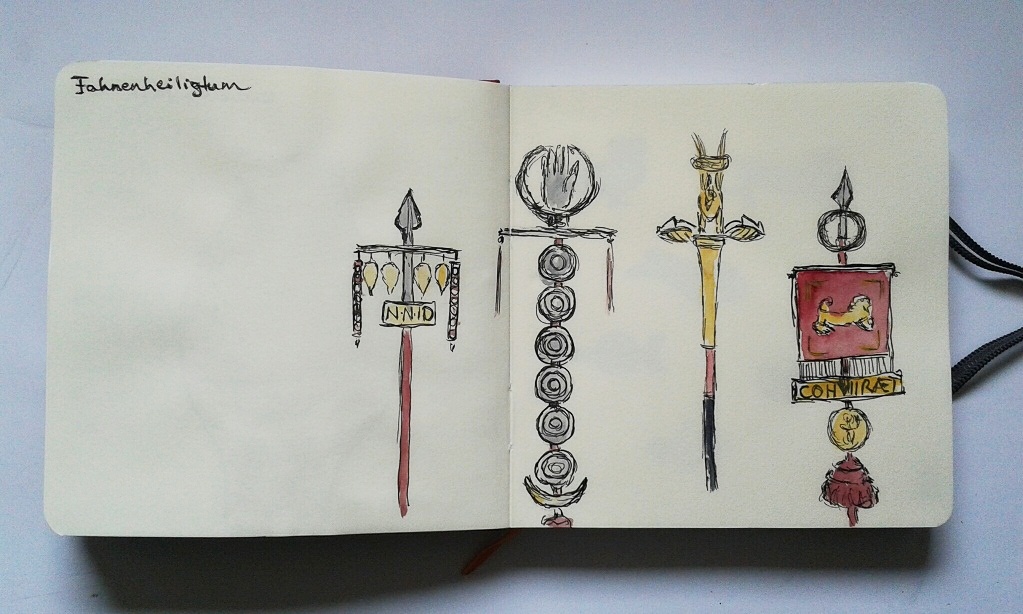
a sketch of Roman military standards

Roman military standards

Writing my Roman romance thus became a true adventure, which allowed me to not only explore a different time period, but also to question and challenge my own writing process and my process of translating the past into fiction.

Indeed, it also challenged me to rethink my own view on history and made me realize there are many aspects of the past we know little or nothing about.

A good example of this is the question whether or not centurions were legally allowed to marry. Though there are a good many grave stones that were erected by a centurion’s “wife”, they are not conclusive proof because the terms maritus (“husband”) and uxor (“wife”) were also used by partners who were not formally wed. Apart from formal, legal marriage, there were two other forms of socially accepted long-term relationships, namely concubinatus and contubernium. While the former refers to “lying together”, the latter term was used for a relationship where the partners lived together in one house. (Initially, the term denoted a community of people sharing a tent, and as such it was also used in a military context to refer to a group of eight soldiers sharing a tent during campaign or a room in the barracks in the fort.)

I have to admit that I found it slightly disturbing that my research often didn’t turn up hard facts, but forced me to make decisions about (key) aspects of my characters’ lives. (It gets even worse when you move beyond the borders of the Roman Empire!) (But hey, who would be stupid enough to do such a thing???) (Eh…um…)

Giving all the challenges of writing a romance set in a completely different period than what I’m used to, I am so thrilled that my first Roman romance it out in the wild. 🙂

covers of Sandra Schwab's Eagle's Honor: Banished

Here’s the blurb:

A proud warrior.
A brave woman.
A forbidden love that is tested by the intrigues of ancient Rome and the hostilities at the northernmost edge of the empire.

Centurion Marcus Florius Corvus has a splendid career in the legions ahead of him. Yet a visit to Rome and a chance encounter with an old friend change his whole life: He falls in love with one of his friend’s pleasure slaves and becomes entrapped in an evil scheme designed to destroy him. And yet—he cannot help risking everything for Lia, the woman he has given his heart to, even if it means he will be banished to one of the most dangerous places in the Roman Empire: the northern frontier of Britannia.

Do you have a Kindle Unlimited subscription? Then you can now grab a copy of the first part of the serialized edition of Eagle’s Honor: Banished: www.amazon.com/dp/B00X50PXC2/

If you don’t have a KU subscription, you can also pre-order the complete edition, which will be cheaper for you: www.amazon.com/dp/B00WMAKH4K/

Please note that this is a steamy historical with explicit sex scenes, some graphic language, and shocking questions about a centurion’s vine staff. And people eat, like, the STRANGEST things! 😉

Would you like to be among the first to read Marcus & Lia’s full story? Then leave a comment for a chance to win a digital copy of the complete edition of Eagle’s Honor: Banished.

Posted in Writing | 7 Replies
Follow
Get every new post delivered to your inbox
Join millions of other followers
Powered By WPFruits.com