Back to Top

Monthly Archives: June 2015

…I love the wooshing sound they make as they fly by.” I wish I’d written that but alas, no. Douglas Adams said it (author of HITCHIKERS GUIDE TO THE GALAXY.) But if I thought of it I would have said it. I find deadlines a challenge.  I thought eliminating the contractual deadline from my life would make writing more fun. It might. If I ever got around to actually writing.

As you may (or may not) recall from my past two posts I have a new story brewing. I anticipate that it will be novella — something under 100 pages and I will epublish it.

The story is in my head, growing and changing every day. I know it will have no external conflict cause Bella Andre has proved that external conflict is not essential to a readable story. Especially a short one.

I’ve blogged about it. I’ve entered the first page at a Retreat I attend every year (Yeah, they liked it and it was an anonymous submission so it was not my warm and generous nature that won them over)

Since the hero and heroine are the names of people I know (by request) I invited one of them over to hear the outline of the story and get her okay to the use of her name in connection with a woman who has a questionable past and use her husband’s name for a hero who has suffered a tragic lost.

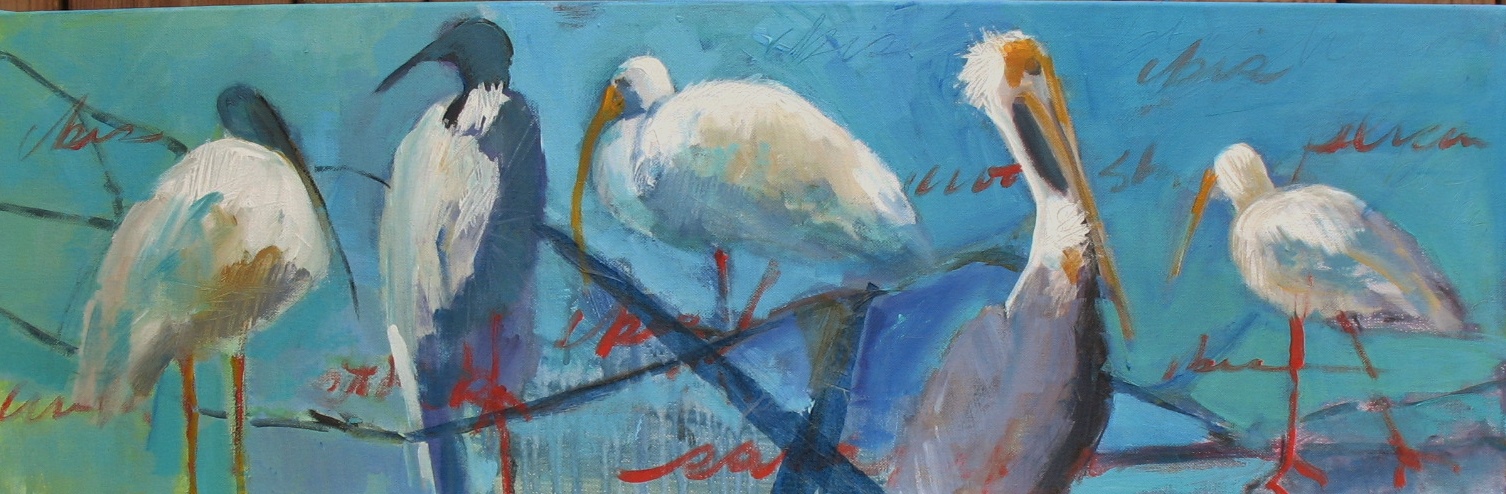
Mimi LaCouture is a  successful artist. One of her painting is below and here is the link to her website(http://mimilittle.com/index.html) Mimi understands the pain of criticism and the value of a suggestion. She said “Fine, sounds like a good story and wouldn’t it be interesting if …. ” and she went on to supply a plot idea that was great and that I had not thought of (might have, but she saved me the effort)Hanging%20Out

So I am all set to put Mimi and John’s story on page. The title has been a big question. It’s (hopefully ) a series so do I name it for the lead two characters, where they live, what they do and with a sub title re this story? Or simplify, cause really a thumbnail cover is pretty small. Still mulling that one over but, let’s face it, I can come up with a title anytime in the next 100 (or so) pages

The house is clean (thanks to house cleaning professional, Michele for that,) the laundry at an acceptable state of overflow. I’ve mastered crock pot cooking so no one starves and I’ve learned to leave lots of white space on the calendar (probably the biggest challenge of all)

Ready, set, STALL. Instead of writing I spent some time last week figuring out how to remove a scorch mark from a cotton dress shirt. (A few drops of ammonia, layered over with a peroxide dampened cloth and then pressed with a medium hot iron. It takes a while but it worked). Then I removed the cloudiness from a crystal vase (white vinegar ), and then, heaven help me, I started daily weeding of  our yard as if it was a mission only I could take on.

What is going on here? Do I actually need a deadline to produce anything. I will keep you posted on this great question. But more important: what is your favorite (or most insane way) to put off the moment when you BEGIN? Not a question just for writers. I do believe this is an experience shared by all. Right Mimi?


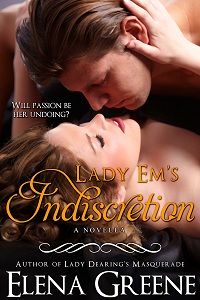
Lady Em's Indiscretion - New CoverI’m hopeful that I’ll be able to get back to writing soon, and when I do, I’ll probably work on a novella. I haven’t had anything “new” out since last April, when I reissued a heavily revised version of Lord Langdon’s Kiss, so I’d like to get more work out there as quickly as I can. That means novellas, in this case, a prequel and sequel to Lady Em’s Indiscretion.

It takes me a long time to develop a full-length book—more than just 3-4 times the length it takes to write a novella. It takes me longer to deal with the complexities of more characters and subplots. Long books are still my absolute favorite both to read and write.

Novellas are fun to write, though, and they go more quickly, not having all of the complications I mentioned above. I enjoy reading them, too. Since they usually focus more closely on the hero and heroine, there’s a certain intimacy to well-written novellas, kind of like chamber music compared to orchestral music. A friend also called my novellas “bon-bons”, which is another fun way to look at it.

However, I’ve had a few readers complain about the length. Even at 99 cents, they were expecting a full-length novel and apparently did not notice the word “novella”, which is on the cover and also in the description along with a word count. I’ve heard this happens to other authors, and we’re all stumped as to how to make the length more clear. I suspect there are readers who buy inexpensive titles on impulse and don’t know what they bought until they start reading.

I’ve also heard of complaints if the digital version of a novella is priced more than 99 cents. Since I personally know the time and work that goes into a novella, I wouldn’t balk at a well-written novella being priced at $2.99 or $3.99, especially from an established author. But of course every reader has the right to make purchasing choices based on her own budget and preferences.

My own novellas are currently priced at 99 cents. My strategy has been to encourage new readers to take a chance on me, in the hope that they might go on to buy my full-length books. However, Amazon’s pricing tool is encouraging me to price my novellas at $2.99. It’s also telling me to use the same price for my full-length Regencies.  That doesn’t seem right to me and would probably annoy readers, so I’ll always price my novellas less than my full-length books.

As for full-length books, I don’t generally want to support the notion that they should have a regular price of 99 cents. I make an exception for introductory prices and special sales. That is the beauty of digital publishing—one can afford to do that—but full length books are such a huge project that I think they should have a regular price that reflects the work that went into them. Even though I’m tickled when a reader tells me she stayed up and read a whole book in one night, I can’t help remembering that it took me a year or so to write it!

What do you think? Do you prefer novellas, long, meaty books, or something in between? Any opinions on e-book pricing?

Elena
www.elenagreene.com

It feels like it’s been forever since I was at the Riskies!  The last several weeks have been spent moving to a new city (and looking for weird stuff in random boxes, because I packed teapots and mugs in different places, and lost the toothpaste…yet I could easily find 20 pairs of shoes!), getting the dog and cat children settled, and most important–getting a library card!  It’s nice to settle back into a writing routine again (I’m working on my 6th Elizabethan Mystery, Murder at Fontainebleau), and take a look at an interesting woman in history for June…

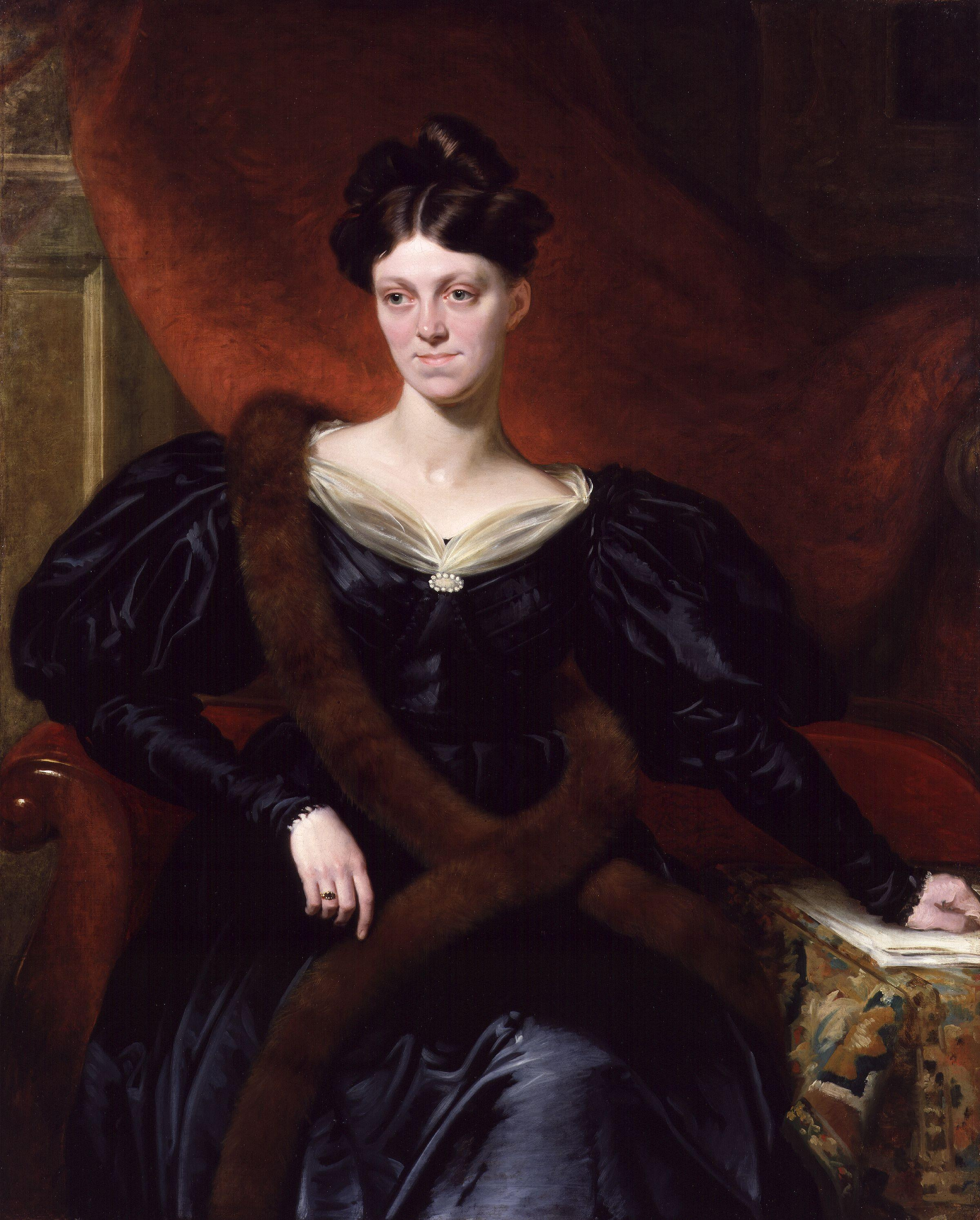
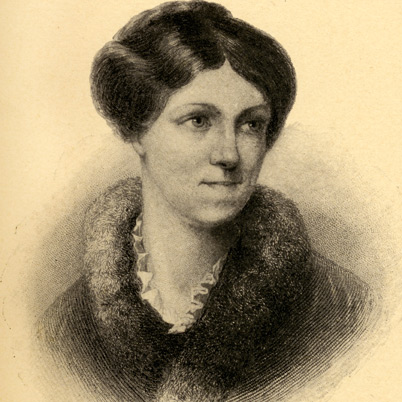
HM1Today we are looking at one of the fascinating women of Regency(ish) history, Harriet Martineau, a Whig writer and social theorist who was called “the first woman sociologist.” She was born June 12, in 1802 in Norwich, England, the 6th of 8 children of a manufacturer. Her family was descended from Huguenots (hence the last name) and of liberal Whig, Unitarian views. She grew up educated and in an intellectual environment, but her health was not good and she became quite deaf at a very young age, which forced her to use an ear trumpet. At 16 she was sent away from home to visit her aunt, who kept a school in Bristol, in hopes that a change of scene would help her health. From 1819 to 1830 she returned to reside in Bristol, and in 1821 began writing anonymously for the Unitarian periodical Monthly Repository, with her first book, Devotional Exercises and Addresses, Prayers, and Hymns coming out in 1823 (she would eventually write more than 50 volumes, on a wide variety of subjects).

In 1826 her father died (soon after the deaths of her eldest brother and her suitor), leaving her and her mother and sisters poverty-stricken. Since her deafness kept her from teaching, Harriet took up serious writing. She went on writing for the Repository as well as short stories (later collected in the volume Traditions of Palestine), won 3 essay prizes from the Unitarian Association in only one year, and did needlework to supplement her writing income. In 1831 she published the first volume ofIllustrations of Political Economy, which was a huge success, with demand increasing for each following volume. In 1832 she moved to London and moved in circles that inluded such people as John Stuart Mill, George Eliot, Edward Bulwer-Lytton, the Brownings, and Thomas Carlyle. She was also friends with Florence Nightingale and Charlotte Bronte. She finished her political economy series, another series titled Illustrations of Taxation, and stories in support of the Whig Poor Law reforms.

In May 1834, Charles Darwin on his Pacific voyage received a letter from his sisters saying that Martineau was “a great Lion in London” and sending him her Poor Laws and Paupers Illustratedin pamphlet size. They also said their brother “Erasmus knows her & is a very great admirer.” When Darwin returned home in 1836 he stayed with his brother in London and found that Erasmus spent a lot of time “driving out Miss Martineau.” The Darwins and Harriet had in common their Unitarian background and liberal Whig politics, but their father thought perhaps her views were a bit TOO liberal for a daughter-in-law and the pair never married. But Charles called on her and stated “she was very agreeable, and managed to talk on a most wonderful number of subjects” though he was also “astonished to find how ugly she is” and “she is overwhelmed with her own projects, her own thoughts and abilities”. Erasmus told his brother “one ought not to look at her as a woman.”

In 1834 she went on a long trip to the United States, where she became an adherent f the Abolitionists and later published Theory and Practice of Society in America and Retrospect of Western Travel, as well as an article called “The Martyr Age of the United States” in theWestminster Review. Her outspoken opinions on the evils of slavery caused a great deal of offense, but she did not care. She followed up this work with a novel, Deerbrook, a story about a surgeon hero and middle-class life.

On a trip to Europe in 1839 she fell ill, and went to stay with her sister and brother-in-law, the well-known doctor Thomas Greenhow, in Newcastle on Tyne to try and alleviate her symptoms (believed to be caused by an ovarian cyst). She then moved to Tynemouth, where she stayed for nearly 5 years in the clean sea air and wrote 3 books, including a novel about the Haitian rebel L’Ouverture and Life in the Sick Room. She loved her new telescope, which allowed her to take in the life of the town and the beach from her window (it’s thought the busybody Mrs. Jellyby in Dickens’s Bleak House is based on her, though she went on being friends with Dickens himself!). She wrote beautifully on her picture of the town: “When I look forth in the morning, the whole land may be sheeted with glistening snow, while the myrtle-green sea tumbles–there is none of the deadness of winter in the landscape.”

902_05_1857556In 1844 she underwent a course of the mesmerism,which she declared returned her to health within months and wrote an account of her case, which caused friction with her sister and brother-in-law, the conventional doctor! In 1845 she left Tynemouth for the Lake District and her new home The Knoll, which she would live in for the rest of her life. In 1846 she made a tour of Egypt, Palestine, and Syria and wrote Eastern Life, Present and Past, which also caused controversy with its “infidel tendency.” She also published a volume called which stated that freedom and rationality, not command and obediance, should be the basis of education. She followed up with a history volume written from the view of a “philosophical Radical”, Household EducationThe History of the Thirty Years’ Peace, 1816–1846. She was always busy, contributing weekly to The Daily News, visiting Ireland and writing Letters from Ireland, and writing for Westminster Review. Her 1838 book How to Observe Morals and Manners laid out some of her general views, that very general social laws influence the life of any society, such as the principle of progress, the emergence of science as the most advanced product of human intellectual endeavor, and the significance of population dynamics and natural physical environment (principles which still hold true today!).

In 1855 she found she suffered from heart disease and started work on her autobiography (though she lived for 20 more years). It was published in 2 volumes posthumously in 1877. She also undertook the translation of Auguste Comte into English, which was published as The Positive Philosophy of Auguste Comte (freely translated and condensed by Harriet Martineau), which Comte himself recommeneded to his students rather than his own!

She died at The Knoll on June 27, 1876.

Some sources on Martineau’s life:
Harriet Martineau’s Autobiography: With Memorials by Maria Weston Chapman (1877)
Deborah Anna Logan, The Hour and the Woman: Harriet Martineau’s “Somewhat Remarkable” Life, 2002
Valerie Sanders, Reason Over Passion: Harriet Martineau and the Victorian Novel, 1986
David Deeirdre, Intellectual Women and Victorian Patriarchy: Harriet Martineau, Elizabeth Barrett Browning, George Eliot (1989)

Celebrating Sandy's 10th blogiversaryA few days ago I celebrated my 10-year blogiversary. I started blogging only a few weeks before my debut novel was due to hit stores in July 2005. (Ten years ago — gosh!) At the time I was working on my second novel, Castle of the Wolf, a gothic romance (or at least it was intended as a gothic romance) in which my English heroine inherits a castle in the Black Forest, but, alas, finds it inhabited by the grumpiest man imaginable (but sort of hot, too) (of course!). And she has to marry him (of course!). There’s an unfortunate incident with a dead mouse, another unfortunate incident with a not-dead bat, and a lady with sturdy boots who stomps all the gothicness to dust. Quite… eh… literally.

And because my heroine needed to somehow get from England to the Black Forest, I decided it would be awesome (AWESOME!!!) if she traveled up the Rhine, past the lovely castles of the Upper Middle Rhine Valley. And maybe I could put in one of those gruesome folk tales? (Because, see above, gothic romance.) Like, the story of the evil Bishop Odo of Mainz being devoured by mice in his tower in the middle of the river? Awesome.

So I spent about two weeks (or more) doing research on traveling on the Rhine and, incidentally, also on British tourists on the Rhine. (Two weeks of research for half a page in the finished book. Just saying.) I pushed back the date of my story to 1827 because that was the first year which saw steamboats on the Rhine, and even tried to see if I could dig up a timetable for said steamboats. (In case you needed any further proof that I tend to go a bit batty where research is concerned: there it is.)

The rising interest in the Rhine and in particular in the Upper Middle Rhine Valley (the super-beautiful part between Bingen and Koblenz, with all the pretty castles clinging to the hills on each side of the river — now a UNESCO World Heritage site) at the end of the eighteenth century was in large parts due to Romanticism as well as to the new aesthetic ideal of the picturesque.
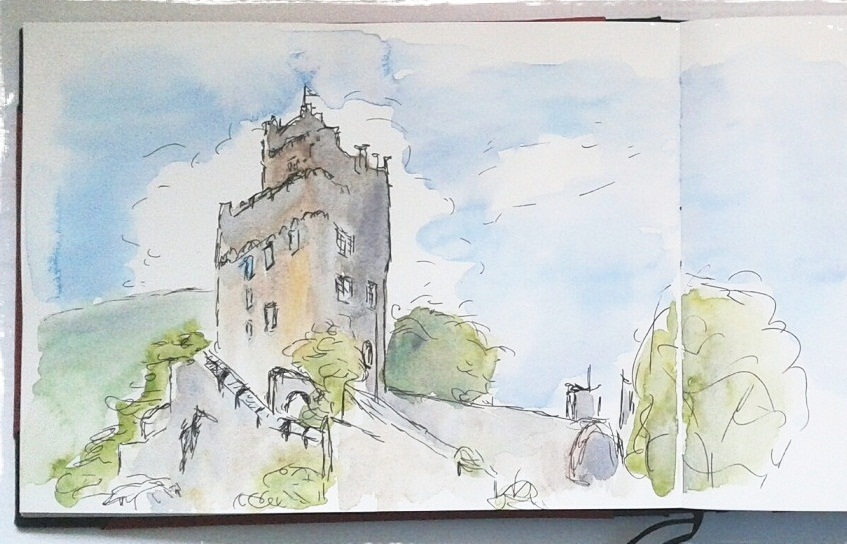
A sketch of Castle Sooneck

A sketch of Castle Sooneck

The first wave of British tourists arrived in the late eighteenth century — among them Anne Radcliffe, who afterwards wrote a whole book about her trip, Journey Made in the Summer of 1794, through Holland and the Western Frontier of Germany with a Return down the Rhine, published in 1795. And it seems that she was quite enchanted by what she saw:

“Sometimes, as we approached a rocky point, we seemed going to plunge into the expanse of the water beyond; when, turning the sharp angle of the promontory, the road swept along an ample bay, where the rocks, receeding formed an amphitheatre, […] then […] we saw the river beyond […] assume the form of a lake, amidst wild and romantic landscapes.”

The steadily increasing stream of tourists came to a halt during the Napoleonic Wars, but immediately resumed afterwards. Going to see the castles of the Rhine became so popular that later in the century the author Thomas Hood remarked,

“It is a statistical fact that since 1814 an unknown number of persons have been more or less abroad, and of all the Countries in Christendom, never was there such a run as on the Banks of the Rhine. It was impossible to go into Society without meeting units, tens, hundreds, thousands of Rhenish tourists. What a donkey they deemed him who had not been to Assmannshausen!”

Incidentally, the most wildly popular English poet also happened to write the most wildly popular account of a journey on the Rhine: since the publication of Byron’s Childe Harold’s Pilgrimage, many British tourists would drag a copy along on their travels so they could trace Childe Harold’s steps. This becomes obvious in the Shelleys’ History of a Six Weeks’ Tour from 1817:

“The part of the Rhine down which we now glided, is that so beautifully described by Lord Byron in his third Canto of Childe Harold. We read these verses with delight, as they conjured before us these lovely scenes with the truth and vividness of painting, and with the exquisite addition of glowing language and warm imagination. We were carried down by a dangerously rapid current, and saw on either side of us hills covered with vines and trees, craggy cliffs crowned by desolate towers, and wooded islands, where picturesque ruins peeped from behind the foliage, and cast shadows of their forms on the troubled waters, which distorted without deforming them.”

Soon, a whole tourist industry grew up around Rhine travels: 1822 saw the publication of the first panorama of the Rhine, consisting of a folded map of the river with larger pictures of the most important sights. Three years later, a publisher in Frankfurt released a panorama of the river and included a small leaflet with explanations of the sights in French, English, and German. (You can take a look at it here.)

Soon, proper guidebooks followed, like Baedeker’s Die Rheinreise (Journey on the Rhine) of 1832. On the other side of the Channel, the firm of John Murray, one of the most influential British publishers with authors like Jane Austen and Sir Walter Scott, started to publish the famous “Red Books”, the Handbooks for Travellers. And again, not surprisingly, the first of the series was the Handbook for Holland, Belgium and the Rhine.
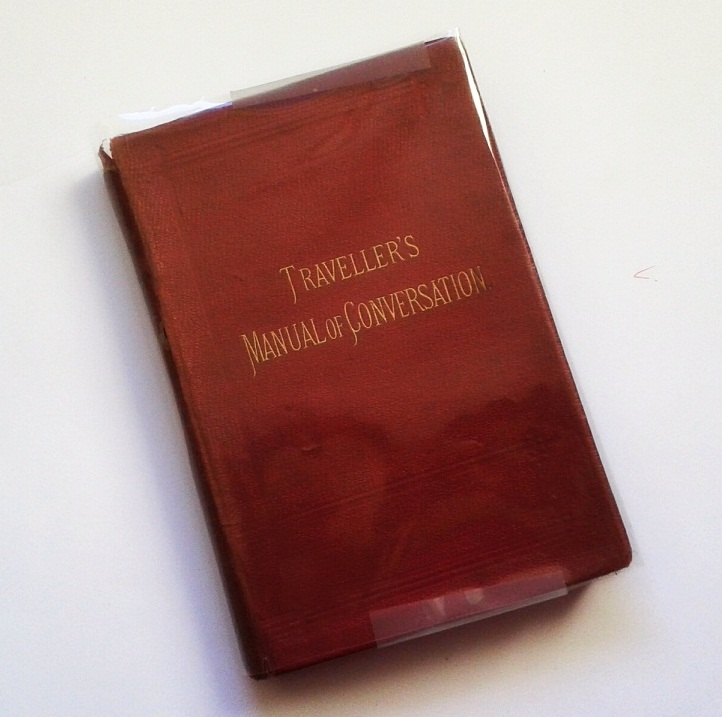
A picture of Baedeker's Traveller's Manual of Conversation

Another of Baedeker’s early publications: The Traveller’s Manual of Conversation in Four Languages

Murray and Baedeker soon joined forces and started to distribute each other’s guidebooks. To make them more uniform, Baedeker also used red cloth for the covers. Indeed, their guidebooks were all standardized, were regularly updated, and were made to fit comfortably into a coat pocket.

But that’s not all.

The star-based rating system that’s now used by online retailers, booksellers and review sites?

That was invented by John Murray for his guidebooks. (So now we know who’s to blame for that!)

The steamboat that were introduced in 1827 formed yet another part of the new tourist industry focusing on Rhine travels. The traditional way of traveling on the river was on boats dragged by horses, and the owners of the horses were not particularly happy about the new steamboats that took business away from them. And so, in 1848, the stable owners of the town of Neuwied fired cannon balls (!!!) at one of the steamboat to express their displeasure — a rather drastic measure (and not a particularly successful one: the boat was hardly damaged and, of course, the steamboat didn’t go away).

Have you ever been on a river cruise? And fellow authors, do you use guidebooks for your research?

Follow
Get every new post delivered to your inbox
Join millions of other followers
Powered By WPFruits.com