Back to Top

Monthly Archives: August 2015

A little over two months ago now, my husband, my daughter and I boarded this plane–a LONG direct flight from SeaTac to Heathrow–for the beginning of our European adventure. I thought that over my next few blog posts, I’d share some pictures and stories from our journey, focusing on those of most interest to Regency readers.

BA

If your vacation is going to focus on history, what better place to start than a TARDIS? (When we asked Miss Fraser what she wanted to see in London, her immediate response was “the TARDIS.” Mr. Fraser was able to track down a blue police box still standing, doubtless just for the sake of photo ops like this one of my two nearest and dearest.)

TARDIS

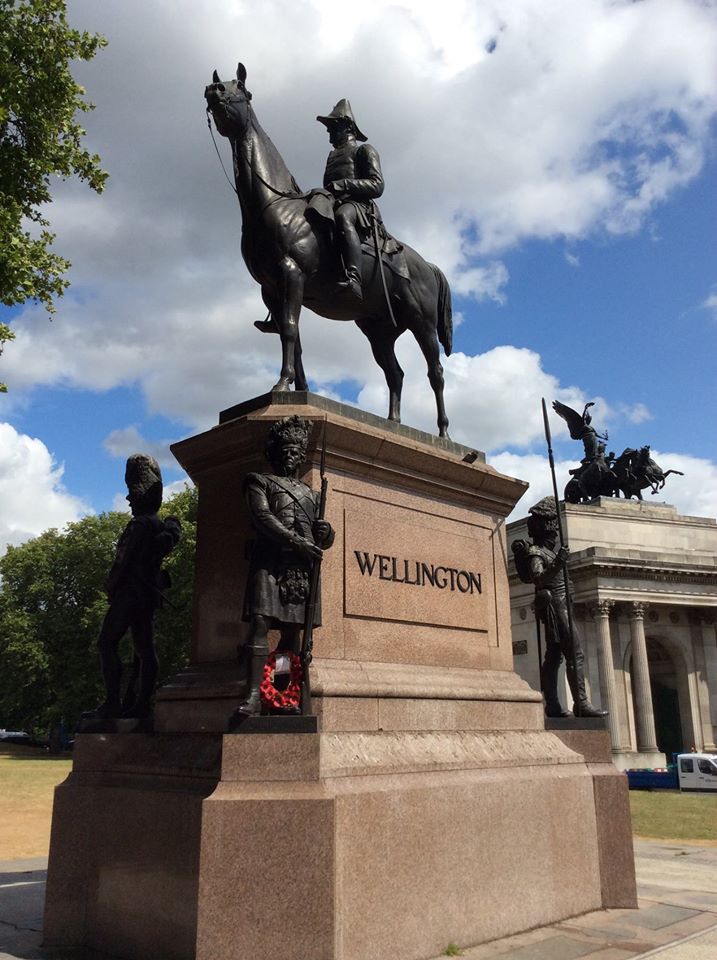
While in London we also stopped by Trafalgar Square, where we saw Nelson atop his column, and Hyde Park Corner, home of a handsome equestrian statue of my beloved Duke of Wellington.
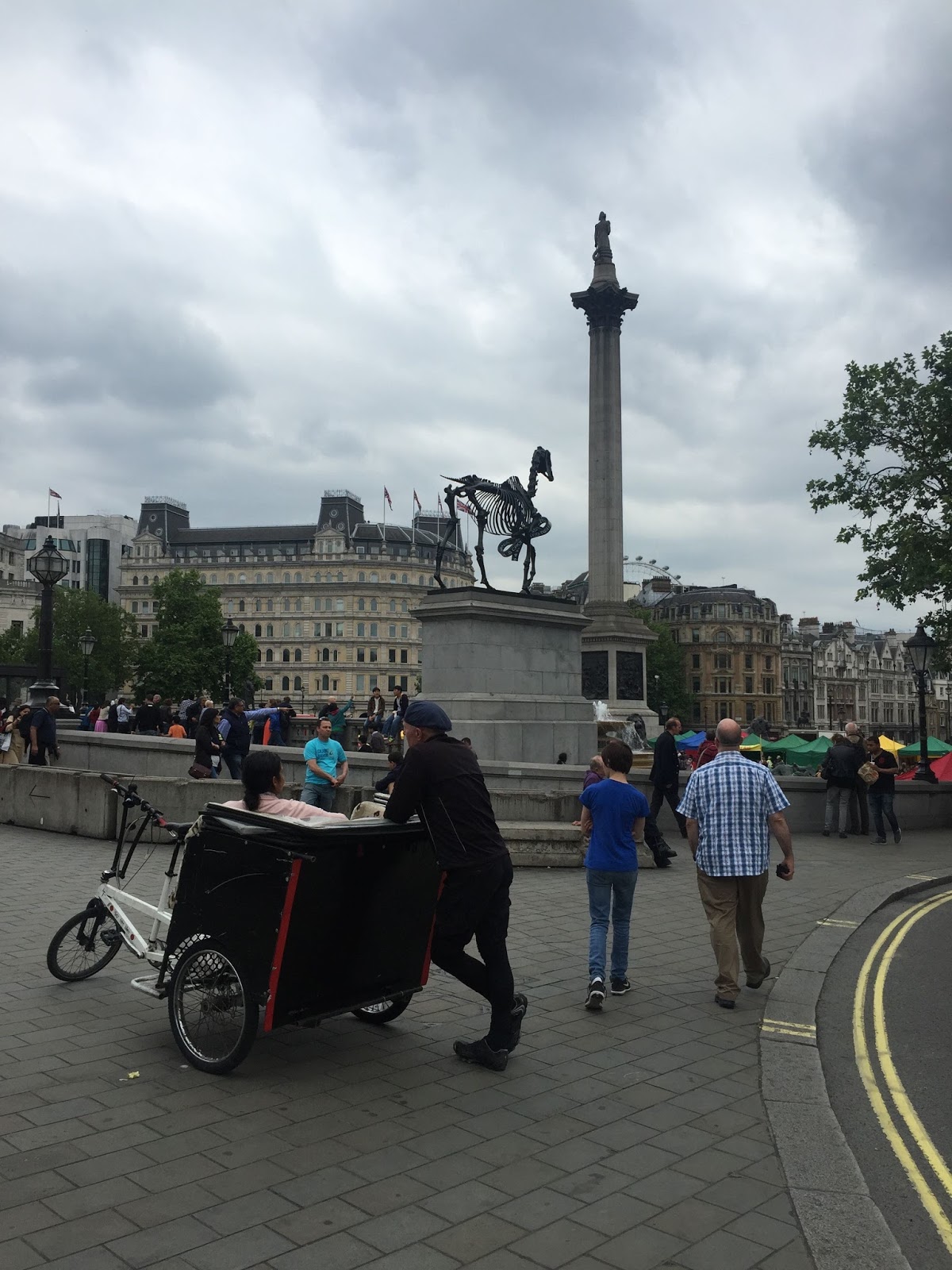
Trafalgar

Wellington

Along the way we visited St Paul’s, where I spent some time in the crypt to pay my respects to Nelson and Wellington at their tombs, but as photography is forbidden in the cathedral, I have no pictures to show for it. Sadly, the same is true of Apsley House, the Great Duke’s impressive London home (my bored daughter’s understatement: “this IS a really fancy house”)…foiling my plans to take a selfie with the outsized and grandiose nude statue of Napoleon contained therein.

I do highly recommend Apsley House for any Regency fan visiting London, incidentally. It’s not one of the Major Big Deal Sights–which means it’s less crowded and you have more time to linger over all the portraits (many of which will look SO familiar to you if you’ve read nonfiction of the era at all), the furnishings, and the general sumptuousness of it all.

But after only a few days in London it was time for Brussels and the Waterloo reenactment. Our entire family loved Brussels. Compared to London and Paris, it has a parochial, small-city feel (despite the whole EU capital thing), and since we didn’t have tremendous expectations for it, almost everything was a pleasant surprise. It’s beautiful, in an echoes-of-antique-grandeur sort of way:
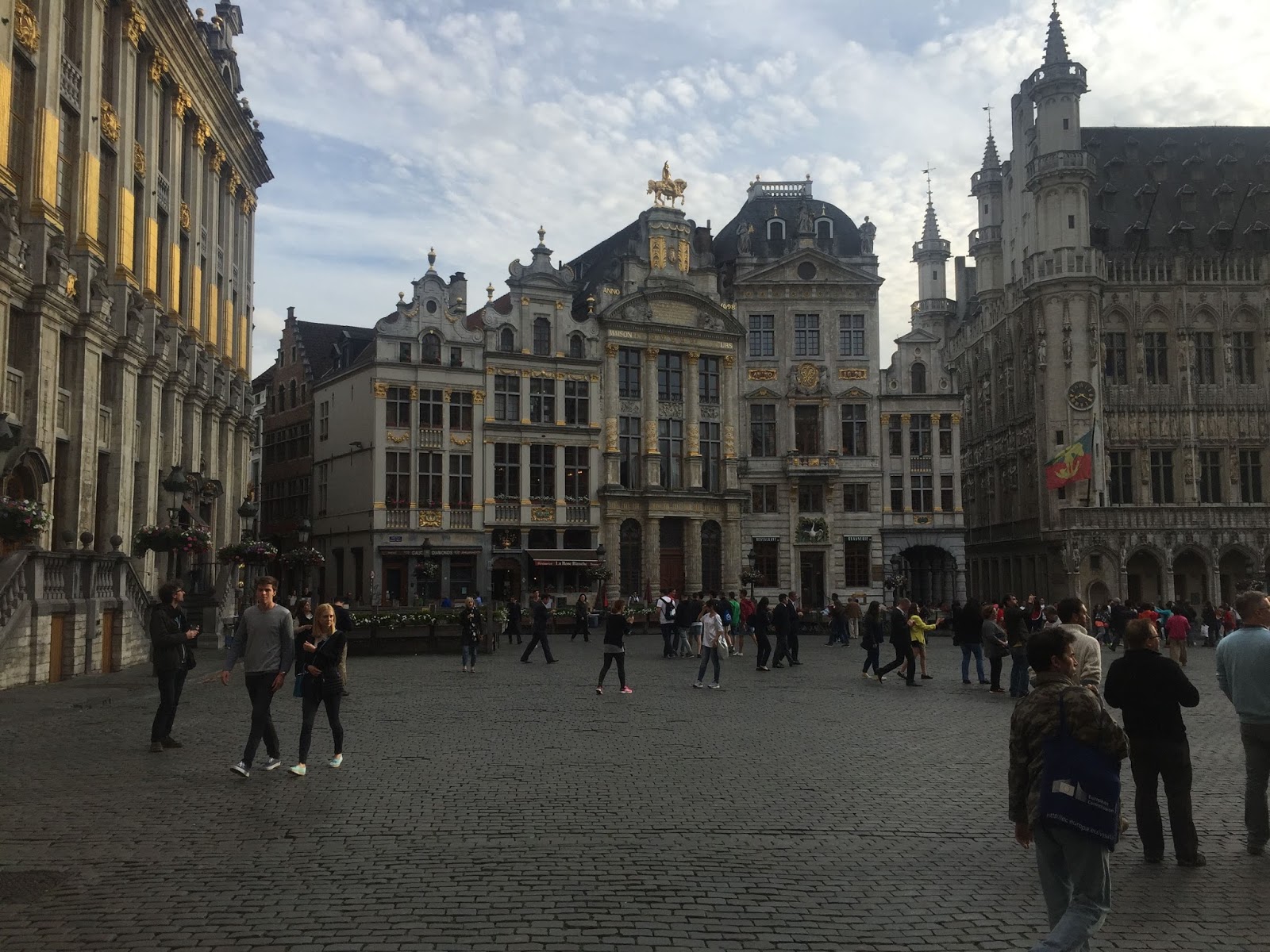
Brussels

And Belgian chocolate? Even better than you’re imagining. AMAZING. When people ask Miss Fraser what was her favorite place in Europe, she always says, “Belgium, because of the chocolate,” and I can’t really argue that point. (That our Brussels hotel had excellent and reliable wifi doubtless raised it in her estimation too.) I also fell in love with the frites, especially the ones in this little storefront place across the square from our hotel with the tourist-trappy name “Belgian Frites.” I wouldn’t have tried it if I hadn’t noticed the long lines of local teenagers my second day there–after which I had frites with mayo as lunch or an afternoon snack four days in a row.

The Waterloo reenactment, however, didn’t quite live up to all my expectations. It might’ve been better if we’d been part of an organized tour with a guide to show us around. As is, it was a bit chaotic and challenging to navigate and understand what was going on.

The actual anniversary of the battle fell on a Thursday, but the organizers held the reenactment on Friday and Saturday evenings. I wanted to have the experience of standing on that ground two hundred years to the day after the battle, so on the 18th we schlepped out to the battlefield by train, bus, and long walk, and visited the Allied reenactor camp.
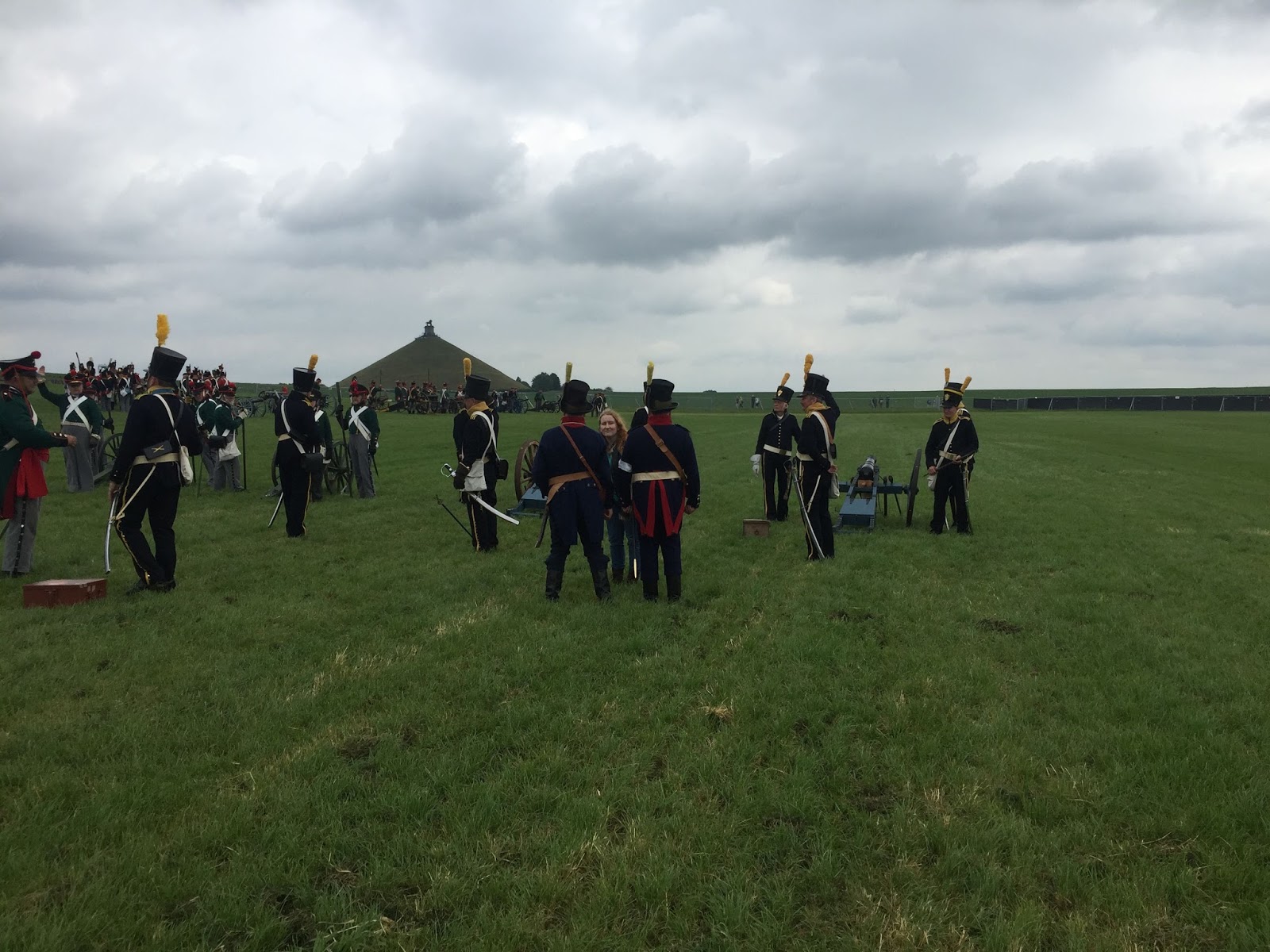
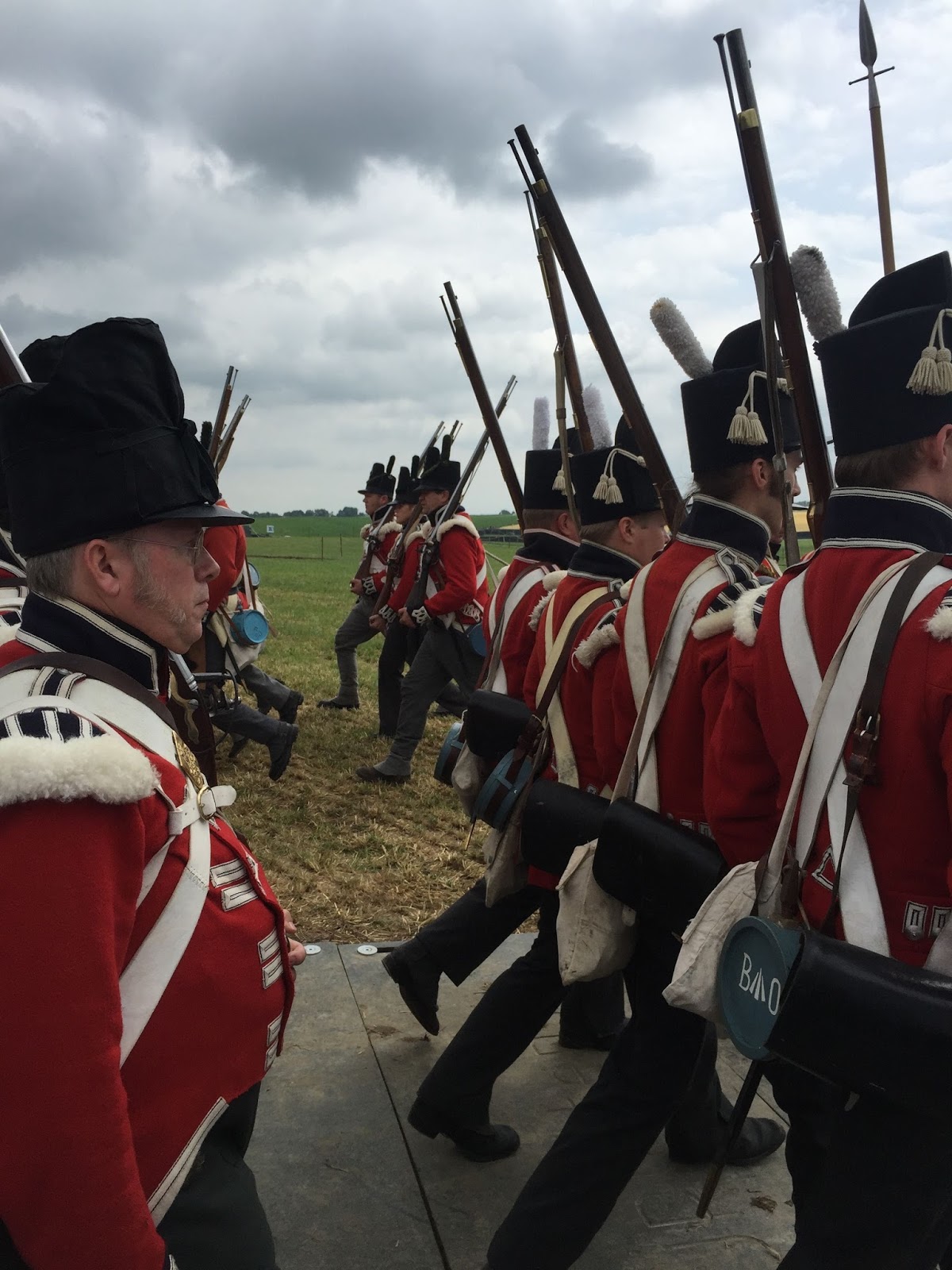
Reenactors

Marching

Rifles

We didn’t get the opportunity to actually hang out with reenactors, somewhat to my disappointment–the handful of times I’ve visited reenactments in the past I’ve gotten to heft the muskets and chat with the people who carry them. Maybe it was just because the Waterloo anniversary was SUCH a big deal, but there wasn’t the same kind of approachability there.

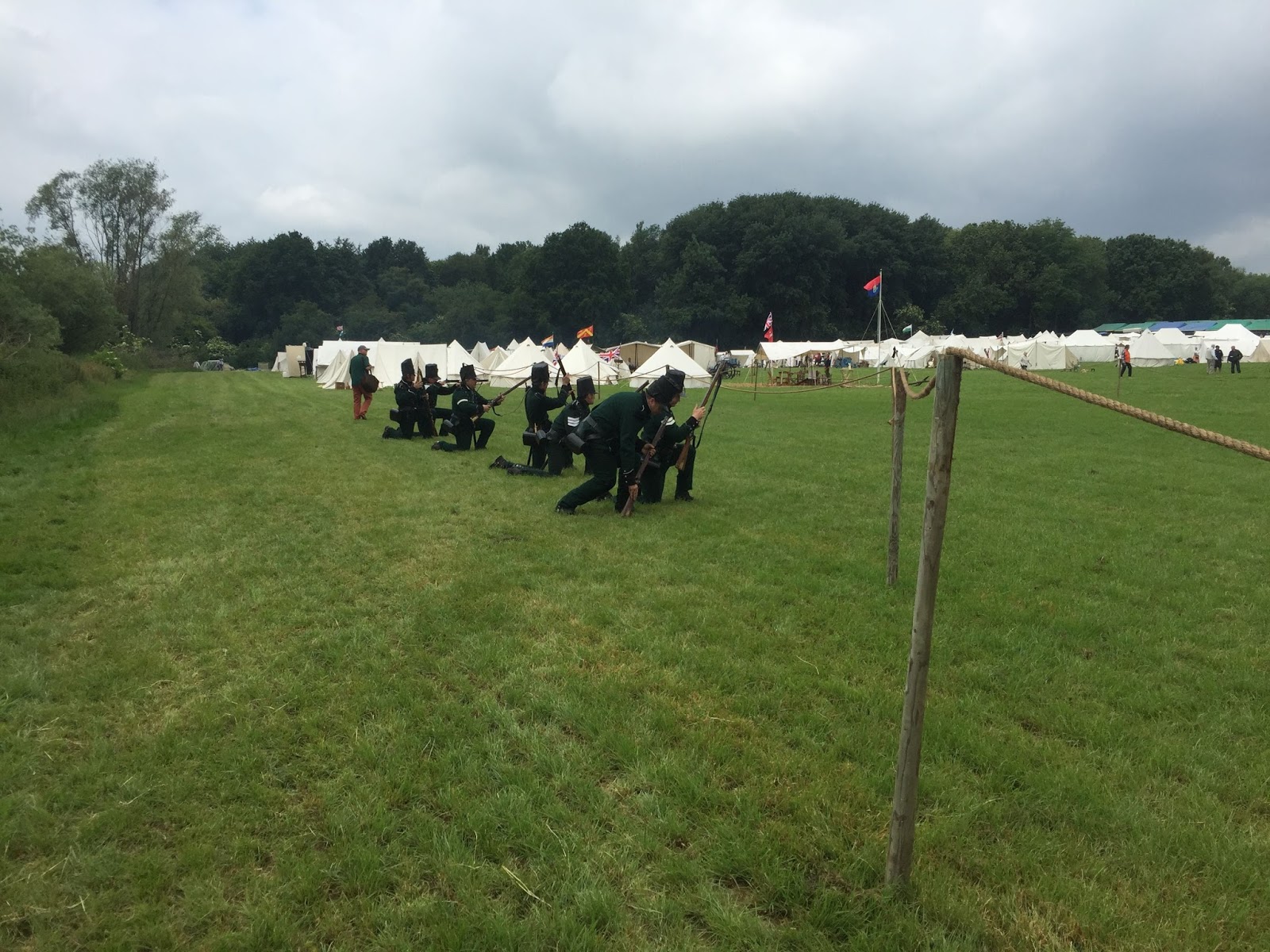
As for the reenactment itself, it was a bit of a challenge to follow the action, even for someone like me who pretty much knows the course of the battle backwards and forwards. That said, it did give a good sense of how very smoky and confusing Napoleonic-era battlefields were:
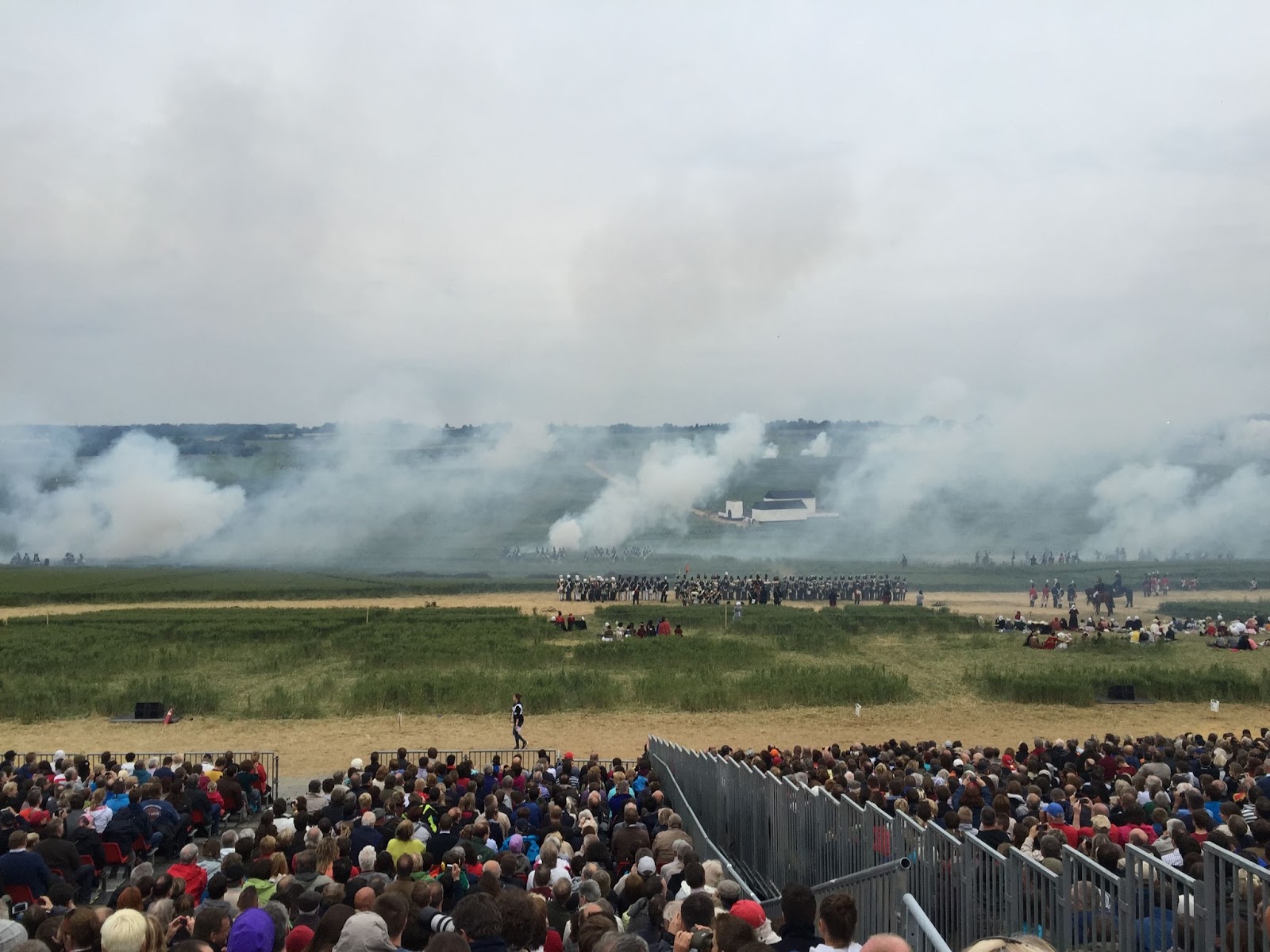
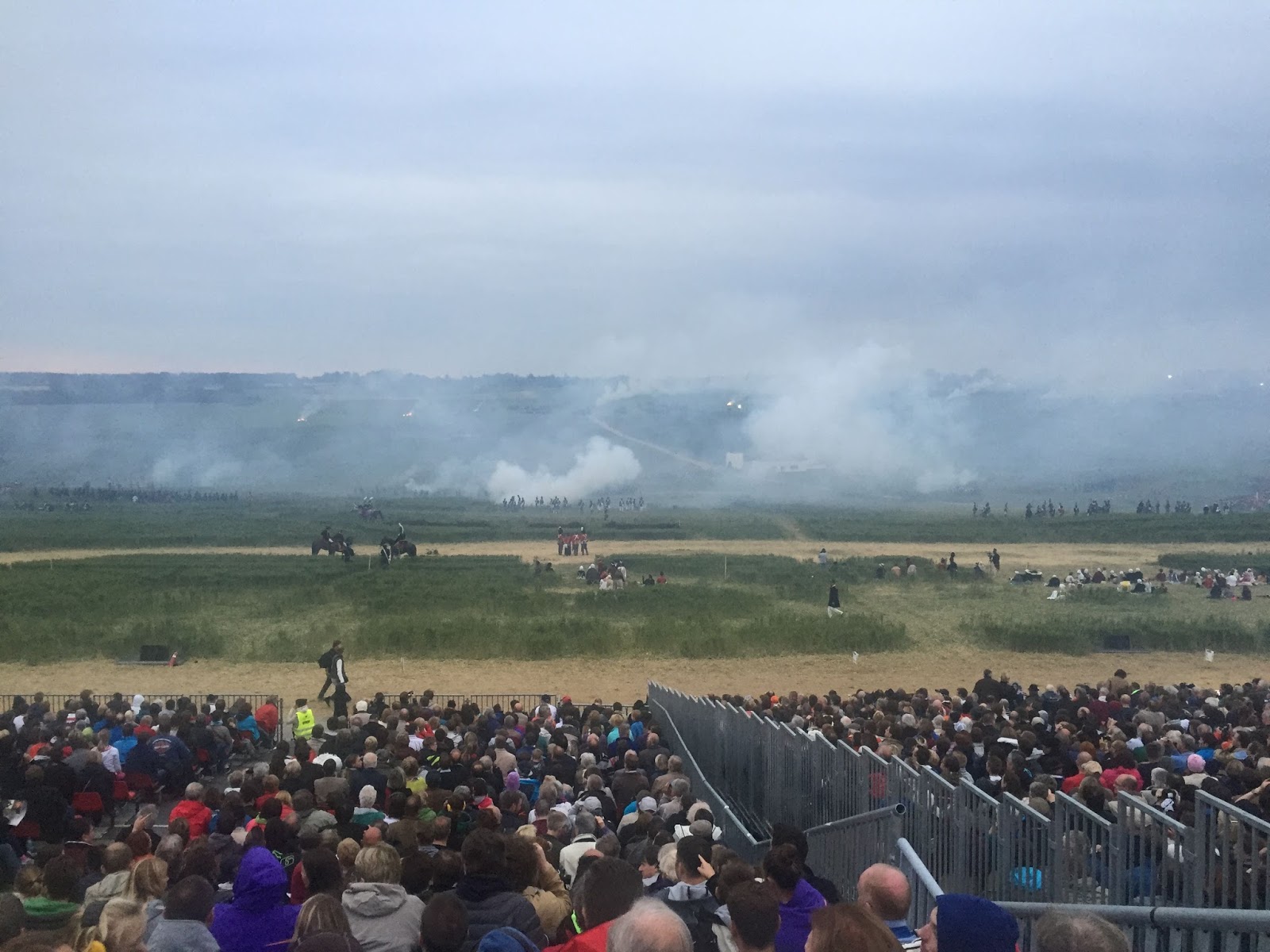
Waterloo1

Waterloo2

And this was just 5000 reenactors out there for three hours or so. When you imagine what it must’ve been like 200 years before, when between the three armies involved there were almost 200,000 men engaged…whoa.

Even though the reenactment wasn’t everything I’d dreamed it would be, I’m glad I went. When I read or write about Waterloo from now on, I’ll have that much clearer a picture in my mind’s eye for having walked some of the ground and seen all those impeccably costumed reenactors. And, let’s face it, if it weren’t for Waterloo, the odds are I never would’ve gone to Belgium, and I would’ve missed out on that chocolate and those frites…

What about you? Have you traveled anywhere exciting this summer? And do you have travel tales of places that either exceeded or failed to live up to your expectations?

Next time I’ll post about our week in Paris (which exactly met our expectations–it really is that amazing). Expect lots of Napoleon…

As I begin the series that has been the subject of the occasional post here on Risky Regencies, I’ve been thinking about my hero and heroine, John and Mimi, and what makes them the unique and intriguing people they are. I’ve got it now but I won’t spoil the fun by talking about it when you can read about them before too long.

In the process of working it out I gave some thought to my past characters and what they have in common.

Anyone who knows me can guess that the key element they all share is “honor at the core of their being.” Though I could argue that Mia in COURTESAN’S KISS was right on the edge of honorable. She was just a bit too manipulative and selfish. Hopefully her loving relationship with her half-sister and her difficult youth made her behavior understandable and acceptable. And, in the end, of course, love conquers all.

At the other extreme of honor at the core has to be Michael Garret, the continuing character (not the hero) in the series I am writing now and the hero of LOVER’S KISS. thDR28GQLZMichael abandoned his religious training and joined the army rather than accept a living that would have made him a puppet. Even as a spy (see TRAITOR’S KISS) he knew the cost of his work and helped his colleagues whenever the need arose, even when it threatened his own safety. He is settled now, responding fully to his call as a vicar (though an unconventional one) and finds great joy in the world around him. (And yes, Michael looks a lot like Liam Neeson.)

But there is one other element that my characters share and it’s what makes them unique in their world. Almost all of them defy the social norm in some way. Michael as an unconventional vicar. Mia, in her extreme, way insisting that she would become a courtesan.

Then there is Lady Olivia, the daughter of a duke, who loves the kitchen, thPBQIXJKAespecially baking. Her brother, Lord David, decides to go into business despite the fact that gentlemen did not. The list goes on and includes either the hero or heroine and sometimes both in my “Kiss series” (Check out my website for titles and details: MaryBlayney.com)

So now what I am wondering is what element your favorite characters share whether you be reader or writer? I bet I know what Diane Gaston will say.

Posted in Regency, Writing | 5 Replies

I’ve been thinking a lot about Gail’s post last week “About Those Dukes”, and also about this this article in the Smithsonian Magazine, “Why Can’t Romance Novels Get Any Love?”

The article talks about Germaine Greer’s “feminist call to arms”, The Female Eunuch (1970) in which:

“Greer was skewering the authors of romance novels, and the readers who made them bestsellers, suggesting they were submitting to nothing short of serfdom to their heaving, rippling fictional heroes: alpha males with giant pectorals, important lives, patriarchal views and very little interest in love…until just the right petite, witty heroine comes along.”

I love the idea that literary scholars like Sarah Frantz Lyons, who started the International Association for the Study of Popular Romance, want romance to get the same attention from scholars as other popular genres such as mystery and science fiction.

“We’ve been talking about this for 30 years: since the 1980s at least, it’s been about empowerment versus oppression. Is this narrative empowering or oppressive to women?” she says. “We need new approaches to romance fiction.”

temptationIt’s the sort of thing Jennifer Crusie has been saying, probably even before this 1998 article “Defeating the Critics: What We Can Do About the Anti-Romance Bias”.

“But romance fiction insists that women be front and center, demonstrating over and over again that women can solve their own problems. Reading that kind of narrative empowers women and therefore attacks the basic assumption of patriarchy.”

I love this statement, and this is part of why I write romance. (I hope Crusie’s smart and sexy books are among those that will be studied.)

I’ve also read romance novels that tapped into fantasies that may or may not work with the idea of women solving their own problems.

I suspect part of the appeal of Duke and billionaire stories is the fantasy of never having to work a boring job or worry about money again. For personal reasons, it’s not a fantasy that appeals to me, but I can understand it. When I’ve been too busy taking care of others to care for myself, I daydream about tropical vacations where all I have to do is snorkel with pretty fish, get massages, and sip umbrella drinks. But I don’t really need a life of luxury. I need to rearrange my life so there’s more time for self-care on a regular basis. I’m working on that, but the vacation fantasies help me get through bad days. Likewise, a woman whose job is unpleasant or unrewarding, or who is struggling to make ends meet, has every right to enjoy an escapist story, even though she may also be actively trying to improve her situation.

I feel the same way about domineering, alpha heroes and “forced seduction” stories. Personally, I find some heroes cross the line from “alpha” to “abuser” and especially if I don’t see a real transformation, the story isn’t going to work for me. It is very, very important to me to see that at least by the end, the hero treats the heroine as a real person and an equal, neither domineering nor putting her on a pedestal. But each reader has the right to decide for herself which stories work for her. Perhaps some women can’t distinguish between the fantasy of being conquered and how healthy relationships work, but that’s no reason that others should not enjoy those books.

I do not care for censorship. What I do believe in is dialogue. Dialogue is good. Criticism is good. I’m thinking about all the conversation about Fifty Shades of Grey. I didn’t participate because I haven’t read it, but from the articles and blogs I skimmed, I could see there were intelligent points made. I believe we should all discuss, criticize, even argue about the books if we want, but judging people personally for their reading choices is just an exercise in ego.

Which gets me back to the academic study of the romance genre. Scholars will likely find many stories featuring strong heroines and the development of healthy relationships.

They’ll also likely read some of those old contemporaries I used to find around the house as a child, where the nurse always marries the doctor and the secretary gets the boss. (And in those old stories there were never any female doctors or bosses.)

purityspassionScholars may also include books like the one in this review on the Smart Bitches/Trashy Books site: Purity’s Passion. A quote, just to give you an idea:

We’re at the midpoint of the book, and let us tot it up: Purity has had consensual sex twice, been raped by six men (two of them multiple times), and nearly raped by a seventh.

So I don’t think a broad study of the romance will lift the genre as a whole to respectability. That’s not important to me. Although some romance novels are complex and beautifully written, not everything needs to be literary. Although I prefer to read and strive to write romances that end in what I think are healthy relationships, I do not deny others the right to read and write what speaks to them.

What I do hope is that the study results in some good discussion. Maybe some of those who haven’t yet tried a romance will do so, at least out of curiosity.

What do you think? Which romance authors or books do you think are most feminist, or most literary? Any favorite guilty pleasures you’d like to share?

Elena


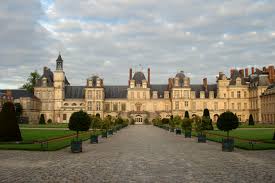
I can’t believe it is Monday already!!  I have a book due on the 15th, and as always on the last week of deadline I am a bit wild-eyed and frantic.  I wasn’t sure what to blog about today except “OMG deadline!” which very boring.  Then I found this post I did for RR way back in 2008, when my book A Sinful Alliance, set at the Greenwich Palace of Henry VIII with a French spy heroine, talking about Greenwich Palace vs. Fontainebleau.  And this WIP is set at–Fontainebleau!  A bit later than Henry VIII, of course, in 1561, with Mary Queen of Scots and Catherine de Medici.  I hope you enjoy another peek at both palaces.  Also–a little look at the cover art concept for “Murder at Fontainebleau”…

Greenwich was originally built in 1433 by Humphrey, Duke of Gloucester, a brother of Henry V. It was a convenient spot for a castle, 5 miles from London and Thames-side, and was popular with subsequent rulers, especially Henry VIII. His father, Henry VII, remodeled the place extensively between 1498-1504 (after dispatching the previous occupant, Dowager Queen Elizabeth, to a convent). The new design was after the trendy “Burgundian” model, with the facade refaced in red Burgundian brick. Though the royal apartments were still in the “donjon” style (i.e. stacked rooms atop rooms), there were no moats or fortifications. It was built around 3 courtyards, with the royal apartments overlooking the river and many fabulous gardens and mazes, fountains and lawns.

The Palace of Greenwich (Placentia)At the east side of the palace lay the chapel; to the west the privy kitchen. Next door was the church of he Observant Friars of St. Francis, built in 1482 and connected to the palace by a gallery. This was the favorite church of Katherine of Aragon, who wanted one day to be buried there (of course, that didn’t turn out quite as she planned…)

Though there are paintings and drawings of the exterior, not much is known of the interior decorations. The Great Hall was said to have roof timbers painted with yellow ochre, and the floors were wood, usually oak (some painted to look like marble). The ceilings were flat, with moulded fretwork and lavish gilding, embellished with badges and heraldic devices (often Katherine’s pomegranates and Henry’s roses). The furniture was probably typical of the era, carved dark wood chairs (often an X-frame design) and tables, benches and trunks. Wool or velvet rugs were on the floors of the royal apartments only, but they could also be found on tables, cupboards, and walls. Elaborate tiered buffets showed off gold and silver plate, and treasures like an gold salt cellar engraved with the initials “K and H” and enameled with red roses.

For the events in my book, the visit of the French delegation, two new structures were built at either end of the tiltyard, a grand banquet house, and a theater where there were masques and concerts.

Many important events of the era took place at Greenwich. Henry VIII was born there on June 28, 1491, and he married Katherine of Aragon there in May 1511. On February 8, 1516 Princess Mary was born there, followed on May 13 by the marriage of the king’s sister Mary, Dowager Queen of France, to Charles Brandon, Duke of Suffolk (a huge source of much gossip!). In 1527 came the French delegation which forms the center of my book. They were received with much pomp “and entertained after a more sumptuous manner than has ever been seen before” (according to one courtier). On September 7, 1533, Princess Elizabeth was also born there, followed nearly 3 years later by the arrest of her mother Anne Boleyn after a tournament. One of the last great events Greenwich saw in Henry’s reign was the wedding to Anne of Cleves in 1540.

It was a royal residence through the reign of Charles I (1625-49), but under the Commonwealth the state apartments were made into stables, and the palace decayed. In 1662, Charles II demolished most of the remains and built a new palace on the site (this later became the Royal Naval College), and landscaped Greenwich Park. The Tudor Great Hall survived until 1866, and the chapel (used for storage) until the late 19th century. Apart from the undercroft (built by James I in 1606) and one of Henry VIII’s reservoir buildings of 1515, nothing of the original survives.

Fon1Fontainebleau, on the other hand, can be seen in much the state Francois I left it in. On February 24, 1525 there was the battle of Pavia, the worst French defeat since Agincourt. Many nobles were dead, and king was the prisoner of the Holy Roman Emperor in Madrid. He was released in May, but only at the price of exchanging his sons (Dauphin Francois and Henri, duc d’Orleans) for his own freedom. In May 1526, Francois created the League of Cognac with Venice, Florence, the Papacy, the Sforzas of Milan, and Henry VIII to “ensure the security of Christendom and the establishment of a true and lasting peace.” (Ha!!) This led to the visit of the delegation in 1527, seeking a treaty of alliance with England and the betrothal of Princess Mary and the duc d’Orleans.

After his return from Madrid, Francois was not idle. Aside from plotting alliances, he started decorating. Having finished Chambord, he turned to Fontainebleau, which he loved for its 17,000 hectares of fine hunting land. All that remained of the original 12th century castle was a single tower. Francois built new ballrooms, galleries, and a chapel, and called in Italian artists like Fiorentino, Primaticcio, and Vignola to decorate them in lavish style (some of their work can still be seen in the frescoes of the Gallery of Francois I and the bedchamber of the king’s mistress the duchesse d’Etampes). The marble halls were filled with artworks, gold and silver ornaments, and fine tapestries. Unlike Greenwich, this palace was high and light, filled with sunlight that sparkled on the giltwork.

A few sources I used a lot with this book are:
Tournaments: Jousts, Chivalry, and Pageants in the Middle Ages, Richard Barber
Excavations of Greenwich Palace, 1970-1971, PW Dixon
Tudor Food and Pastimes, FG Emmison
The Six Wives of Henry VIII, Antonia Fraser (there are LOTS of books on this subject, of course, but Fraser’s is great!)
Prince of the Renaissance: The Life of Francis I, Desmond Seward
Food and Feast in Tudor England, Alison Sim (yes, I do like researching food!)
The Royal Palaces of Tudor England: Architecture and Court Life, 1460-1547, Simon Thurley
Henry VIII: The King and His Court, Alison Weir (full of wonderful info!)
Henry VIII and His Court, Neville Williams

MurderFontainbleau2

Posted in Research | 3 Replies

I’m a bit late with my post today as I spent the day at the Rhine with friends. And since I’ve already written about 19th-century travels on the Rhine, I thought it might be nice to share pictures of our day trip and add to them some descriptions from guidebooks from the 19th and early 20th centuries.

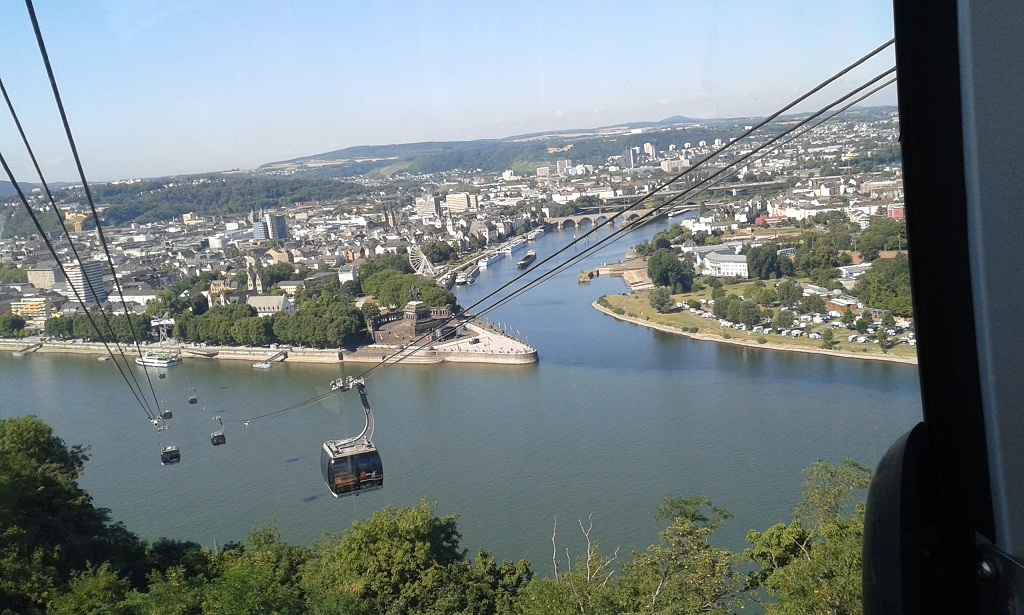
Koblenz with the "German Corner," where the rivers Rhine and Mosel meet

View of Koblenz with the “German Corner,” where the rivers Rhine and Mosel meet

We visited Koblenz, which Murray’s Handbook for Travellers on the Continent: Northern Germany of 1845 describes thus:

“Coblenz is a strongly fortified town on the left bank of the Rhine, and right of the Mosel. It received from the Romans the name Confluentes, modernised into Coblenz, from its situation at the confluence of these 2 rivers. It is the capital of the Rhenish provinces of Prussia, and its population, together with that of Ehrenbreitstein, including the garrison, is about 25,000.”

Ehrenbreitstein

Ehrenbreitstein

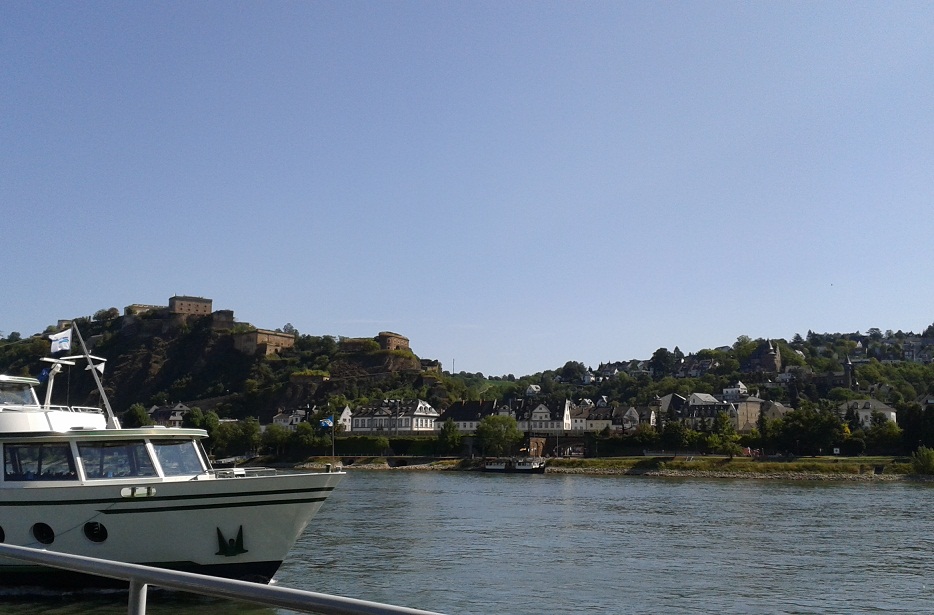
Right across the Rhine from Koblenz lies the Ehrenbreitstein. Murray’s tells us the following about the fortress:

“Ehrenbreitstein (honour’s broad stone), the Gibraltar of the Rhine, connected with Coblenz by a bridge of boats. In order to enter it, it is necessary to have permission from the military commandant residing in Coblenz, which a valet-de-place will easily procure, on merely presenting the passport, or a card with the name of the applicant upon it.”

The garrison was destroyed by the French in 1801, but was rebuilt by the Prussians between 1817-1828 and, together with Koblenz on the other side of the river, was meant to protect the Middle Rhine.

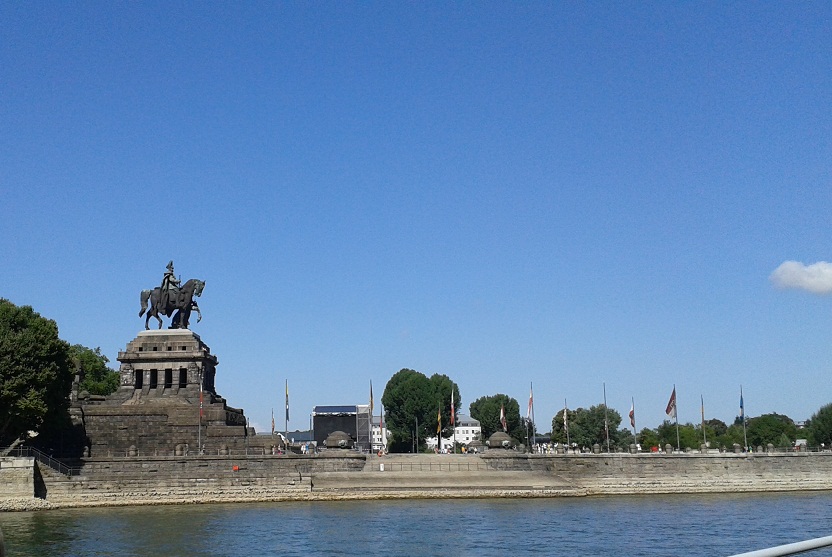
Deutsches Eck

Deutsches Eck

One of the most famous sights of Koblenz is the so-called German Corner (Deutsches Eck), where the river Mosel meets the Rhine. After Kaiser Wilhelm’s death in 1888, a colossal equestrian statue was erected here in commemorate the Kaiser who had brought about the German unification of 1871. The statue was finished in 1897.

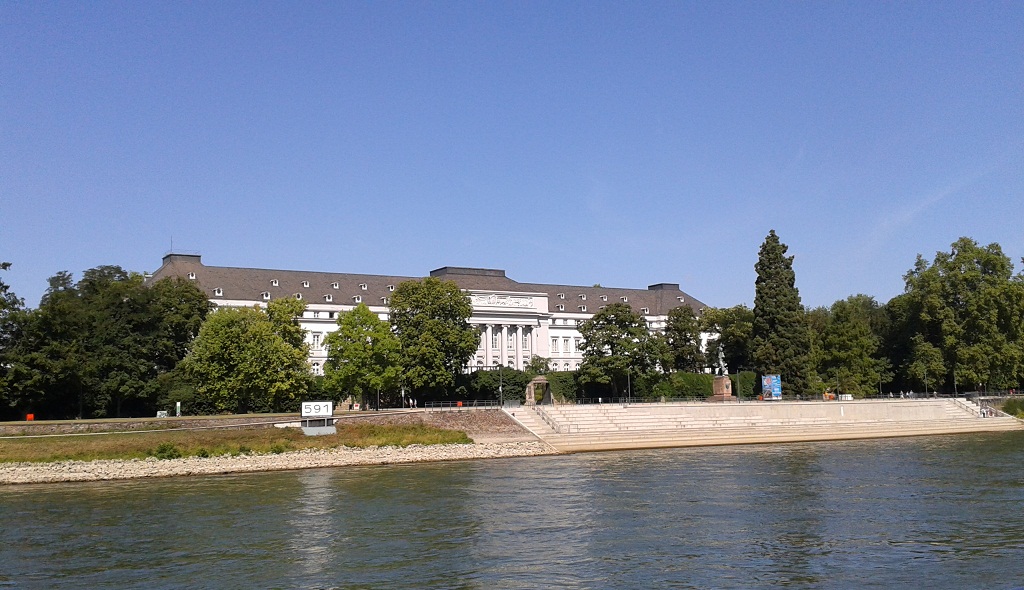
Electoral Palace, Koblenz

Electoral Palace

Bradshaw’s Continental Railway Guide from 1913 has the following to say about other sights of Koblenz:

“The beautiful Rhein Anlagen (gardens and promenade) extends along the river front a little south of the boat bridge. Above and behind the Anlagen is the Schloss [i.e., the Electoral Palace], formerly a favourite residence of the German Imperial family; the royal apartments may be seen.”

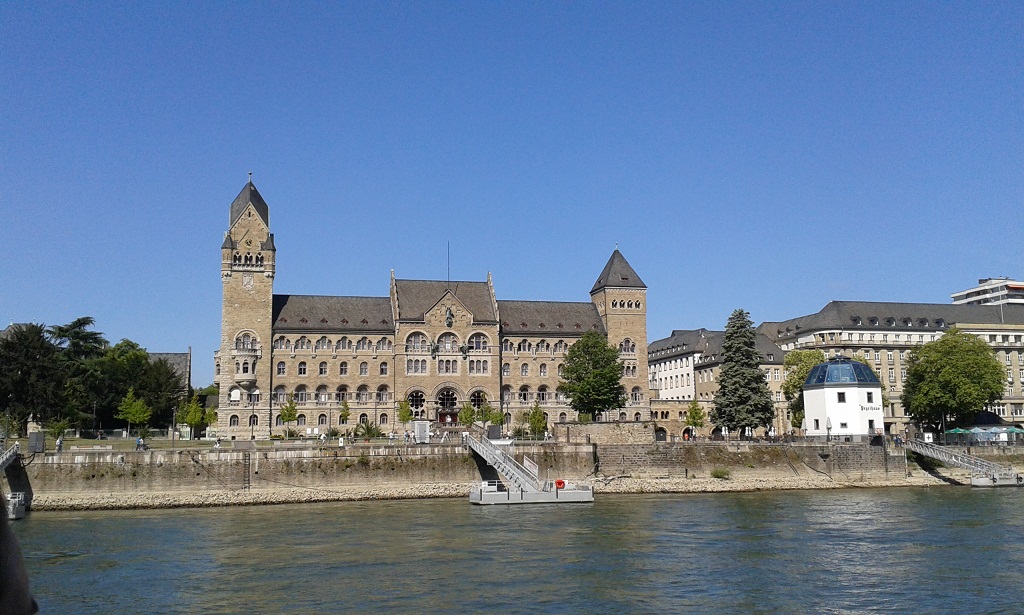
Prussian government building and Koblenzer Hof

Government Palace and the hotel Koblenzer Hof

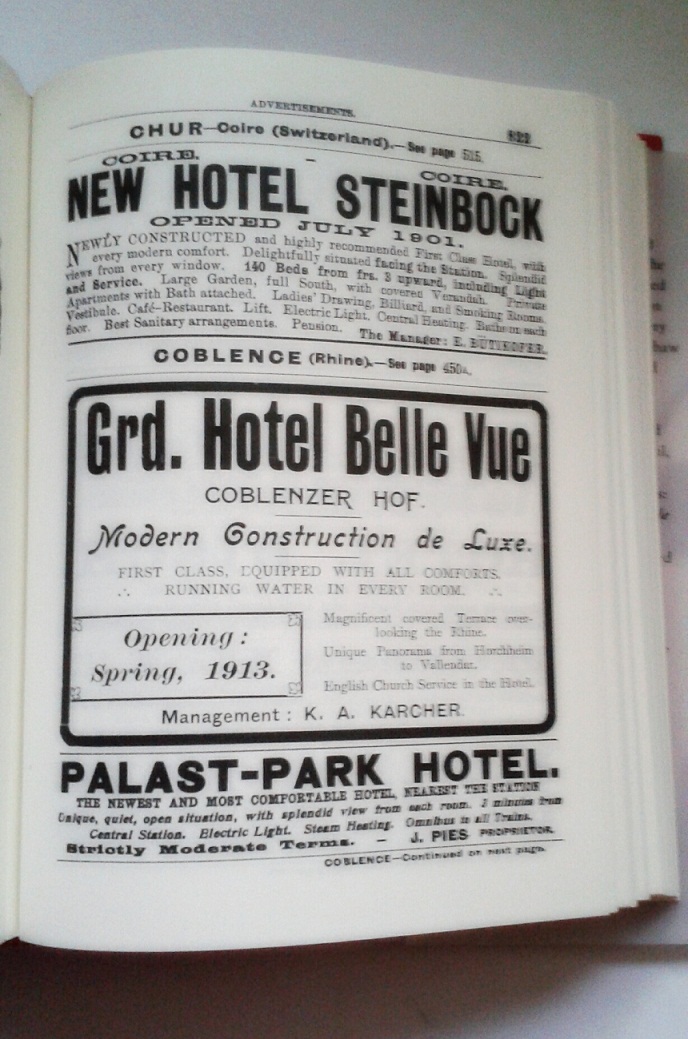
Bradshaw’s also mentions “the imposing Regierungspalast (Government office) with square peaked towers” as well as the “[n]ew first class hotel” right next to it, the Grand Hotel Belle Vue – Coblenzer Hof, which had just opened in spring 1913. The ad in the guidebook proudly points out that there’s “running water in every room.” 🙂

ad for Coblenzer Hof in 1913 guidebook

Ad from Bradshaw’s Continental Railway Guide (1913)

But not just the buildings along the Rhine are particularly nice, you can also find beautiful buildings when you walk through the town itself.

pretty houses in Koblenz

Pretty houses in Koblenz

And oodles of churches like the Liebfrauenkirche, which is dedicated to Mary.

Liebfrauenkirche, Koblenz

Liebfrauenkirche, Koblenz

As you can see I had a truly wonderful day! 🙂 And I also had something to celebrate, namely the re-launch of my debut novel, The Lily Brand, which was published ten years ago by Dorchester. Here’s the blurb & the pretty new cover. Until the end of this week, you can still snatch it up for the launch price of $2.99.

Troy Sacheverell, fifth earl of Ravenhurst, was captured in France. He’d gone to fight Napoleon, but what he found was much more sinister. Dragged from prison to an old French manor on the outskirts of civilization, he was purchased by a rich and twisted widow. And more dangerous still was the young woman who claimed him.

Lillian had not chosen to live with Camille, her stepmother, but nobody escaped the Black Widow’s web. And on her nineteenth birthday, Lillian became Camille’s heir. Her gift was a plaything: a man to end her naiveté, a man perfect in all ways but his stolen freedom. Yet even as Lillian did as she was told, marked that beautiful flesh and branded it with the flower of her name, all she desired was escape. In another place, in another world, she’d desired love. Now, looking into burning blue eyes, she knew there was no place to run. No matter if should she flee, no matter where she might go, she and this man were prisoners of passion, inextricably linked by the lily brand.

And while her heart remained locked in ice, his burnt with hate. Would they ever find true happiness?

Get it on Amazon or Kobo

cover of Sandra Schwab's The Lily Brand

Posted in Places | Tagged , | 2 Replies
Follow
Get every new post delivered to your inbox
Join millions of other followers
Powered By WPFruits.com