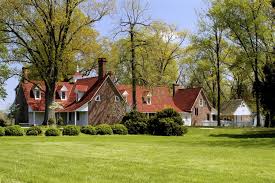
 I went on a field trip yesterday with a bunch of museum/history geeks to Sotterley Plantation, in Hollywood. (No, not that Hollywood. The one in Maryland.) It’s on the Patuxent River and is the only tidewater plantation open to the public, and is over four hundred years old.
Did I mention how old it is? I did. The land was first colonized by James Bowles in 1699, who built a modest two room a few 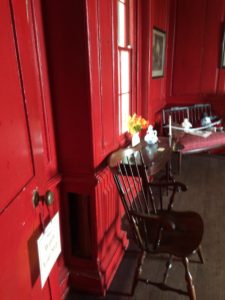 years after, which forms the core of the house. It’s possible to date it so accurately because dendochronology has determined that the cypress posts used in construction date to 1703. This extremely red room, apparently a highly popular color in the period, is the oldest part of the house. There’s a dark rectangle to the right of the notice on the door which is actually a hole cut in the woodwork to reveal the original cypress post.
 Naturally subsequent owners began to make expansions and improvements, and suddenly, later in the century, Chinoiserie became all the rage. Hence this extraordinary staircase in the expansion of the house undertaken by George Plater III (lots of Georges in this family). He also became a governor of the State of Maryland, and, eew, I cannot get this out of my head: he married a 13 year old who had their first baby when she was 14, and who became, according to the Sotterly website, “a political and social asset to her husband.” Gawd.
 A pretty yellow parlor was added in this period and the shell alcoves in the room are original (built with help from Mt. Vernon’s slaves).
Note the picture over the mantelpiece. This is an amazing bit of Colonial Revival kitsch. Colonial Revival was a big hit in the second half of the nineteenth century. There was a sudden burst of interest in the noble patriots of the revolution, gentlemen and landowners (and that meant slave owners. Mr. Bowles bought over 200 slaves when he arrived in 1799, and so it continued). Given Maryland’s geographical location, the division during the Civil War, and the reluctance of the state to free its slaves, the colonial period seemed a lot safer. The Colonial Revival movement presented an imaginary version of the good old days, in terms not only of interior design and decoration, but also in interpreting uncomfortable history. So a late 19th century artist was moved to paint this (pardon my assymetry):
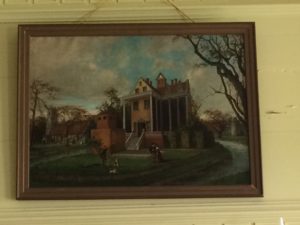
Wow. Is it Tara? Is it … well goodness only knows, but the artist had apparently never visited this house in Suffolk, Sotterley Hall, which it’s meant to depict:

The Platers believed they were descended from a Thomas Playter who owned Sotterley Hall in the fifteenth century (they weren’t), hence the name of the plantation.
And here’s a pic of a view from the gardens of the house, looking out over the Patuxent:

Are you planning to visit any historical sites, or have you been to any recently? Plans for the summer?