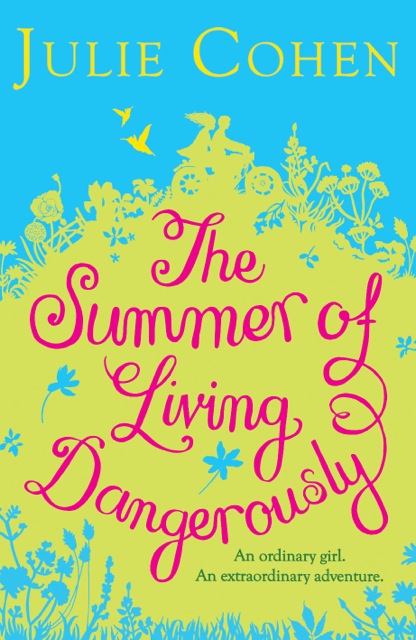
 Julie Cohen is a multi-pubbed author who writes humorous, emotional, smart contemporaries. I know her because she is the best friend of one of my critique partners here in the US but lives in my home town in England (weird, huh?). She gave me a copy of The Summer of Living Dangerously when I visited England last month and I read and enjoyed it on the flight home. I am proud to be mentioned in the acknowledgments for my expert knicker advice.
Alice Woodstock has been running away.
Well, not literally. She spends most of her time glued to her desk, writing about grommets and model aeroplanes. No, Alice is avoiding the real world because there’s something—someone—in her past that she’s desperate to forget. So when she’s commissioned to write about life in stately home Eversley Hall, she jumps at the chance to escape into Regency England, even if it does mean swapping her comfy T-shirt for an itchy corset. Perhaps she’ll meet her own Mr Darcy…
But when her past resurfaces in the shape of Leo Allingham, Alice is brought down to earth with a bump. Reckless, unpredictable Leo reminds Alice of the painful price of following her heart. And the new Alice doesn’t live dangerously.
Or does she?
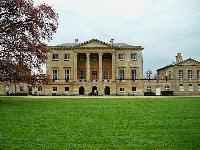 Tell us about the settings you used for the book. My heroine works at Eversley Hall. I based it quite heavily on my local stately home, Basildon Park, a Palladian mansion built in the late 18th century by John Carr for the nabob Sir John Sykes. It was used as Netherfield Hall in the 2005 film of Pride and Prejudice, though even without the film it has literary and romantic connections; Disraeli had an affair with Henrietta Sykes, the wife of the grandson of the original owner, and he based his novel Henrietta Temple on his relationship with her.
I blatantly stole the floor plan and the decorating scheme, though I added a fountain and several oil paintings and I made the house even larger and grander than it is in real life. In the book, everything has meticulously been restored to how it was in 1814, including the paint colours and the furniture polish.
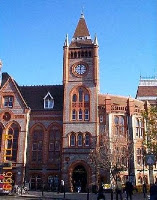 The other setting for the story is Brickham, which is a fictional name for Reading, where I live. Thomas Hardy called it ‘Aldbrickham’ in his novels, so I nicked part of the name, but it’s appropriate because Reading is, at its heart, a Victorian town built of bricks that were produced here. My heroine lives in a Victorian neo-gothic house that has been modernised. Brickham is all about commerce and modern values, whereas Eversley Hall represents the romantic past. I really wanted the settings to be a mixture of old and new, history and present.
(I thought so! Reading is where Jane Austen went to jail and Oscar Wilde went to school, or possibly the other way round.) What research did you do? It was interesting doing research. Because my heroine is part of a project re-creating life in 1814, it was less important to know what life was really like in 1814 than to know how a woman in 2012 would react to and learn about life in 1814. Therefore, I spoke to quite a few historical re-enactors. I was interested in why they chose that hobby or profession, and how they acted and were treated differently when they were in costume. I spoke to costume experts, too, although I was as interested in how modern people perceived the costume, as in what the authentic costumes were like.
The whole underwear issue was interesting; we take underpants for granted, and yet there seems to be no surviving evidence that the lower classes wore them in 1814. Of course, why would there be evidence? A housemaid wasn’t going to write a letter about her knickers. So some people think they wore them, and some people don’t, and I was left to make my own mind up for my book. A historical character wouldn’t mention such things, but my modern heroine certainly would. I also learned how to do several Regency dances, and went to a Regency ball. It was huge fun.
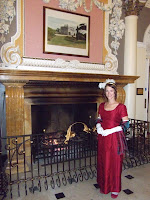 What did you find out about the Regency that surprised you? It really is difficult doing the Duke of Kent’s Waltz whilst wearing an ostrich plume in your hair if your partner, however charming, is shorter than five foot eight. I was also quite surprised to learn that an authentic short-sleeved Regency gown, whilst looking quite comfortable, is constructed so that the sleeves are rather tight. You can get bruises from over-vigorous arm movements.
Did you find it difficult switching gears between the contemporary and historical sections of the book? Not really. I soaked myself in Georgette Heyer before I started writing and so whenever I had to write an 1814 section, I relaxed into a fond approximation of her dialogue style. It was a treat to try to impersonate her witty repartee. It’s a first-person novel, so I was always in my heroine’s head, and although she’s a keen reader she really is a modern woman, so I didn’t have to change gear completely. I enjoyed it a lot.
Your books are fairly light in tone but also tackle some serious, painful issues. How do you maintain the balance? For most of my characters, humour is a defense mechanism. My heroine and hero in Summer have gone through a tragedy, and that influences everything they do. The whole Regency re-enactment thing is a charade for Alice, who is trying to escape her own real past. In general everything in the pretend-1814 is light, but a lot of the real-life scenes have a darker undertone. But bits and pieces encroach into Alice’s fantasy Regency life. Her 1814 character is in mourning, for example, whereas the real Alice is trying to ignore her own grief. And there’s a scene where the 1814 characters are celebrating Napoleon’s defeat, until a rude guest reminds them that Napoleon came back from Elba and that the war continued. So every scene has its light and its dark.
What’s your writing process? I’m not naturally a planner. I usually write the first 20,000 words or so and then I delete them. Then I start over and write a first draft straight through from beginning to end, trying to write at least 1000 words a day, discovering the plot as I go. At some point, about 2/3 of the way through, I do stop and plan the ending, but much of it is a discovery draft for me. This draft is largely utter rubbish; I don’t stop to edit and if I don’t know something I just put ‘XXX fill in later’ and carry on.
A lot of my novel gets put together in the revisions, which I do quite carefully and analytically and in several stages. That’s usually when I slot in the details from my research, too.
I love that characters from earlier books made cameo appearances here. Are we likely to meet the h/h of this book anywhere else? I don’t tend to repeat main characters; it’s the secondaries who keep on cropping up—I suppose because I haven’t resolved their stories yet, whereas the main characters have found their ending. There’s one character in Summer who was in two of my earlier novels, and I love how he’s evolving, albeit very very slowly in bit parts.
Has the book inspired you to become a docent at a historical house yourself? I would love that! But with a small child and a full-time writing career, I don’t have the time. I spoke with many National Trust volunteers when I did my research at Basildon Park, and they were so enthusiastic and knowledgeable that I could picture myself having a go sometime in the future.
What’s up next for you? I’m working on my next novel, a contemporary women’s fiction that will be out in 2013. And on a completely different tack, I’m putting the final touches on an erotic science fiction romantic comedy novella which will be out this spring under my pen name, Electra Shepherd.
Thanks for having me, Riskies!
Enter a comment to win a signed copy of The Summer of Living Dangerously. We’ll pick and announce a winner on Monday evening. Julie’s question of the day is:
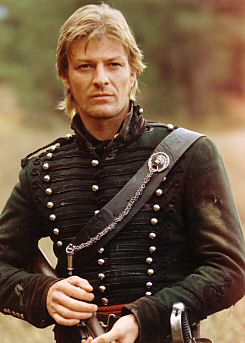
What modern man would you most like to see in tight Regency breeches?

 Dreadfully Important Survey here. Much more important than that census nonsense. The fate of the world hangs in the balance.