Back to Top

I’m always interested in hearing what verbal pet peeves people have. (I’m alliterative today, I see! Please pardon my prankish prose.)

Some people don’t approve of a sentence like “Hopefully it will rain today” — they think that “hopefully” should stop being naughty and start behaving like a regular adverb. I think it’s fine and dandy, and this construction is extremely useful.

Some people don’t like splitting infinitives. I think such reservations are ridiculous, and were introduced into English at a very late date anyway, so don’t even have the weight of tradition behind them.

But just when I start to think I’m a language “liberal”, believing (as I do, for the most part) that language change is normal and healthy, and there is no “right” way to talk (or write), I come face to face with my, er, tastes. Tastes? Perhaps I should be honest and call them prejudices. There are just some words, spellings, phrases, and grammatical errors that drive me bonkers. So I will share some of my pet peeves here, and please share yours too! And if you want, do go ahead and tell me my pet peeves are ridiculous.

WORDS, SPELLINGS, AND PHRASES I UTTERLY LOATHE:

alot
alright
bobbed wire (or bobwire)
congradulations
could care less (for couldn’t care less, unless used sarcastically)
decimate (for exterminate — decimate means killing ten percent)
infer (when imply is meant)
lay (used for lie)
literally (when used as merely an intensifier; e.g. “Paris Hilton is literally American royalty”)
more unique, most unique

WORDS, USAGES, AND PHRASES THAT I KNOW ARE ACCEPTABLE NOW, BUT WHICH I HATE ANYWAY, AND AM WILLING TO JOIN THE ARMY OF RESISTANCE AGAINST:

comprise (in the modern American sense)
livid (meaning either red or angry)

Well, that’s all I can think of at the moment. What are your pet peeves? Do any of my pet peeves strike you as small-minded? Please share!

Cara
Cara King, www.caraking.com
MY LADY GAMESTER — out now from Signet!!!!
Posted in Reading, Writing | Tagged | 19 Replies


I’m celebrating St. Patrick’s Day a bit late–like today. I feel the same way about it as I do Valentine’s Day. Much of it very tacky. I am not into green food coloring in my beer, will take the genuine Guinness instead, thank you very much. Also, my own heritage is Lithuanian (more people who drink a lot and sing sad songs), so I don’t particularly feel the need to BE Irish for a day.

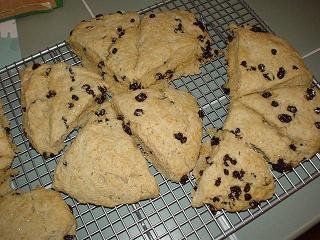
But there are some things I enjoy around this time. Celtic music: I put on my CDs of Loreena McKennitt, the Boys of the Lough, and others. Later today I’m going to a Celtic Songfest by the Binghamton Madrigal Choir. Meanwhile, my husband is going to make corned beef and cabbage. And I’m baking scones.

Here’s the recipe I used last year, and it worked well. Hope they turn out as well this time!

IRISH SCONES

3 cups white flour
1/2 tsp baking soda
2 tsp cream of tartar
1/2 cup butter, softened
2 TBSP sugar
3/4 cup milk
1 cup raisins and/or other dried fruit
1 egg

1. Preheat oven to 400 deg. Lightly butter two large cookie sheets.
2. In a large bowl, sift together flour, baking soda, cream of tartar and sugar. Add butter and mix well.
3. Stir in milk. (Dough is heavy.)
4. Mix in raisins (use hands if necessary).
5. Press dough on a floured surface and roll out gently to 1/2 inch thickness. Cut scones into round shapes or triangles.
6. Beat the egg, brush scones with egg wash for shine.
7. Bake 15-20 minutes or until golden brown.

Elena
LADY DEARING’S MASQUERADE
http://www.elenagreene.com/


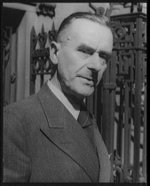
A writer is a person for whom writing is more difficult than it is for other people.Thomas Mann, German writer (1875 – 1955)

I can’t do this. I can. No, I really can’t. This is terrible. Why am I wasting my time? Why can’t I be as good as [insert fantastic author here].

Yeah, welcome to the inside of my head. I’ve been working on a second Regency-set historical, and it is about 2/3rds of the way done. But–and this is a big but–I’m not sure if it’s good. I’ve got a lot of ends to tie up, some to undo in the first place still, and I worry I’m just writing loads of words where nothing happens.

My case is not unusual. In fact, I doubt if there are any authors out there who haven’t had the same derisive little voices lodged inside their heads (well, all except Barbara Cartland, who apparently thought she was all that and a side of fries). So–given that giving up is not an option, how do we rise above (which, of course, reminds me of hardcore band Black Flag‘s song “Rise Above,” which is an anthemic triumph. But I digress–a natural problem when one is beset by insecurities.

A scrupulous writer, in every sentence that he writes, will ask himself at least four questions, thus: 1. What am I trying to say? 2. What words will express it? 3. What image or idiom will make it clearer? 4. Is this image fresh enough to have an effect?
George Orwell, “Politics and the English Language”, 1946, English essayist, novelist, & satirist (1903 – 1950)

Last week, I printed my whole manuscript out and read it over with a pen and some post-its in hand. I edited, wrote down themes and plot points I needed to bring in and/or flesh out, and this week I’ve been incorporating the smaller edits and am getting prepared to dive in for the bigger stuff. But what if it still stinks?

Keep writing. Keep doing it and doing it. Even in the moments when it’s so hurtful to think about writing.Heather Armstrong, Keynote Speech, SXSW 2006

My mind has been chasing itself in circles, nutty dog style. Can I assemble a plotting group? Should I revisit the synopsis and try to nail down my story? Do I just plunge back in and start writing again and see where the story takes me (“. . . to Stinkyville,” my mind answers. Shut up, mind!).

You must keep sending work out; you must never let a manuscript do nothing but eat its head off in a drawer. You send that work out again and again, while you’re working on another one. If you have talent, you will receive some measure of success – but only if you persist.
Isaac Asimov, US science fiction novelist & scholar (1920 – 1992)

Stay tuned. I guess if I were secure, I’d be content with my stinky story, and wonder why my readers (if, indeed, this manuscript reaches the point of publication) didn’t like it as much as I did.

We do not write because we want to; we write because we have to.
W. Somerset Maugham, English dramatist & novelist (1874 – 1965)

And now–back to the work-in-progress.

Megan

www.meganframpton.com

Posted in Writing | Tagged | 7 Replies

As I mentioned in my last post here, I’m working on a road romance that opens in the immediate aftermath of the Battle of New Orleans. Since my heroine is a third or fourth generation New Orleans native, I’ve been reading up on the early history of the city to get a feel for her world and how it shaped her.

By sheer luck I stumbled across a book called The Accidental City: Improvising New Orleans, by Lawrence N. Powell. It covers the history of the city from its founding through the Battle of New Orleans, and it’s full of lovely footnotes I’m mining for more detailed sources of what life was like when the Crescent City looked something like this:

New Orleans 1803

To my vast surprise, I discovered that the demography and culture of 19th century New Orleans were impacted, and significantly so, by a part of history I know much better–the Peninsular War. You see, much of the Francophone population of 19th century New Orleans did not in fact descend from the original settlers, but from refugees from the Haitian Revolution in 1804. At first the refugees went to Cuba and were accepted there, since France and Spain were then allies. But when Napoleon invaded Spain in 1808 and put his brother Joseph on the throne, the French were no longer welcome in a Spanish possession like Cuba…so they fled to New Orleans, which had been in neutral American hands since 1803.

Who knows what other unexpected connections I’ll discover as I continue to explore New Orleans, the Natchez Trace, and the rest of 1815 America? Right now I’m just hoping to find a Louisiana cookbook from sometime close to my time period, so I’ll know what foods to make my heroine homesick for!

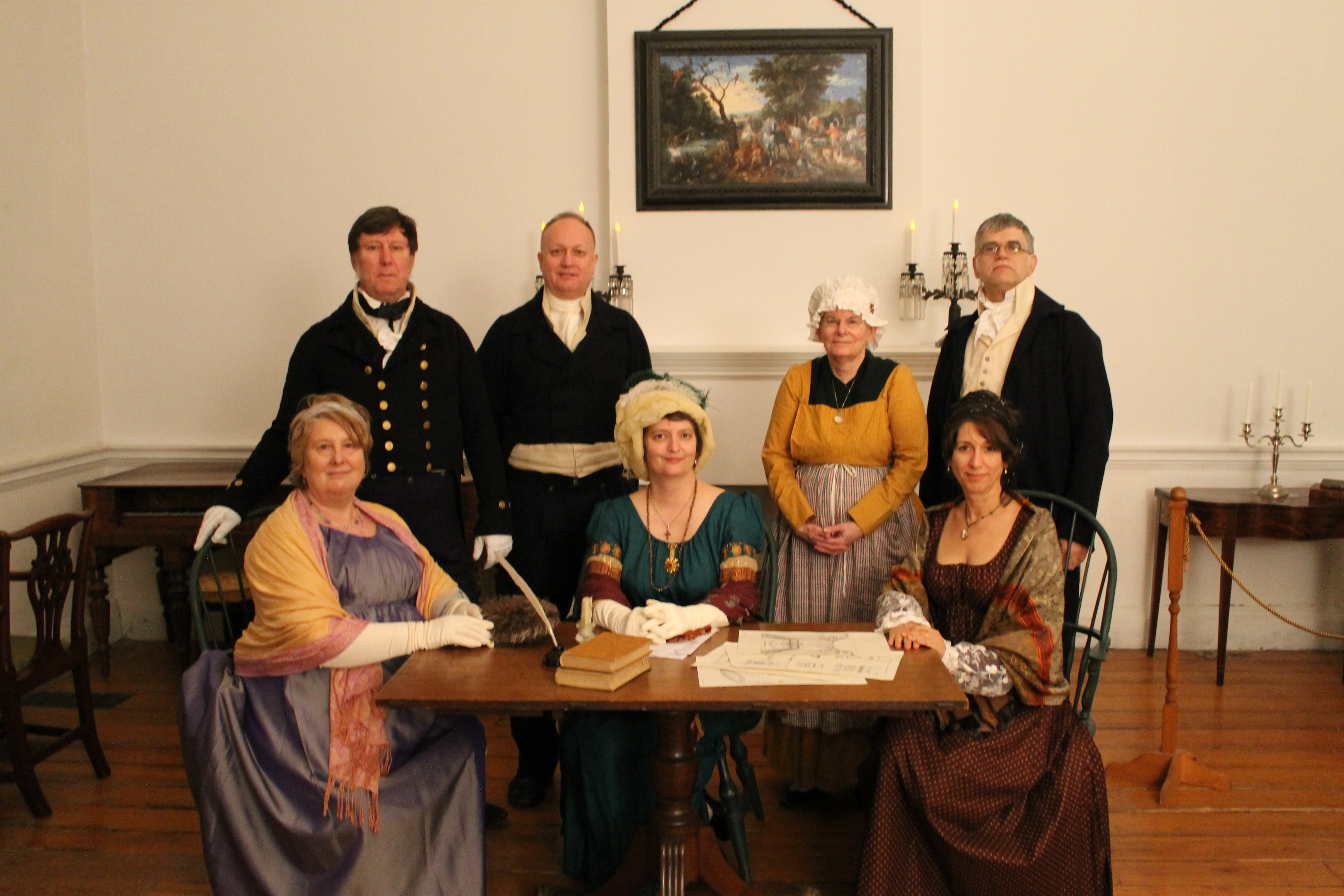
Because you can–and will–get that everywhere else, and I wish you much chocolate and flowers and smoochy stuff. But today I want to tell you about what I did last Saturday. It was a Regency Drag occasion at Riversdale House Museum where we had a historical whodunit event at which about thirty guests had to guess the instigator of the horrid event in the study with a poker.

IMG_3039

From left to right, sitting,  Mrs. Merry (with historically incorrect long underwear you can’t see because it was cold outside), our hostess Mrs. Rosalie Calvert (wearing an extremely lovely Indian silk gown), and Mrs. Lowndes (don’t let that demure exterior fool you). Standing, Mr. Foster the current English ambassador, our host Mr. George Calvert of Riversdale, Kitty the maid, and the wicked smuggling extortionist Col. Barclay (who made a lovely corpse).

I have no knowledge of the other participants’ underwear but by golly, don’t we look authentic! Most of the others were extremely well-informed and serious historical reenactors (I think I was given a line about “non-intercourse acts” as a test of my moral fiber. It refers to trade restrictions). We all played known historical characters who may or may not have committed murder.

merry

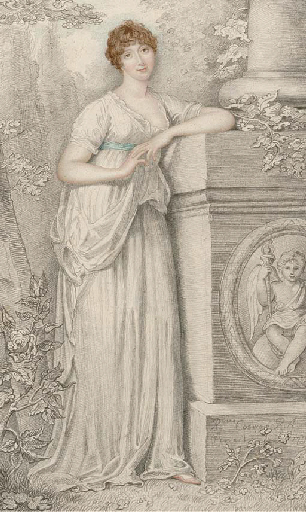
Elizabeth Merry (attrib. Richard Cosgrove)

Mrs. Merry was the wife of the former English ambassador who became entangled with Aaron Burr and was sent home in disgrace.The Merrys did not have a happy time in the Federal City. They were shocked that Thomas Jefferson received Mr. Merry in his carpet slippers (that is, Jefferson wearing his own slippers) and Mrs. Merry was slighted when, at an official dinner in their honor, Jefferson made a serious breach of protocol in escorting another woman to the table. Mrs. Merry then began a boycott of official social events but became well known for her own hospitality.

According to Cokie Roberts in her book Ladies of Liberty, there was a rumor that Mrs. Merry, who came from a modest background, had been a barmaid at a Suffolk tavern. In a quest for upward mobility, she married the local squire, and as a rich widow, picked Anthony Merry as her next husband, a hot commodity in diplomatic circles. Napoleon’s nickname for Merry was Toujours Gai because of his dour disposition. And Mrs. Merry’s maiden name was Death. I bet she spent a lot of time correcting people on its pronunciation.

The evening was a lot of fun, pretty much like writing except you didn’t have to write anything down–but then you couldn’t go back and erase and rewrite–and while there was a temptation to go off on tangents, we had to remember to casually drop clues into the conversations.

So unless you participated in a historical whodunit recently and would like to share details, please tell me how you celebrate Valentine’s Day.


Follow
Get every new post delivered to your inbox
Join millions of other followers
Powered By WPFruits.com