Back to Top


Greetings! It is I, Bertram St. James, delighted to be here (as always). I know you Twenty-First Century folk do not much care to answer my questions, but I will nonetheless continue to ask them. Such as:

1. How can the United States of America call itself a republic, and yet have a queen? And what sort of a queenly name is Latifah, anyway?

2. Why would anyone pay eighty dollars to buy Obsession? Is not Obsession something one comes by naturally, and occasionally pays large sums to be rid of?

3. In my day, musicians had names like John and Nathaniel. Why do musicians today have names like N Sync and Eminem? And why do they play no instruments?

4. Speaking of musicians, if M.T.V. truly stands for “Musical TeleVision”, why does it play no music?

If anyone can explain to me the answers to these conundrums, I will be most grateful.

Yours as ever, and exquisite as always,

Bertie the Beau

Alfie Dolittle, who sings this in MY FAIR LADY, definitely would have agreed with Cobbett’s analysis of why beer is better than tea.

Put it to the test with a lean hog: give him the fifteen bushels of malt, and he will repay you in ten score of bacon or thereabouts. But give him the 730 tea messes, or rather begin to give them to him, and give him nothing else, and he is dead with hunger, and bequeaths you his skeleton, at the end of about seven days.

Proof positive. At least, that beer can fatten you like a hog. Did we really need Mr. Cobbett to tell us that?

I used to be exclusively a wine drinker, but I fell in love with English ale during the three years my husband and I were on international assignment in England. The first time we walked across the road to the Fox and Hounds, our neighborhood pub in Funtington, West Sussex, my husband ordered a pint of Ruddles Best Bitter. Intrigued by the deep color, I took a sip. He had to order himself another. Some time after that, we joined the Campaign for Real Ale and used their Good Beer Guide and Good Pub Food Guide to help us plan our weekend excursions.

Now I no longer have any excuse for the mistake of having a Regency hero dash angrily into a pub and order lager. (I cringe a little when I read such scenes, but won’t go as far as book-flinging.) During the Regency, they would have drunk “real ale”. Here’s CAMRA’s definition:

Real ale is beer brewed from traditional ingredients, matured by secondary fermentation in the container from which it is dispensed, and served without the use of extraneous carbon dioxide.

Real ale is also known as ‘cask-conditioned beer’, ‘real cask ale’, ‘real beer’ and ‘naturally conditioned beer’.

Here are a few of the terms to describe varieties and styles of real ale:

  • bitters: well-hopped, copper-coloured, stronger versions are called “best” or “special”
  • pale ales: premium bitters that are not pale, just lighter than brown ales
  • India Pale Ale: pale ales adapted for transport to India, stronger, more heavily hopped
  • brown ale: reddish-brown to dark brown, somewhat sweet
  • mild: usually dark brown, lightly hopped
  • stout: extra-dark, almost black, strong flavored
  • porter: also dark, but lighter-bodied than stout.

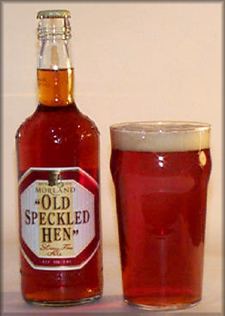
Here’s one of my favorites: Morland’s Old Speckled Hen (the website explains how this ale was named). Fortunately for me, it is not impossible to find on this side of the pond.

Have you tried real ales? If so, what are your favorites? If not, it’s worth trying if only to better one’s understanding of Regency beverages. Anything for research, I say. 🙂

Elena, beer connoisseur and tea slut, hoping Cara will not cut my acquaintance 🙂

LADY DEARING’S MASQUERADE, an RT Reviewers’ Choice Award nominee
www.elenagreene.com


William Cobbett, round about 1821, wrote:

The drink, which has come to supply the place of beer has, in general, been tea. It is notorious, that tea has no useful strength in it; that it contains nothing nutricious; that it, besides being good for nothing, has badness in it, because it is well known to produce want of sleep in many cases, and in all cases to shake and weaken the nerves.

Okay, so far, I slightly agree with Cobbett. Lack of sleep — yeah, if you drink more than you’re used to, or you drink late in the day, it can cause insomnia! But “shake and weaken the nerves”?

Cobbett continues:

It is, in fact, a weaker kind of laudanum, which enlivens for a moment and deadens afterwards.

Laudanum, which is opium dissolved in alcohol, being compared to tea??? Dude, what have YOU been drinking???

It is impossible to make a fire, boil water, make the tea, drink it, wash up the things, sweep up the fire-place and put all to rights again in a less space of time, upon an average, than two hours. . . . Needs there any thing more to make us cease to wonder at seeing labourers’ children with dirty linen and holes in the heels of their stockings?

There you have it, kiddies! The poor are wretched not for any of the commonly held reasons (e.g. because they are poor, or because they are lazy, or because no one who labours in the fields from dawn to dusk has time or energy to darn stockings) but because they drink too much TEA!!!!

You heard it here first.

Cara
Cara King, Tea Drinker Extraordinaire
for more weird period details, see www.caraking.com

Posted in Regency, Research | Tagged , | 7 Replies

Last week, I started a new job. I think it will be all right, but right now I’m completely stressed out, trying to learn new computer databases, new procedures, and still find time to write at home! By coincidence, I’ve also been reading a book titled “Ladies-in-Waiting: From the Tudors to the Present Day” by Anne Somerset, detailing one of the few careers open to women (upper-class women, anyway) during the Regency–royal service.

Chapter Eight concerns the “Later Hanoverian Court”. In the summer of 1761, it was announced that the new king, George III, would marry his cousin Princess Charlotte of Mecklenburg-Strelitz. The king’s mentor, Lord Bute, was immediately bombarded with requests for places in her household for wives and daughters. On July 23, Horace Walpole wrote to Sir Horace Mann, “The new Queen’s family consists of…the Duchess of Ancaster, Mistress of the Robes and first lady of the Bedchamber; the others are the Duchess of Hamilton, Lady Effingham, Lady Northumberland, Lady Weymouth, and Lady Bolingbroke” (he missed one addition, Lady Egremont). The Countess of Dalkeith had angrily turned down a position when she heard she would have to work with the Duchess of Hamilton, who had been one of the famous Gunning sisters. The Duchess of Bedford was also insulted–she was left off the list altogether. The husbands of both these ladies soon went into Opposition. Coincidence? I think not. 🙂

Princess Charlotte herself had hoped to bring with her a large retinue from her own country, as royal brides had in the past (Catherine of Aragon, for example, brought many Spanish retainers with her when she married Prince Arthur Tudor). But the king decreed “the utmost she can bring is one or two femmes de chambre whom I own I hope will be quiet people, for by my own experience I have seen these women meddle more than they ought to do.” So, Charlotte brought two German ladies, Johanna Haggerdorn and Juliana Schwellenborg, who served as joint Keepers of the Robes. Haggerdorn proved to be ” a placid amiable ladylike woman”, but Schwellenborg was a different kettle of fish. In 1765, the king, irritated by her intrusiveness and arrogance, was only dissuaded from sending her home by the persistent entreaties of his wife! Among the other ladies she was seen as a petty tyrant. Novelist Fanny Burney, Haggerdorn’s successor, wrote that S. was “noxious and persecuting.” The Queen, however, adored her, calling her a “faithful and truly devoted…servant.”

Perhaps one reason for the queen’s dependence on S. was the fact that she was never really at ease with her sophisticated English ladies (and not encouraged to develop close friendships by her possessive husband!). The Duchess of Ancaster stayed at her post until her death, but in 1784 the queen fell out with the Duchess of Arrgyll (formerly Hamilton), who was flirtatious and unpunctual, as well as the mother of a scandalous daughter. The Countess of Northumberland (a “vulgar woman” who liked “show and crowds and junketing”) left way back in 1770. And Lady Bolingbroke had to leave when she and her husband divorced. I can’t imagine these ladies partiuclarly mourned leaving court (except for the chances for family advancement and prestige), as the king and queen were known to be deadly dull (until the king went crazy, that is!).

There are so many interesting things to say on this topic, I may have to continue next week! In the meantime, how do you think YOU would have fared as lady-in-waiting?

Since I found so much interesting info (interesting to me, anyway!) on the lives of Georgian ladies-in-waiting, I decided to do a Part Two this week, continuing from last Monday.

The Countess of Harcourt became a Lady of the Bedchamber to Queen Charlotte in 1784, and she also became one of the Queen’s few friends, staying with her until her (Charlotte’s) death in 1818. Lady H. recalled one occasion when she said to the Queen, “I should like to tell YOU something, but pray promise never to let the QUEEN know it.” The Queen laughed and answered, “Oh, no, SHE can have no business with what passes between us in our private unreserved conversation.” But these lighthearted moments were an exception in what was considered a very dull Court indeed.

The Queen would receive at Court only women of unblemished reputation, “proscribing from her society all females of bankrupt or even ambiguous character” (Anne Somerset, from “Ladies in Waiting”). I don’t think ladies of, shall we say, a more risky disposition could care too much about this exclusion. The Court was no longer a center of fashion, as it had once been, since the values espoused by the King and Queen were so far from those set by the leaders of fashion.

The Court was also bound by rigid, uncomfortable etiquette. Fanny Burney, the novelist and sometime lady-in-waiting, wrote after first visiting Court, “In the first place you must not cough…In the second place you must not sneeze. In the third place, you must not, upon any account, stir either hand or foot. If, by chance, a black pin runs into your head, you must not take it out. If the pain is very great you must be sure to bear it without wincing; if it brings the tears into your eyes, you must not wipe them off…”

Other rules include one forbidding anyone to initiate a conversation with the King or Queen, or to eat in their presence. Ladies could not leave the Queen’s presence of their own accord, and when they did leave they had to back smoothly out of the room (with a train!). No one could sit in the Queen’s presence, even if faint or pregnant.

Of course, their duties could have been worse. The Ladies of the Bedchamber didn’t have to wait on the Queen at meals or assist with her toilette, aside from ceremonial; duties such as fastening her necklace. There were six of these ladies, drawn from the highest reaches of Society, each on call for two months of the year, usually only for formal occasions. The more day-to-day duties were now divided between the two Keepers of the Robes and their assistants, the wardrobe women (a whole ‘nother article, I think!). Ladies of the Bedchamber were paid 500 pounds a year (rather unfairly, the hardworking Keepers got only 200, but they did have free accomadations). Though the King and Queen were always eager to reduce their domestic budget, the Queen, despite a reputation for parsimony, would never permit savings at the expense of her ladies. She even fought the Government’s efforts to reorganize financial arrangements in 1812, condemning their proposed cuts as “shabby.”

Now, last week I asked if YOU would make a good lady-in-waiting. This week I wonder would your own heroine (or the heroine of your favorite books) do well at Court? Or would they be too rebellious? 🙂

Follow
Get every new post delivered to your inbox
Join millions of other followers
Powered By WPFruits.com