Back to Top

Confession: for the last two days, I’ve been sitting around eating turkey and pie, not getting any exercise, and watching Deadwood DVDs. So, for this Saturday’s post I knew I had to find something where I could use lots of pictures. Something that wouldn’t take much brain-power, since I lost that a few slices of apple pie a la mode ago. Something that grows out of last week’s post. Something with–corsets! Yes! That’s what I need after mashed potatoes and gravy. Elizabethan Costuming 101.

The Basic Elements:

The Smock A basic garment, worn by all classes to help protect outer clothing. There are various styles–some are cut close to the body with a low, square neck and close-fitting, ungathered sleeves. Some have puffed sleeves gathered to cuffs. Generally made of linen.

Partlet A rectangular fill-in for the open-necked bodice. If a smock with a low, square neck is worn, this can go over it. It’s cut with a straight, standing collar, and can have a small ruff attached, or have a larger ruff pinned or basted to it.

Stockings These came to just above the knee, could be made of wool or fine silk yarn, tied by a ribbon garter.

Corset (or Stays, or Pair of Bodies) The Elizabethan corset, unlike the Victorian, is not designed to squeeze the waist to Scarlett O’Hara proportions, but to smooth the line of the torso into a cone shape and flatten the bosom into a high, mounded bustline. Made of heavy boning, generally with back lacing. Extant examples are very rare; this pic is a German corset from around 1598.

Farthingales There are 2 popular varieties: Spanish and French. The Spanish is the most flattering, a straight A-line angle from waist to hem. The French, or drum farthingale, is a large, crescent-shaped pad or rigid framework worn around the waist. This was the fashion later in the 16th century.

Bum roll A crescent-shaped pad worn around the waist, supporting most of the weight of the skirt.

Drawers Not generally worn by Englishwomen. Queen Elizabeth had a few Italian pairs, but they were a shocking, racy rarity.

Underskirt (or kirtle) with a decorated forepart A plain skirt, gored or pleated to fit over hoops, bum rolls, etc. The forepart is decorated, embroidered or made from fancy fabric, and it lies flat in a gentle, downward arc. Over this goes the overskirt, attached to the bodice to form the gown. The overskirt is split up the front.
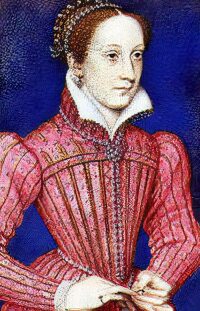
Two common styles of bodice are the square-necked variety and the doublet (with standing collar, fastened down the front center. See the portrait of Mary Queen of Scots on the right).

Sleeves detachable, could match the bodice fabric or could be contrasting (sleeves were often used as a fairly easy way to try out new looks)

Surcoats were a popular loose, coat-like garment, either worn over the bodice and skirt for warmth or on their own over the undergarments. (See the portrait of Christina, Duchess of Milan, in black).

A few good sources to read more:

Queen Elizabeth’s Wardrobe Unlocked by Janet Arnold (this book is one of the great Prides of my book collection! One of the most valuable both in terms of money and information. Also check out her two volumes of Patterns of Fashion)

The Tudor Tailor by Ninya Mikhaila

The Tailor’s Pattern Book ( reprint of a Spanish book of cutting layouts from 1589)

Dressing the Elite: Clothes in Early Modern England by Susan Vincent

Funeral Effigies in Westminster Abbey by Anthony Harvey

And a few pics of my own costumes (match to the inspiration! The silver gown isn’t actually mine, though I wish it was–it belongs to the Folger Shakespeare Library)


I hope everyone had a great holiday! I think it may be time for me to get up off the couch before I need a corset and bum roll, too…

Today is the Official Start of the Holiday Season. If you’re like me (and honestly, I hope for your psyche’s sake you’re not), you’re wishing various members of your family would just shut up. Thanksgiving? I’m giving thanks I don’t see you except once a year*.

But I digress.

The Holiday Season is where we name our favorite things:

Raindrops on roses and whiskers on kittens
Bright copper kettles and warm woolen mittens
Brown paper packages tied up with strings

Uh, for me, not so much.

I am grateful for (in no particular order):

1. My Risky Regency Friends, both my fellow posters and our lovely community.
2. Clive Owen
3. Silver Hoop Earrings
4. Coffee
5. Flavored Coffee
6. Books
7. HEAs
8. Loretta Chase
9. Mary Balogh
10. Carla Kelly
11. Cashews
12. Black hoodies
13. Sean Bean
14. Jane Austen
15. Bookmarks
16. BLTs
17. Artichokes
18. Converse Sneakers

19. Wine
20. Port
21. Peanut Butter
22. Barbara Hambly
23. The Picky Vegetarian
24. The Delightful Phone Friend
25. The Partner-in-Crime
26. The Faux Critique Partner
27. Greek Yogurt
28. Lee Child
29. Elsa Schiaparelli
30. The Scent of Grapefruit

I could go on and on (and have!); what are you grateful for this Holiday Season?

Megan
*I am not normally this bitter, but geez, can’t we have some interesting conversation? Plus I woke up too early to get here, so I’m crabby. I promise I am on my best behavior in public, it’s just inside my head I am this snarly.

Posted in Uncategorized | Tagged | 12 Replies

Or, why Daniel Deronda is like Thanksgiving Dinner.

Yes, it’s Thanksgiving and it’s also the birthday of George Eliot (born 1819), to whom I would like to give thanks today. Highly literate and educated despite being born into the sort of provincial society she depicts in her novels, she left England at the age of thirty after the death of her parents and traveled in Europe, returning to become a writer for the Westminster Review. Her life was unconventional (she lived out of wedlock with a married man, George Henry Lewes, for years–as she grew in fame and fortune Victorian society accepted the liaison. After Lewes’ death she married a man twenty years her junior; go, girl. And she earned a living as a writer, “coming out” as George Eliot, a name she adopted early in her career.). Interestingly Eliot’s books rarely turn up on lists of “my favorite romance novels” in the company of Pride and Prejudice and Jane Eyre.

Why? Here’s a reason, in her own words:

Marriage, which has been the bourne of so many narratives, is still a great beginning, as it was to Adam and Eve, who kept their honeymoon in Eden, but had their first little one among the thorns and thistles of the wilderness. It is still the beginning of the home epic – the gradual conquest or irremediable loss of that complete union which makes the advancing years as a climax, and age the harvest of sweet memories in common.

Consider Middlemarch, possibly her greatest work, where the emphasis is on the community itself and the burgeoning romances are only part of the big picture. She subverts the marriage of true minds–Lydgate and Dorothea, two peas in a pod of innocence and idealism–and instead pairs them with partners who, in Lydgate’s case, are far their inferior. And Dorothea and Rufus Sewell, oops, Will Ladislaw–well, I can only conclude that he’s great in the sack and has the right sort of politics, certainly nothing to turn up one’s nose at, yet I digress–I’m left feeling that she sacrifices herself to romance. And I certainly think Mary Garth could have done better than Fred Vincy. Of course Eliot was smart enough to know that if she paired up Lydgate and Dorothea, there would be no book; that the troubling and imperfect relationships and their uncertain outcomes makes the book a brilliant masterpiece.

Now I love Daniel Deronda for similar reasons–the relationships aren’t what you think they’re going to be–and there’s no overt happy ending but a huge amount of interwoven complexity. She took the risk of trying to write about a truly good hero–Daniel, making a journey of discovery into his origins, forging his own destiny–and even she couldn’t quite do it. Daniel is really only interesting when he’s suffering, upon rare occasions, some sort of negative feelings–when he acknowledges his own snobbishness in becoming associated with a family of Jewish shopkeepers (oh, the vulgarity! How embarrassingly materialistic they are!). So Daniel is the turkey at the Thanksgiving dinner, handsome to look at, but a bit bland and occasionally dry. The rest of the book–the gravy and yams and cranberries and the rest of the delicious accompaniments, the fabulous secondary characters and their love interests and concerns–is Eliot’s unconventional triumph.

Have a great Thanksgiving, everyone.

Give thanks every month when you receive the Riskies newsletter. Sign up now at riskies@yahoo.com

Posted in Uncategorized | Tagged , , , | 8 Replies

I am covered with embarrassment that I forgot to announce what will be the next movie we’re discussing in the Jane Austen Movie Club!

I’m so sorry! (And I also apologize to Janet, for posting this on her day without asking first!)

We will discuss the 2005 version of PRIDE AND PREJUDICE, the one with Keira Knightley and Matthew Macfadyen. And the discussion will be on Tuesday, December 4 — always the first Tuesday of the month.

I now return you to your regularly scheduled Riskiness…

Cara

Last week I blogged about the fun of doing amateur art, music, theatre, etc… without the pressure of making a career of it. Risky friend Susan Wilbanks commented that she enjoys singing, but though she has not yet sold a novel, her writing is not a hobby. I know what she means and I definitely don’t think it’s publication that separates the amateur writer from the professional.

It’s harder to put my finger on the difference, though.

There are people in Romance Writers of America who believe that membership in the organization confers professionalism. But some have been members for a decade or more, write sporadically or not at all and have not completed or submitted a manuscript. So I don’t think declaring oneself a professional is enough.

Part of it is that the pro seeks payment for her art (and that’s where finishing and submitting come in). She will take her craft seriously and strive to create work worthy of publication.

But it’s not just money either. Here’s what Steven Pressfield (THE WAR OF ART) says about the difference between the amateur and the professional: “The word amateur comes from the Latin root meaning ‘to love’. The conventional interpretation is that the amateur pursues his calling out of love, while the pro does it for money. Not the way I see it. In my view, the amateur does not love the game enough. If he did, he would not pursue it as a sideline, distinct from his ‘real’ vocation. The professional loves it so much he dedicates his life to it. He commits full-time.”
To me this quote feels a bit derogatory to the amateur (though perhaps it wasn’t intended that way). Nor do I think one has to write full time to be a professional. But I do believe it is about commitment. Being an amateur is like dating while being a pro is like marriage. One can walk away from a hobby but a true professional hangs in there.

Some writers say one should write every day. I agree with that in principle but I also suspect the ones who say that have wives to deal with sick kids and household disasters. I agree with a married, working friend of mine who once said there were times she wished she had a “wife”. 🙂

Whether or not one writes every day–or even takes occasional breaks from the writing–I do think it’s important to come up with goals (which can be modest) and a schedule (which doesn’t have to be anything like 9-5) and stick to it. At one point I was working a “regular job” 3 days a week and had a young baby. I wrote during her naps (when they happened) on my two days off and on Wednesday evenings and Sunday afternoons when my husband was able to babysit. The hours were erratic, but I showed up and did my best. LORD LANGDON’S KISS was the result.

So anyway, this is what I’ve come up with so far. A professional writer is one who strives to improve her mastery of the craft, one who sets goals and shows up for work even if she’s not in the mood.

What do you think makes a professional writer?

Elena
www.elenagreene.com

Follow
Get every new post delivered to your inbox
Join millions of other followers
Powered By WPFruits.com