
Happy Saturday, everyone! We have so many exciting things coming up on Risky Regencies–a contest (stay tuned this week for the announcement!); a Guest Blogger visit tomorrow from Keira Soleore; and next week I will be in New York, staying with Risky Megan (so I can report on her new house firsthand!). Also, if you’d like to win a signed copy of A Sinful Alliance, I will be at Unusual Historicals for one more day. Be sure and visit! Oh, and I finally wrote “The End” on my Caribbean/Balthazar book this week!!! Chocolate all around. 🙂
And, since I had absolutely no idea what to talk about today (trying to do laundry so I can pack my suitcase!), I decided to pull out some of the research I did for ASA. Can’t let it go to waste, after all! Here is a story of the 2 palaces that appear in the book, Greenwich and Fontainebleau.
 Greenwich was originally built in 1433 by Humphrey, Duke of Gloucester, a brother of Henry V. It was a convenient spot for a castle, 5 miles from London and Thames-side, and was popular with subsequent rulers, especially Henry VIII. His father, Henry VII, remodeled the place extensively between 1498-1504 (after dispatching the previous occupant, Dowager Queen Elizabeth, to a convent). The new design was after the trendy “Burgundian” model, with the facade refaced in red Burgundian brick. Though the royal apartments were still in the “donjon” style (i.e. stacked rooms atop rooms), there were no moats or fortifications. It was built around 3 courtyards, with the royal apartments overlooking the river and many fabulous gardens and mazes, fountains and lawns.
At the east side of the palace lay the chapel; to the west the privy kitchen. Next door was the church of he Observant Friars of St. Francis, built in 1482 and connected to the palace by a gallery. This was the favorite church of Katherine of Aragon, who wanted one day to be buried there (of course, that didn’t turn out quite as she planned…)
Though there are paintings and drawings of the exterior, not much is known of the interior decorations. The Great Hall was said to have roof timbers painted with yellow ochre, and the floors were wood, usually oak (some painted to look like marble). The ceilings were flat, with moulded fretwork and lavish gilding, embellished with badges and heraldic devices (often Katherine’s pomegranates and Henry’s roses). The furniture was probably typical of the era, carved dark wood chairs (often an X-frame design) and tables, benches and trunks. Wool or velvet rugs were on the floors of the royal apartments only, but they could also be found on tables, cupboards, and walls. Elaborate tiered buffets showed off gold and silver plate, and treasures like an gold salt cellar engraved with the initials “K and H” and enameled with red roses.
For the events in my book, the visit of the French delegation, two new structures were built at either end of the tiltyard, a grand banquet house, and a theater where there were masques and concerts.
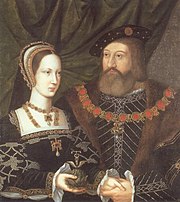 Many important events of the era took place at Greenwich. Henry VIII was born there on June 28, 1491, and he married Katherine of Aragon there in May 1511. On February 8, 1516 Princess Mary was born there, followed on May 13 by the marriage of the king’s sister Mary, Dowager Queen of France, to Charles Brandon, Duke of Suffolk (a huge source of much gossip!). In 1527 came the French delegation which forms the center of my book. They were received with much pomp “and entertained after a more sumptuous manner than has ever been seen before” (according to one courtier). On September 7, 1533, Princess Elizabeth was also born there, followed nearly 3 years later by the arrest of her mother Anne Boleyn after a tournament. One of the last great events Greenwich saw in Henry’s reign was the wedding to Anne of Cleves in 1540.
It was a royal residence through the reign of Charles I (1625-49), but under the Commonwealth the state apartments were made into stables, and the palace decayed. In 1662, Charles II demolished most of the remains and built a new palace on the site (this later became the Royal Naval College), and landscaped Greenwich Park. The Tudor Great Hall survived until 1866, and the chapel (used for storage) until the late 19th century. Apart from the undercroft (built by James I in 1606) and one of Henry VIII’s reservoir buildings of 1515, nothing of the original survives.
 Fontainebleau, on the other hand, can be seen in much the state Francois I left it in. On February 24, 1525 there was the battle of Pavia, the worst French defeat since Agincourt. Many nobles were dead, and king was the prisoner of the Holy Roman Emperor in Madrid. He was released in May, but only at the price of exchanging his sons (Dauphin Francois and Henri, duc d’Orleans) for his own freedom. In May 1526, Francois created the League of Cognac with Venice, Florence, the Papacy, the Sforzas of Milan, and Henry VIII to “ensure the security of Christendom and the establishment of a true and lasting peace.” (Ha!!) This led to the visit of the delegation in 1527, seeking a treaty of alliance with England and the betrothal of Princess Mary and the duc d’Orleans.
 After his return from Madrid, Francois was not idle. Aside from plotting alliances, he started decorating. Having finished Chambord, he turned to Fontainebleau, which he loved for its 17,000 hectares of fine hunting land. All that remained of the original 12th century castle was a single tower. Francois built new ballrooms, galleries, and a chapel, and called in Italian artists like Fiorentino, Primaticcio, and Vignola to decorate them in lavish style (some of their work can still be seen in the frescoes of the Gallery of Francois I and the bedchamber of the king’s mistress the duchesse d’Etampes). The marble halls were filled with artworks, gold and silver ornaments, and fine tapestries. Unlike Greenwich, this palace was high and light, filled with sunlight that sparkled on the giltwork.
A few sources I used a lot with this book are:
—Tournaments: Jousts, Chivalry, and Pageants in the Middle Ages, Richard Barber
—Excavations of Greenwich Palace, 1970-1971, PW Dixon
—Tudor Food and Pastimes, FG Emmison
–The Six Wives of Henry VIII, Antonia Fraser (there are LOTS of books on this subject, of course, but Fraser’s is great!)
—Prince of the Renaissance: The Life of Francis I, Desmond Seward
—Food and Feast in Tudor England, Alison Sim (yes, I do like researching food!)
—The Royal Palaces of Tudor England: Architecture and Court Life, 1460-1547, Simon Thurley
—Henry VIII: The King and His Court, Alison Weir (full of wonderful info!)
—Henry VIII and His Court, Neville Williams
I know it’s hard to comment on a research-type post, but I’m curious–after reading about both palaces, which would you prefer to live in? (I’m torn, but I lean toward Greenwich). Where would you like to see a book set?
See you next week from New York!


