Back to Top

Monthly Archives: June 2008

“The battle of Waterloo was won on the playing-fields of Eton” –Duke of Wellington

“Probably the battle of Waterloo was won on the playing-fields of Eton, but the opening battles of all subsequent wars have been lost there” –George Orwell

Today here at Risky Regencies we’re kicking off Waterloo Week! Be sure and visit every day for historical information on the battle itself, life in the Regency-era military, and weaving all that research into characters and plots.

My topic today is the Duchess of Richmond’s famous ball, held on the night of June 15, 1815 (193 years ago tomorrow) in a huge old carriage-house on the property of the Richmonds’ Brussels house in the Rue de la Blanchisserie. (The Duke of Richmond was in command of a reserve force in Brussels, charged with protecting the city in case Napoleon invaded). But lest you think everyone was partying in rustic decor, with carriage wheels and horses everywhere, the space was done up in grand style indeed. There were flowers and greenery wreathing all the pillars, and hangings of red, gold, and black draped on the walls. Thackeray, who later used the ball in a pivotal scene in Vanity Fair, declared it “perfectly delightful…with few nobodies present.” Caroline Lamb wrote, “There was never such a ball–so fine and so sad.”

The people who were “not nobodies” in attendance included the Prince of Orange (later King William II of Holland), the Duke of Brunswick (who died the next day at Quatre Bras), the Prince of Nassau, several earls including Conyngham, Uxbridge (commander of the British cavalry, who famously lost his leg), Portalington, and March. There were 22 colonels, sixteen comtes and comtesses, and many English peers. There were 224 invitees in all, though only 55 were women, so I doubt there were any wallflowers that night! (For a list of all invitations, you can go here).

It was at this ball that Wellington learned Napoleon had crossed the border and was on the march. He had assumed Napoleon would advance on Brussels via Mons rather than the more direct Charleroi route, and received word that he was wrong about this during supper. The Richmonds’ daughter, Lady Georgiana Lennox (later Lady De Ros) recalled that “The news was circulated directly, and while some of the officers hurried away, others remained at the ball, and actually had no time to change, but fought in evening costume.” 72 hours later, more than 4 in 10 of those officers were wounded or dead.

Lady De Ros later wrote a great deal about this ball and the events that followed. She said, “My mother’s now famous ball took place in a large room on the left of the entrance, connected with the rest of the house by an ante-room. When the Duke of Wellington arrived, rather late, I was dancing, but at once went up to him to ask about the rumours. He said very gravely, ‘Yes, they are true; we are off tomorrow.’ It was a dreadful evening, taking leave of friends and acquaintances, many never to be seen again. I remember being quite provoked with poor Lord Hay, a dashing merry youth, full of military ardor, whom I knew very well for his delight at the idea of going into action, and of all the honors he was to gain; and the first news we had on the 16th was that he and the Duke of Brunswick were killed.”

(Perhaps young Lady Georgiana wore a gown like this one, said to have been made for the Richmond ball! See a page about its restoration here).

I’ve always thought that this ball (and the subsequent events) would make a terrific centerpiece for a story. It’s a romantic, tragic setting, full of desperate merriment and the terrible sense of time growing short. Even as the champagne flows and everyone dances, there’s an edge of deep, deep sadness.

For more information, I love the books The Duchess of Richmond’s Ball by David Miller, and Dancing Into Battle: A Social History of the Battle of Waterloo by Nick Foulkes. (And then there’s always Sharpe’s Waterloo…)

I also love the first stanza of Byron’s poem The Eve of Waterloo:

“There was a sound of revelry by night,
And Belgium’s capital had gathered then
Her beauty and her chivalry, and bright
The lamps shone o’er fair women and brave men.
A thousand hearts beat happily; and when
Music arose with its voluptuous swell,
Soft eyes looked love to eyes which spake again,
And all went merry as a marriage bell;
But hush! hark! a deep sound strikes like a rising knell!”

I hope you enjoy our Waterloo Week! What do you think of the Richmond ball in a romance? Would it be romantic–or just too sad?


Oh, geez. Friday already?

Last week, I talked about great book beginnings. I’ve since changed mine to this:

“If you don’t get your stinkin’ farmer’s hands off me, I will rip your head off and feed it to your pigs.”

Spoken by the hero, of course, a sharp(e)-tempered man bent on revenge. I’ve now got three chapters under my belt, and I have to write the synopsis. Ugh.

To inspire my writing, I’ve started reading Sharpe’s Havoc, a Richard Sharpe book by Bernard Cornwell set in Portugal in 1809 (Elena posted about Sharpe in India, too, if you wanna read more about him).

I don’t know if any author as skilfully embeds history within exciting action; sure, Cornwell takes liberties with some aspects of the Napoleonic Wars, but in general he gives you the feeling of what it must have been like to be there. Awesome, awesome writing and a super-compelling hero (Cornwell’s site, www.bernardcornwell.net, is great for more insight into his most famous character. I would say ‘memorable,’ but I also really liked Thomas of Hookton in the Grail Chronicles).

And inbetween all this “research” (did I mention I got some of the Sharpe miniseries from the library? Yeah, pure research, baby), I’ve been watching ladies win on Top Chef and Celtics win in Los Angeles. Plus getting back to the gym for the first time in 2 1/2 months.

Which is why I am late, and aghast it is Friday.

So I have very little to offer here, except that it is finally cooling off some, I cannot wait to see the Incredible Hulk, freaking out that my son gets out of school for the summer in a week and a half, that National is next month (!), and that I am finally writing fresh stuff again.

In other words, life is good, and I am dull. So let’s talk about you, instead.

What are you doing this summer?

Posted in Uncategorized | Tagged , | 11 Replies

Hi, Eva!

We have not forgotten you and we still want to get you your copy of La Petite Four by Regina Scott. Unfortunately, your emails have still not made it through.

We did notice that there was an Eva from Finland who won from us once before. If you are the same Eva and haven’t moved, please let us know and we’ll just use the same address.

If not, we have several suggestions:

1) If you feel comfortable doing so, just put your address in a comment to this post.

2) If not, you could try sending it to any or all of these addresses:

riskies@yahoo.com
ammcabe7551@yahoo.com
caraking1@yahoo.com
egreene@stny.rr.com

Also, we are not techies here, but we suspect that maybe something along the way thinks your emails are spam. Try putting “La Petite Four” in the subject header and avoiding any words like “contest” or “winner” since those words are sometimes associated with spam. If these things don’t work, you may wish to check with your service provider.

We are sorry this is taking so long and sincerely hope this works!

Elena and the Riskies

Posted in Risky Regencies | Tagged | 1 Reply

I blogged yesterday over at The Spiced Tea Party about dealing with the heat. I live near Washington DC where every year, when the temperatures spike into the upper, and very humid, 90s we assure each other, and unlucky visitors, that it never normally does this here. Right.

So I thought I’d talk today about the joys of Regency summer living. Ice cream certainly wasn’t invented in the Regency, but it was very popular among those who could afford it–visit historicfood.com to check out recipes for this gorgeous collection of ice creams and water ices: in the back, royal cream ice, chocolate cream ice, burnt filbert cream ice and parmesan cream ice; in front, bergamot water ice and punch water ice. I’m guessing that the parmesan cream ice (and some of the others, too) must have been served as a savory accompaniment, to be expected when each remove would include items that nowadays we’d consider being strictly dessert.

Big question–were ice cream cones used in the Regency? According to this illustration from 1807, and article at historicfood.com, they were.

The great houses made sure they would have plenty of ice by constructing an ice house–this is the interior of a brick-built Georgian ice house at Parlington Hall, Yorkshire, which measures a mighty 16 ft. in diameter and around 20 ft. deep.

Ice would be cut from local lakes or imported from countries such as Norway, and insulated with straw. The actual igloo-like design of the ice house, and its position in a shady spot on the grounds would aid in keeping the ice cool.

As for cool drinks, spruce beer was always a favorite. Made from spruce buds, its flavor could cover a whole range from citrus to pine–or possibly not. exoticsoda.com bravely tested a modern brand and came to this conclusion:

If ever offered a bottle, save yourself the trouble and drink some paint thinner. It will taste the same, but you can wash your brushes with the remaining thinner you don’t drink. Spruce Beer would probably melt the bristles off. But it’s not all bad …there is a sweet buffer that does keep you from projectile vomiting.

Lemon barley water was a favorite, too, first manufactured by Robinson and Belville in 1823 in powder form, to be mixed with water to cure kidney complaints and fevers. It also aids in lactation, should you have the need, and Robinson’s lemon barley water is still the official drink of Wimbledon for players (although presumably not for that reason). Here’s a modern recipe from cuisine.com.

As for lemonade itself, here is a recipe from the seventeenth century from coquinaria.nl, and Mrs. Beetons’, from the 1830s, at thefoody.com.

I also looked around for some ginger beer recipes–ginger was readily available as it was a subsidiary crop in the sugar-producing islands and found this one at allrecipes.com which claims to date back to the Tudor era.

What are your favorite summer drinks or ice cream flavors? Have you ever made any yourself? Do you have any favorite historic food sites?

The last few weeks our neighborhood has enjoyed visits by a number of black bears, including a mother with three cubs. Here they are in the back yard of a friend who lives two houses down. Aren’t they cute!

Of course, my next door neighbors have taken in their bird feeders (which may have been what attracted the bears) and we’re all being careful about sending our kids out to play right now, but no one is seriously worried. Under normal circumstances, black bears aren’t aggressive. My family and I have had a few encounters with them while camping and each time they shambled away from us. Though obviously a mother with cubs should always be treated with caution!

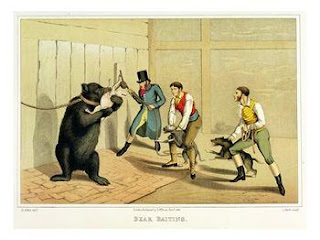
There haven’t been any wild bears in England since the Middle Ages. However, Regency folk might have seen captive bears in menageries or at various events. Bear baiting (tormenting a chained bear with dogs, etc…) was waning in popularity by the Regency. Many people had recognized by then what a degrading sport it was, however it was not made illegal until 1835.

Regency folk might also have seen performing bears at fairs and such. Given that handlers were unlikely to be treated the bears in anything approaching a humane manner, I doubt it would have been entertaining to anyone like our heroes and heroines.

I don’t think I’ve read anything about bears in a Regency. One could perhaps imagine a hero or heroine freeing an abused bear, but that really could be way too Disney (there was just such a scene in the Pocahontas sequel). Though it could be amusing to picture the havoc caused by a bear running loose in some genteel locale, sadly I doubt it would end well for the poor bear.

I’m much happier just continuing to watch our woods for deer, wild turkeys and possibly more glimpses of these black bears (at a safe distance).
Have you had any interesting experiences with bears, real or fictional?

Elena
Posted in Uncategorized | Tagged , | 11 Replies
Follow
Get every new post delivered to your inbox
Join millions of other followers
Powered By WPFruits.com