 A big Riskies welcome to Eliza Knight, who’s offering a free copy of her e-novella Her Captain Returns to one lucky commentor today. Eliza is the author of multiple sizzling historical romances and Highlander time travel erotic romance novellas published by The Wild Rose Press. She is a freelance copy editor, Newsletter Editor for Hearts Through History Romance Writers, and President of the Celtic Hearts Romance Writers. Eliza is the author of the award-winning blog History Undressed and has published numerous articles in various newsletters. She presents workshops on history, researching techniques and writing craft, to writing groups online.
How could anything considered sinful feel so good?
That is what Miss Corinne Claymore asked herself as she gave into the titillating suggestions of Captain Ryder Montgomery. Corinne never knew what she was getting into with her innocent flirtations with Ryder. Scandal ensues as they are discovered in an amorous embrace in the gardens at Lady Covington’s ball. Corinne finds herself not only married to Ryder, but abandoned. A short letter tells her he will be gone for several years …
Thank you Risky Regencies for having me today!
 In light of my recent Regency release, Her Captain Returns, part of my Men of the Sea series, I thought I would take today to talk about Royal Navy Captains in the Regency era. Let us travel through the hero of my novella, Captain Ryder Montgomery’s training, and life at sea.
Ryder was born the second son of an earl, and from his earliest days, had a penchant for the sea. It was only natural for him to join the navy at the age of thirteen as a mid-shipman. He certainly did his share of scrubbing the deck and tying knots, but when he was a little older he was allowed to take care of the log line, and sometimes delegate sailing duties. By the age of twenty, he was promoted to Lieutenant, and by 23, was Captain of his own ship, HMS Conqueror.
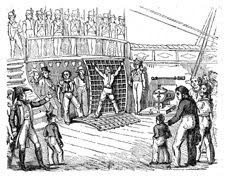 Ryder himself was only flogged once, but several of his shipmates were flogged regularly. What for, you ask? Ryder himself was given ten lashes for neglect of duty. Ever hear the term poor salt on a wound? Well that’s exactly what the ship’s surgeon did when he was taken there after his punishment… We must remember, poor Ryder was only fourteen at the time, and he wasn’t exactly neglecting on purpose, he was in fact heaving his guts out from dinner the night before.
 Food on the ship wasn’t exactly appetizing, although, most sailors were excited to have regular meals, as when they were on land, eating three times a day wasn’t always a guarantee. The main staples of a navy diet, included salted meat, which was sometimes so rancid it was inedible by some, and even when boiled for hours the meat could still be as hard as a rock, unless they hadn’t been at sea very long and “fresh meat” in the form of livestock was onboard. This would be made into a stew with whatever fresh or dried veggies were available and rice or oats. Instead of bread, they had ships biscuits that were either filled with weevils. Sounds tasty! For breakfast it was porridge sweetened with molasses. To drink, if the fresh water had already turned a slimy green, they had watered down ale, watered down wine or watered down rum.
As a member of the crew, Ryder slept in a hammock twenty inches from the next hammock. When he became a captain he got his own room aboard the ship, but had a hammock placed inside, as he found after ten years at sea, it was much easier to sleep on.
 The life of a Naval Officer wasn’t all pomp and squalor. While most of them lived privileged lives, they had to earn it. Some were second or third sons of the nobility, and some were sons of well to do merchants. And there were even those who were born at the bottom of the barrel and made their way to the top.
During the Regency era, a ship’s captain could become quite wealthy. How? Was the king paying well? The salary for a seaman was meager, and for a captain also wasn’t opulent—most would try to marry for money. No, most captain’s made their riches from other captains, especially during the Napoleonic campaigns. When a ship’s captain commandeered another ship, the whole crew shared in the spoils.
Officers in the military were well respected by the people, and since most came from well to-do families, they often hob-nobbed with the rich and the aristocrats.
 In Her Captain Returns, Ryder ends up going away on a mission for several years, and isn’t allowed contact with anyone outside, including his wife. One of the things I wanted to illustrate in this story, was how hard it was for the wife of a man of the sea. Just as it is today with a military wife, it was much the same back then, except they didn’t have television to see what was happening, and their news stories were a lot more delayed. A wife may have still been receiving correspondence from her husband, only to learn he’d been dead for two months.
To end this blog, I leave you with a couple of fun naval terms:
Bitter End – Have you heard the phrase “faithful to the bitter end”? Well, it is a naval term! The wooden or iron posts sticking through a ships deck were called a bitt. Turning a line around them was called, the bitter end.
Chewing the Fat – Remember my description of the nasty meat? Well some men would chew on it for hours, and referred to it as, chewing the fat.
He knows the ropes – Nowadays this means someone is pretty skilled at what they’re doing. Back in the day though, it meant literally, novice and that all he knew were the ropes.
Took the wind out of his sails – this originally described a battle move where one ship would get so close to the other it would take the wind away, and slow down the opposing ship.
Your comment or question will enter you into a drawing to win a copy of Her Captain Returns, so come and chat with Eliza!


