 One thing I love about February around here is that it’s big book sale month! There are 3 library sales (one is HUGE), and a couple private schools (which also include bake sales, yum). I always find treasures at these sales (even if they’re just treasures to me!), and it’s so much fun to dig around on the tables and in boxes, never knowing what’s going to show up. I already hit one sale last weekend, and found almost a complete set of Will Durant’s Story of Civilization (for $1 a volume!), stuff like The Civilization of Europe in the Renaissance and Life in Medieval France, as well as oddities like an intriguing memoir called Love is a Mix Tape, a book of watercolors of Louisiana plantation houses from the 1950s, and some Heyer hardbacks in like-new condition. And this isn’t even the BIG library sale (which is on February 20).
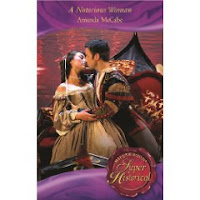 I also like February because it’s Valentine’s Day, which means more stuff about romance novels in papers and magazines, and lots and lots of chocolate in the stores. It’s also release month for me this year, and not just Countess of Scandal! If you’re in the UK, Harlequin is releasing my Renaissance Trilogy in their “Super Historical” line, starting this month with A Notorious Woman. See more about it here…
And yesterday marks the birthday of actor John Philip Kemble, scion of the famous theatrical family and brother of Sarah Siddons! I’ve been fiddling about with a Georgian theater story myself, and thus reading lots about the subject, so this was a nice find. (And thanks to Elena for recommending the book Fashionable Acts! It’s great).
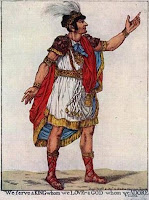 John Philip Kemble was born February 1, 1757 at Prescot in Lancashire, the second child of actor-manager Roger Kemble. His mother was Catholic, and thus he was educated at the Sedgley Park Catholic seminary, and at the English college at Douai, with the expectation that he would become a priest. He found he had no vocation, though, and returned to England to join the theatrical company of Crump and Chamberlain, debuting as the title role of Theodosius at Wolverhampton on January 8, 1776. In 1778 he joined the York company of Tate Wilkinson, making a splash in roles like “Wakefield” in The Recruiting Officer, Macbeth (in Hull on October 30), and in York as “Orestes” in Distresset Mother. In 1781 he obtained a “star” engagement in Dublin, appearing there as Hamlet in November. He was a big hit in Ireland, as Hamlet, Raymond in The Count of Narbonne (a play from Castle of Otranto).
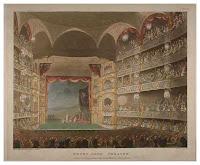 By 1783 his acclaim, along with the immense fame of his sister Mrs. Siddons, landed him an engagement at the Theatre Royal, Drury Lane, where he debuted as Hamlet on September 30. His greatest role there was Macbeth, and he also got rave reviews opposite his sister in Edward Moore’s The Gamester. They went on to play together in numerous productions, including Othello, Julia, The Carmelite, and Kemble own adaptation of Philip Massinger’s A Maid of Honor. In 1787 he married the actress (and widow of an actor) Priscilla Hopkins Brereton, and soon after was appointed manager of Drury Lane, which gave him the opportunity to indulge his own vision of the plays they presented (and to take whatever parts he fancied, including a wide variety of Shakespearean characters). He resigned this position in 1802, and in 1803 became manager of the Theatre Royal, Covent Garden (which he had bough a sixth share in for a high price). The theater burned in September 1808, and the rise in ticket prices after its re-opening led to the Old Price Riots, which suspended performances for over 3 months and nearly ruined Kemble financially (he was saved by a loan, later made a gift, of 10,000 pounds by the Duke of Cumberland). He retired from the stage after a last performance of his best-known role, Coriolanus, in 1817. He died in Lausanne in 1823.
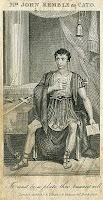 In 1785, the critic Richard Sharp wrote to his friend, the actor John Henderson, after viewing a performance by Kemble: “I went, as promised to see the new ‘Hamlet,’ whose provincial fame had excited your curiosity as well as mine…yet Nature, though she has been bountiful to him in figure and feature, has denied him a voice; of course he could not exemplify his own direction for the players to ‘speak the speech trippingly on the tongue,’ and now and then he was as deliberate in his delivery as if he had been reading prayers and had waited for the response. He is a very handsome man, almost tall and almost large, with features of a sensible but fixed and tragic cast; his action is graceful, though somewhat formal, which you will find it hard to believe yet it is true. Very careful study appears in all he says and all he does; but there is more singularity and ingenuity than simplicity and fire.”
Some sources for this post I found were:
Herschel Baker, John Philip Kemble: The Actor in His Theater
Linda Kelly, The Kemble Era: John Philip Kemble, Sarah Siddons and the London Stage
(And a book I really like, but which is about John Philip Kemble’s great-niece, a stage star in her own right who married an American plantation owner: Fanny Kemble’s Civil Wars, by Catherine Clinton)
What have been some of your best book sale finds?? Seen any good plays lately?

 OK, I admit it. I’m still in my odd nightwear and wearing a wonderful shawl which I affectionately call the horse blanket because it is so very large. The heat isn’t on yet because my office is sunny but my feet are cold…
 I’m pretty sure women could resort to woollen petticoats, although I haven’t been able to find a whole lot of evidence of any existing. In the eighteenth century, and later in the nineteenth century as skirts became full again, quilted petticoats, like this gorgeous example from Williamsburg, were worn.
 In the Regency, of course, shawls were in fashion, like this amazing red wool twill with embroidered panels. I found it at vintagetextile.com, a site well worth looking at (and for breeding covetousness).
 At the same site I discovered this gown from 1800, made of silk faille, that looks warm even if it isn’t. Wouldn’t this be a great dress to make a heroine stand out in society…
 Outside (the thought of wind whistling up however many petticoats, whatever they were made of, makes me shiver) the well dressed woman would wear a muff and/or tippet. You’ll be glad to hear that muffs became smaller than this monstrosity. She isn’t carrying a hedgehog.
 And she’d probably wear pattens, still around since medieval times, to protect her feet from the mud and muck of the street, although walking on ice in these must have been hazardous.


