Back to Top

Monthly Archives: January 2012

I have made a disturbing discovery. In a few hours I will be aboard a plane to England and if there are any Scotsmen aboard, it may not be a restful flight.

Today is Robert Burn’s birthday, celebrated with a traditional Burns Supper which range from stentoriously formal gatherings of esthetes and scholars to uproariously informal rave-ups of drunkards and louts (Robert Burns Country).

Reflecting Burns’ vigorous, earthy, emotional poems, a Burns Supper menu should include Neeps and Tatties (recipe here), featuring the ever popular combo of rutabagas (also known as swedes) and potatoes, and haggis, the great chieftain o’ the pudding race. Mmmm!

… oat-meale mixed with blood, and the Liver of either Sheepe, Calfe or Swine, maketh that pudding which is called the Haggas or Haggus, of whose goodnesse it is in vaine to boast, because there is hardly to be found a man that doth not affect them. The English Huswife, 1615
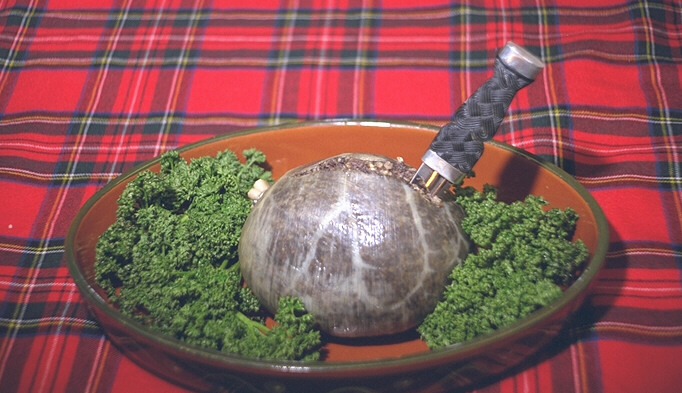
Here’s a modern recipe for haggis. Hungry yet?

There are many Burns resources online so I thought I’d mention a couple I found. You can find all of his poems at Robert Burns Country including a translation of dialect terms into several languages including American. At robertburns.co.uk you can download the XXX-rated The Merry Muses, which includes such masterpieces as Nine Inch Will Please A Lady. (Talking of which, check out this timeline of Burns’ busy and prolific life at the Burns Museum in his birthplace in Alloway, Scotland.)

And naturally the celebrations are washed down with whiskey/whisky, however you’d like to spell it. And although in Romancelandia Regency dukes swill it like water, it didn’t really catch on until much later, notably after whiskey production became legal in 1823, following years of enthusiastic consumption in Scotland. So unless his grace is Scottish and/or has a still at the bottom of the garden of his London town house, it’s not going to be the ducal beverage of choice. There’s a history of whiskey here which includes an account of the funeral of Peter Grant, who was the oldest survivor of the 1745 Jacobite uprising (110 years old!) in 1824; four gallons of whiskey were drunk even before the coffin was lifted to take to the burial ground.

Questions for you: when did people start drinking whiskey socially in England? And what would you include, including favorite Burns’ poems, at your Burns Supper?
Posted in Uncategorized | Tagged , , | 6 Replies

Happy Tuesday, everyone! I just realized that it is Tuesday. I got back from a weekend trip to Santa Fe late last night, and this morning rolled out of bed and went to see what was going on with the Riskies today….

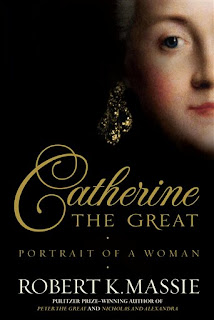
On my trip, I started reading one of my birthday gifts, Robert K Massie’s new biography of Catherine the Great. I love Massie’s work–his Nicholas and Alexandra was what got me interested in Russian history in the first place, when I read it years ago, and this book was no less fascinating. Massie has the gift of making history come alive and feel immediate and real, and in the coomplicated, fascinating figure of Catherine he has the perfect subject.

Catherine was born Princess Sophia Fredericka Augusta of Anhalt-Zerbst, the daughter of a minor German princeling who had not much money or influence. But her mother’s brother had been engaged to Empress Elizabeth of Russia before dying on the eve of the wedding, and Elizabeth (an equally complex character!) had fond memories of him. Plus she wanted a young girl she could control who could give Russia an heir. She brought Sophia to Russia and married her to her nephew Grand Duke Peter, a disfigured, alcoholic obesessed with the Prussian military (a complete wackjob, in other words). But after years and years of a painful marriage, loneliness, and virtual imprisonment (which luckily gave her much time to read and plan) Catherine overthrew her deeply unpopular husband in a coup d’etat and became Empress in her own right. She reigned from 1762–1792.

Among other achivements, Catherine added 200,000 square miles to Russian territory (mostly at the expense of the Turks and the Poles), was a patron of the arts, literature, and education (she corresponded with French philosophes like Voltaire and Diderot, whose libraries she eventually purchased), opened the Smolny Institute to educate girls, wrote the “Nazna” (a code of laws), and tried to impose Enlightenment ideas on her vast empire (with mixed results). She also had at least 12 lovers, including the vastly gifted Gregory Potemkin. As she got older they got younger and dumber (the last of them, Zubov, was 40 years her junior)….

Massie’s book is full of court intrigue, seductions, romance, illegitimate children, bloody uprisings, power grabs, battles–and a 389 carat ruby. What can be better???

For more info on her complicated life, look here

What have you been reading lately??? What books have sparked a love of history and historical heroines in your life?

Posted in Uncategorized | Tagged | 6 Replies

Last week I talked about the death of Sir John Moore, the anniversary of which was last Monday. Today is the anniversary of the death of William Pitt, the Younger. (I seem to be on a death kick)

Pitt became the youngest Prime Minister of Great Britain in 1783 at the age of 24, finally accepting the post after King George III had urged it on him three times. He was ridiculed for his youth, even in a popular ditty of the period that called Great Britain, “a kingdom trusted to a schoolboy’s care.”

He replaced Charles James Fox, whom the king detested and who became Pitt’s lifelong political rival. Pitt resigned the office in 1801 when he clashed with the king over Catholic Emancipation.

Pitt became Prime Minister again in 1804, a stressful time due to the rise of Napoleon in France, and Fox’s continued opposition.

Pitt, who had suffered from bouts of ill health since childhood, became ill in 1806. He died on this date in 1806, probably from peptic ulceration of the stomach. Pitt never married.

Parliament passed a bill to pay Pitt’s debts and to honor him with a public funeral and a monument. It passed easily, although Fox opposed it. Pitt was buried in Westminster Abbey.

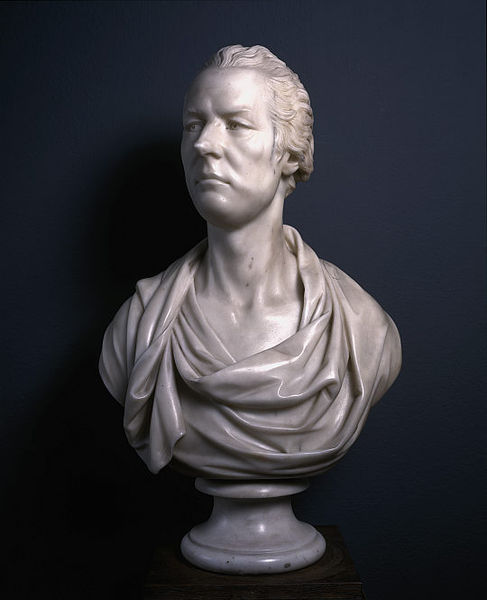
When I went on the Regency Tour in 2003, we visited countless country houses of the Regency period. In almost all of them a bust of Pitt was displayed.

When I discussed Sir John Moore last week, I mentioned that he sent his regards to that intrepid traveller, Lady Hester Stanhope, whom it was thought he would have married had he lived. Well, Lady Hester Stanhope was William Pitt’s niece. She designed his gardens and acted as his hostess for a time.

Do you have any interesting connections like that? Like knowing someone in one part of your life who also is connected to someone in another part of your life? For example, my husband, a government computer guy took a training class recently and sat next to someone, not in the government, who was an employee of my friend Pam Palmer’s husband. I’m not sure how, in a computer training, they got to talking about romance novels….

Next week I will have a guest blogger! My friend Victoria Vane aka Emery Lee will be blogging about her latest, an erotic novella set in the Georgian period, Breach of Promise. She’ll also be giving away a free download of the novella to one lucky commenter chosen at random!

Posted in Uncategorized | Tagged , | 8 Replies

Now that I’ve finished reissuing my old “Three Disgraces” trilogy, I’m looking at the remaining two titles in my backlist. I’m pretty sure I want to reissue my novella “The Wedding Wager” which first appeared in the anthology HIS BLUSHING BRIDE, as it is. Although it’s different in style than my later books and may need a different cover to match, it should please readers who like sweet, traditional Regency novellas.

I’m not so sure about my first published Regency, LORD LANGDON’S KISS, which I recently glanced through. To put it as kindly as possible, I have improved a great deal as a writer since then! Some readers and reviewers loved it, but it garnered about 3 stars on the average (which is probably about right). One reviewer talked about the “increasing depth of characterization” in the book and now I understand what she meant. The first half or so could use some work.

The question I’m pondering now is whether to reissue the book at all. I don’t want readers who happen to read this title first to be put off trying my later books. If I do reissue it , should I try for a do-over?

This is the cool thing about reissues. I was tickled when Janet announced that a new edition of her debut Regency, DEDICATION, is coming out from LooseId. Not because the original wasn’t fantastic already, but because this time Janet says it will have “all the sex I really wanted to put in the first time around but which was just inferred”. What’s not to love?

What do you think about do-overs? Any books you would like to rework or see reworked?

Elena

www.elenagreene.com
www.facebook.com/ElenaGreene

P.S. Next Saturday, I’ll be interviewing Mallory Jackson, author of THE PENWYTH BRIDE, a haunting paranormal romance set in 18th century Cornwall. Visit and comment for the chance to win an e-copy!

To be honest, I am not the best researcher out there (I know! Color you all surprised).

What I am is a good mimic. I cut my teeth on Regency-era romance, and spent a lot of my formative years alone, so a lot of my language and vernacular was formed by what I read. For example, I use “disguised” to mean drunk, as Heyer did. I always say a lady is “mutton-y” (as in mutton dressed like lamb) when she is wearing clothing too young for her age, think (in my head, at least) that they’re mushrooms if they’re aspiring above their station in an aspirational way, and also use phrases like ‘cut my teeth’ (see above).

I also love language, and vernacular, and how idioms come about. We all know what we mean when we say something has “jumped the shark,” but the first time someone used it, they were likely met with puzzled stares (as I recall, it is the example of Happy Days when Fonzie was out waterskiing and literally jumped a shark, which was the precipitous downfall of the show’s quality). I think my love of language has made it possible for me to write in the Regency period, even though I might not know what exactly happened during certain years (not to mention the whole title thing–oy! I stink at that!)

Do you have any favorite phrases? What Regency-era terms delight you?

Megan

Posted in Uncategorized | Tagged | 7 Replies
Follow
Get every new post delivered to your inbox
Join millions of other followers
Powered By WPFruits.com