Your regularly scheduled Tuesday post will return next week! I got two sets of revisions this week and am going into the cave…see you when it’s all over…


Your regularly scheduled Tuesday post will return next week! I got two sets of revisions this week and am going into the cave…see you when it’s all over…
 I’m at that exciting scary time of starting a new book. The possibilities are endless. That is the exciting part AND the scary part. I need a way to focus, to narrow it down.
So, I’m thinking of those popular Romance and Regency themes.
I’ve written several marriage of convenience plots (The Mysterious Miss M, The Wagering Widow, Scandalizing the Ton), forbidden love (Innocence and Impropriety, Gallant Officer, Forbidden Lady, Chivalrous Captain, Rebel Lady, Born to Scandal), and road stories (The Vanishing Viscountess, The Liberation of Miss Finch). I’ve done a reforming the rake plot (A Reputable Rake), love at first sight (Innocence and Impropriety,Valiant Soldier, Beautiful Enemy) and reunion stories (A Twelfth Night Tale, A Not So Respectable Gentleman?).
Here’s a great list of Classic Romance Plots, by the way.
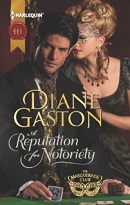 I could categorize the next book, A Reputation for Notoriety, but it doesn’t fit neatly into one category. It has elements of a few – forbidden love, opposites attract, boss/employee…and another that would be a spoiler!
My challenge for this to-be-written book is to take one of these classic romance plots, twist it in some interesting way, and devise a story that hopefully readers will love.
Do story ideas come easily to you? What are your favorite romance plots? Are there any Regency plots that you want to see? Any that you think have been overdone?
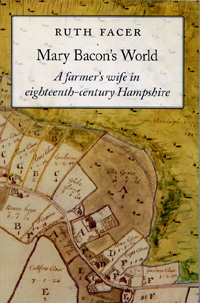 I’ve been reading Mary Bacon’s World by Ruth Facer, a detailed look at the life of a farmer’s wife in 18th century Hampshire, taken from her personal ledger, which contained much more than financial entries. It’s a personal journal in which she has recorded many aspects of her life; truly an historians dream of source material.
Like those of many women of her generation, her journal includes things like recipes and the minutiae of farm life, all of which are interesting to anyone writing about the period. For example, when she and her new husband moved to their home at Aylesfield Farm, she meticulously recorded the expenses for needed repairs, including holdfasts (probably some sort of clamp or staple), brushes, Linseed oil, nayls (and also nails). In total they spent £43 15s. Quite a lot to get the farm in order, not mention chips, 5 cord of Grub wood (roots or branches lying on the ground). This was, probably for heating. She also includes a furniture inventory which indicates a level of prosperity for the new couple.
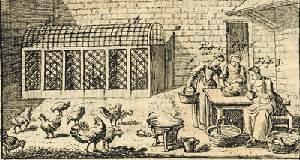
A farmer’s wife in her yard with chickens
Her ledger also includes a detailed picture of the life of a farmer’s wife, including stock, the weather, the care of animals, and cures for people living in or around the farm.
Mary seemed to rely on Culpeper’s Complete Herbal and English Physician for caring for her livestock. For example, to cure a bovine urinary tract infection:
Take a handfull of Hot Dung, half a pint of Rennet half a pint of Brine and a handful of mustard Seed Bruised Simmer it together and Give it to the Cow and let her Stand two hours without meat If one Drink fails Stop one Day & Give her another in the morning.
Sort of makes you glad you’re not her cow. She has equally interesting cures for human ailment, including piles, constipation, dental problems, and epilepsy.
Mary’s kitchen inventory gives a good picture of how she cooked and her ledger contains recipes, many copied from Hannah Glasse’s First Catch Your Hare, The Art of Cookery Made Plain and Easy, but also some of her own and those from her friends.
From the ledger, we also learn a lot about Mary’s reading material, including Almanacs, chapbooks, and newspapers. Among the things she copied out in her journal was a table of information about the West Indies (including, the length and breadth of each island, it’s principal towns and which country owned it) , in which she was apparently interested.
Her ledger includes her extensive book list. This includes, as well as Culpeper’s Herbal, many religious books, The Universal Parish Officer (containing the laws in force pertaining to parish business), The Gentleman’s Jocky & approved farrier, and a history of England.
I could go on. There is an incredible amount of useful material in this book, if you’re interested in the life of an intelligent and fairly prosperous farmer’s wife during the late 18th and early 19th century. I highly recommend it.
“Mom?” asked Miss Fraser, age 8. “How’s the writing going?”
“Pretty good,” I replied. “Rose had some ideas for putting more conflict in my Christmas novella, so I’m working on fitting those into the story.”
“What do you mean, conflict?”
“You know–all the bad things and problems that make a book interesting, that the characters have to work through to get to the happy ending.”
“Oh.” She frowned thoughtfully. “I have a good idea. You could put an earthquake in the story.”
“Well, that would be exciting, only the story is set in England, and they almost never have earthquakes there.”
Miss Fraser shrugged and gave me a look that said, Do I have to do EVERYTHING for you? “Then put in something they DO have.”
I then tried to explain about internal conflict and all the baggage my hero and heroine have left over from when they last met five years before, but her eyes started to glaze over. Miss Fraser thinks my stories sadly lacking in wizards, Greek gods, and clans of warrior cats going on quests.

A few days later I got into a conversation with my husband about how sometimes problems are easier to solve than you think. I had a character in my aforementioned Christmas novella whose existence was critical to my other characters’ lives, so I couldn’t just write him out altogether. But he had nothing interesting to do within the few days of my plot, and having him around was pulling focus off the characters who DID matter.
At first I was stumped, but then I came up with a simple solution: I changed my atmospheric Christmas Eve snow flurries to a wind-driven storm that accumulated thickly, and I made my extraneous character’s wife heavily pregnant instead of halfway through her second trimester. Voila! Now Harry the Necessary but Uninteresting wouldn’t dare venture on the roads and risk having his firstborn delivered in a carriage mired in a snowdrift, and all was right with my fictional world.
Mr. Fraser wasn’t so easily satisfied. “What are you going to do when some reader comes after you with an almanac proving it didn’t snow that Christmas Eve?”
I shrugged.
“You don’t CARE, do you?” he asked, eyebrows climbing in indignation. (I should note here that Mr. Fraser is a bit of a weather geek. As a child his dream career was meteorologist.)
“Look, I’m all about historical accuracy–to a point. I wouldn’t write Waterloo without the big rainstorm the day before, since it had a huge impact on the outcome of the battle, or forget that 1816 was the Year Without a Summer. But looking up the exact weather of every single day is several levels of obsessiveness beyond where I’m willing to go. Besides, this is a CHRISTMAS STORY. A white Christmas is a TROPE. It snows in England NOW. No one is going to have trouble believing in a Christmas snowstorm in 1810–especially given that the more of a weather geek they are, the more likely they are to know about the Little Ice Age and how much colder it was back then.”
“But what if 1810-11 was the warmest winter on record? What if it’s the year everyone talked about the daffodils blooming in January and all the young rakehells swimming naked in the Thames on Christmas morning?”
“Hmph. Unlikely.”
“Hmph. Where is your story set, exactly?”
“Kent.”
Mr. Fraser opened a new browser tab for Google and searched for weather in Kent in 1810. When nothing much came up, he searched on London and found a bit of data, but nothing that specifically remarked on Christmas. Peering over his shoulder, I spotted a reference to the Thames freezing over in January 1811. “Ha!” said I. “I stand by my story.”
“But what if it was a sudden cold snap?”
“I don’t CARE. A white Christmas is a TROPE.”
I hope you’ve enjoyed this glimpse of living a writer’s life in House Fraser. Does your family give you helpful advice whether you ask for it or not? And where do you draw the line between accuracy and obsessiveness?
doesn’t mean it’s Regency.
Today I’m going to take a look at a few of my unfavorite myths about England and the Regency and rant about them.
First, the Downton phenomenon, otherwise known as when will it be safe to watch PBS again? The Downton phenomenon, formerly known as the OscarWildeization phenomenon can be further subdivided into:

THIS is a gel
The Gel thing aka the Maggie Smith Making a Quick Buck thing. Why do dowagers refer to young women as gels? Most of them seem fairly solid to me. Why in fact does this upper class accent predominate in the Regency? We don’t know how they spoke. We do know that the Countess of Devonshire and her crowd affected a particular drawl. But the rest of them? One accent in society, another at home (particularly men who had to speak to the ragged oppressed on their estates)? See below, Beautiful Accents.
Which leads me to the Loveable Servant with vaguely cockney accent whatever their origins. I will stop right there. These are just two examples of this egregious blight.
The Postcard Phenomenon. This is the assumption that every part of England, particularly rural areas, are beautiful. Not so. Neither are thatched roofs generic.
The Wrong Food and Drink. Scones, afternoon tea referred to as high tea, muffins (unless sold by a muffin man; they are things like big flat crumpets), whisky outside of Scotland, bacon and eggs etc. for breakfast. And in other periods, potatoes were unknown in the medieval period; seventeenth century cottage dwellers did not cook apple crisp over their open fires. (Yes, I have seen these.) And if you were a vegetarian it was from necessity (and you’d kill for a bit of bacon to add to the pottage; some things just don’t change) or you’d be dying.
Moving on to topics also relevant to contemporaries:

English soccer fan
Excessive politeness and grace. I think I do not need to explain further.
Beautiful accents. Some of them. Some are unintelligible. But Fuck You sounds so much more genteel in a posh accent.
The Royal family and people with titles are universally adored, loved, and respected. Not so and certainly not all 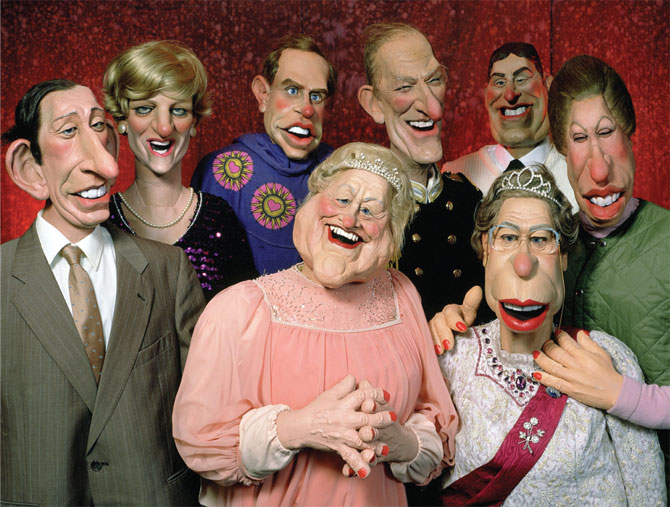 the time, unless there’s a need for a Big Celebration or a Big Cry. Much of the time they are regarded as overpaid embarrassments. During the worst of the Charles-Di breakup honest satirists and comedians were put out of work as the Royals surpassed themselves.
But back to the Regency. Would you care to share your favorite myths?