Back to Top

Monthly Archives: January 2015

Everyone, please give a warm welcome to Rose Lerner, who’s here to talk about her latest release, True Pretenses, and give away a copy to one lucky commenter!
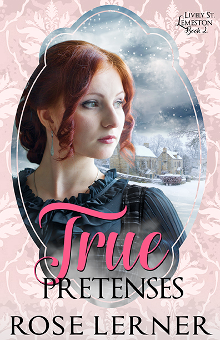
True Pretenses

Never steal a heart unless you can afford to lose your own.

Through sheer force of will, Ash Cohen raised himself and his younger brother from the London slums to become the best of confidence men. He’s heartbroken to learn Rafe wants out of the life, but determined to grant his brother his wish.

It seems simple: find a lonely, wealthy woman. If he can get her to fall in love with Rafe, his brother will be set. There’s just one problem—Ash can’t take his eyes off her.

Heiress Lydia Reeve is immediately drawn to the kind, unassuming stranger who asks to tour her family’s portrait gallery. And if she married, she could use the money from her dowry for her philanthropic schemes. The attraction seems mutual and oh so serendipitous—until she realizes Ash is determined to matchmake for his younger brother.

When Lydia’s passionate kiss puts Rafe’s future at risk, Ash is forced to reveal a terrible family secret. Rafe disappears, and Lydia asks Ash to marry her instead. Leaving Ash to wonder—did he choose the perfect woman for his brother, or for himself?

Warning: Contains secrets and pies.

And now here’s Rose:

True Pretenses is your second book in a village-set series. Did you find writing it easier or harder than a stand-alone?

Definitely easier. Having an established world meant there were so many things I didn’t have to stop and think about. I already had a map of Lively St. Lemeston, for example (you can see it on my Lively St. Lemeston Pinterest board).

However, the two books were pretty loosely linked (if you’ve read Sweet Disorder, the heroine of True Pretenses is the daughter of Nick’s mom’s political archnemesis Lord Wheatcroft). So as far as writing characters and plot was concerned, it didn’t make too much difference.


What was your inspiration for this book?

I was watching Mark Ruffalo movies after The Avengers came out. One of them was a movie called “The Brothers Bloom” in which he and Adrien Brody are good-looking Jewish con artist brothers. The ending of the movie upset me so much that I had to fix it.

The basic set-up of the movie is that Adrien Brody wants to go straight, so Mark Ruffalo tries to set him up with Rachel Weisz, an endearingly eccentric heiress. Something that I realized while turning it over in my mind was that Mark Ruffalo set his brother up with someone exactly like him. Now, this is not an uncommon plotline, but usually it’s leading to either (A) “I set you up with a mini-me because I’m in love with you myself” or (B) “I arbitrarily decided you would be perfect with this person and pressured you into dating them and then HORRIBLY BETRAYED YOU by falling in love with them myself” (cf. Dan/Blair on Gossip Girl. Blair, Serena would have been FINE with you guys dating if you hadn’t gone ON AND ON about how she and Dan should get back together first, and tricked them into going on a weird Valentine’s Day date, and planted old people in the restaurant to talk about how great marrying your high school sweetheart is, and and and).

I went with option (B) for obvious reasons. Delicious angst! BUT with a happy ending, UNLIKE “The Brothers Bloom”. (Seriously, I love the movie, watch it, but BE WARNED.)


Did you learn anything that surprised you in your research? (I’m particularly interested in how you researched your hero’s background, since he’s not your typical Regency hero on several levels.)

I was surprised by how many Jews were involved in the Regency criminal world! Apparently most London fences were Ashkenazi Jews, for example, who had immigrated from the Netherlands and still had the connections to offload hot items there.

The word “swindler”, which my hero Ash uses to describe himself (“confidence man” is first attested in 1849, and in the US), entered the English language in the 1760s probably as a borrowing from Yiddish. (See a summary of the debate here. When it first came into use, the word had a much narrower meaning in bankruptcy fraud.)

I almost hesitate to share that because I don’t want to contribute to anti-Semitic stereotypes, but on the other hand, I don’t think that erasing Jewish criminals in favor of imagining an all-Englishborn all-Gentile underworld is any better.

Some books that were helpful to me in building Ash’s backstory were The Jews of Georgian England by Todd Endelman, The Regency Underworld by Donald Low (especially the chapter “Nurseries of Crime” about child criminals), The Big Con by David Maurer (a very entertaining history of American con artists that provided the blueprint for most modern heist stories and requires no background knowledge to enjoy), and A Vocabulary of the Flash Language (1819) by James Hardy Vaux, which not only teaches slang terms, but indirectly demonstrates a lot about London criminal culture and practice. 


What was the most difficult part of the book to write?

Ash and Lydia are both very different from me! They don’t like reading fiction, they live in the moment, they get a thrill from taking risks, in their hearts they don’t really care about the rules, they aren’t cranky and enjoy crowds. There were a lot of times where I was writing them and thinking Ugh I would hate this SO MUCH but I guess it doesn’t really bother Ash. 


Read any good books lately?

I feel like I’ve read ONLY good books lately! I think as I get older I get better and better at knowing my own taste and avoiding books I won’t enjoy. A few standouts: A Bollywood Affair by Sonali Dev, Jeannie Lin’s new steampunk Gunpowder Alchemy, and Secrets of a Scandalous Heiress by Theresa Romain (yay for a Bath setting!).


What do you do when you’re not writing or reading?

Apart from working at my day job (cooking), mostly watching TV with my BFF. Fiction is my jam, and TV is fiction you can enjoy in real time with someone else! At the moment we’re obsessed with Leverage and enjoying The 100, Selfie, Forever, Brooklyn Nine-Nine, and an embarrassing number of others.


What’s next for you?

The third Lively St. Lemeston book comes out in January 2016! It’s called Listen to the Moon and it’s about Toogood (Nick’s impassive valet) and Sukey (Phoebe’s snarky maid) from Sweet Disorder. I’m writing it now and I can’t wait to share it with everyone!

———-

Thanks for visiting today, Rose!

If you’d like a chance to win a copy of True Pretenses, comment and tell us who your favorite fictional criminal is.

Also, note that the first Lively St Lemeston book, Sweet Disorder, is on sale for $0.99 at all retailers through tomorrow, January 20. And last but not least, Rose is giving away a con artist gift basket on her blog.

So, I’m between projects at the moment, finishing up my blog tour for Freedom to Love and planning for my big Waterloo bicentennial trip to Europe this summer. I decided it might be a good idea to put a free short story or two up on my website in the meantime, and I’m planning to start by pairing off my characters’ next generation–Charles Farlow, son of Henry and Therese from Freedom to Love, with Lucy Atkins, daughter of Will and Anna from The Sergeant’s Lady.

Pairing Charles and Lucy will require me to venture into unfamiliar territory: the 1840’s. So in the next month or two I’ll be giving myself a crash course on early Victorian Britain–all the important political, technological, scientific, and cultural trends that will make their world different from the one their parents knew as young Regency lovers. But the very first thing I looked up was the fashions. I’ve already decided that Lucy is going to have her father’s chestnut-red hair with her mother’s Scottish looks. If I was the kind of author whose books became movies, I’d want her to be played by someone like Karen Gillan:

Karen Gillan

To complete my mental picture, I needed to know what sort of dress she’d wear to a ball, and how she’d arrange her hair. I hurried off to Wikipedia to check out 1840s in Western Fashion. The dresses are quite pretty, though I don’t like them as much as Regency or Edwardian fashion. At least the exaggerated puffed sleeves of the 1830’s were gone, and skirts hadn’t reached the crinolined extremes of the 1850’s or 60’s.

But then I saw the hair.

Spaniel Curls

“Spaniel curls” were all the rage.

Spaniel Curls 2

Maybe it’s just me, but it seems like an unfortunate look.

Spaniel Curls 3

On the other hand, authors who live in glass houses should be careful how they throw stones. Here’s me as a teen with 80’s hair:

80's hair

I used to hate my naturally straight hair and envy the girls who could effortlessly achieve the desired Big Hair SO MUCH. And my teenaged self would be boggled to learn that in 2015 I wouldn’t even own a bottle of hair spray.

So, how do you feel about 1840’s fashion? Are spaniel curls due for a comeback?

Hello everyone!  I feel like it’s been ages since I last popped in here at the Riskies, but it has been a long month.  Christmas, a surgery (which went well, and only meant one night in hospital, even though that one night was Christmas Eve!), and deadlines all over the place have been making me a wee bit crazy.  (But I am excited to say my next Amanda Carmack book, Murder in the Queen’s Garden, will be out in a couple of weeks!)

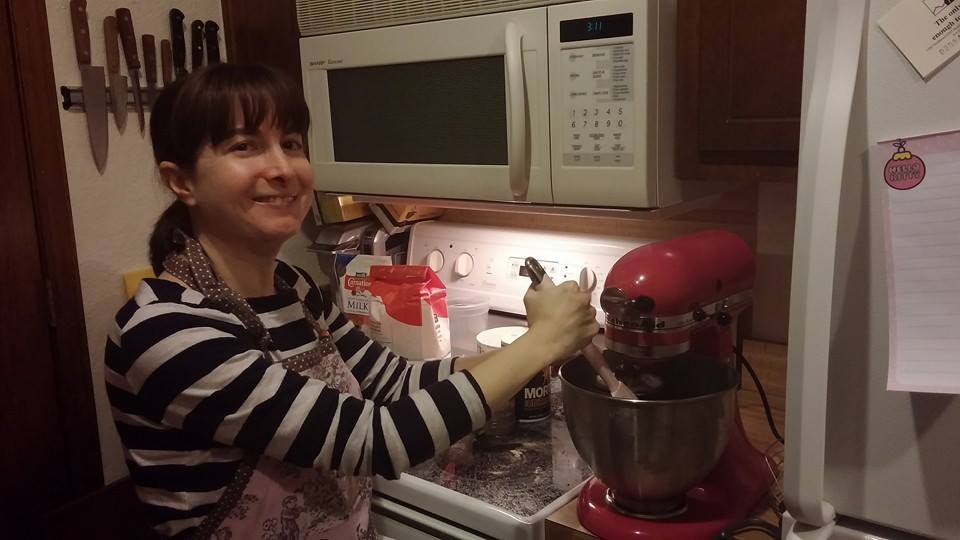
BreadIn the meantime, I am at work on the next Elizabethan mystery, Murder at Whitehall, which is set at Christmastime.  Christmas at the court of Elizabeth I was way more complicated than a holiday at my house (I am not feeding hundreds of people who insist on stuff like gilded peacock, for one thing).  But one of my Christmas gifts was a pink Kitchen Aid, which means I’ve been learning all sorts of fun recipes, including cookies, cake, and my own bread.  If I was making bread in the queen’s kitchen in 1560, though, the recipe might be something like this…

Take one Gallon of flowre, two pound of Currans, and one pound of butter or better, a quarter of a pound of sugar, a quarter of a pint of Rose-water, halfe an ounce of nutmeg, & half an ounce of Cinnamon, two egs, then warm cream, break the butter into the flower, temper all these with the creame, and put a quantity of yest amongst it, above a pint to three gallons, wet it very lide, cover your Cake, with a sheet doubled, when it comes hot out of the Oven; let it stand one hour and a half in the Oven.

I am definitely adding some rosewater next time!!!

What are some of your favorite bread recipes???

My daughters and I have been passing around some sort of cold/flu/plague thing. It’s been so bad I even forgot this was my day to post! That NEVER happens. Anyway, here are some Regency cold remedies I posted a while ago.

~ ~ ~ ~ ~ ~ ~ ~ ~ ~ ~ ~ ~ ~ ~ ~ ~ ~ ~ ~ ~ ~ ~ ~ ~

“People do not die of little trifling colds.”

But what Mrs. Bennett didn’t say is sometimes it feels like you could.

What would Regency folk have done when they felt like I do?

One of my favorite period sources on medicine is DOMESTIC MEDICINE, by William Buchan, first published in 1769 with 18 subsequent editions. Buchan was pretty forward-thinking about general health and prevention and many of his suggestions are far less kooky than those of his counterparts (though that’s not saying much!) I think of it as the sort of book my heroines might have owned and used to help keep their families healthy during the happily-ever-after.

Anyway, here are some suggestions:

“THE patient ought to lie longer than usual a-bed…”

Amen to that one.

“A SYRUP made of equal parts of lemon-juice, honey, and sugar-candy, is likewise very proper in this kind of cough. A table-spoonful of it may be taken at pleasure.”

This sounds very nice.

“If the pulse therefore be hard and frequent, the skin hot and dry, and the patient complains of his head or breast, it will be necessary to bleed, and to give the cooling powders recommended in the scarlet fever, every three or four hours, till they give a stool.”

I checked some of the recommended medications, and they include “Peruvian bark” and “snake root”. Googling these exotic terms, I learned that Peruvian Bark is also called cinchona bark, and can still be used to treat fevers. Seneca Snake Root has expectorant properties. OK, so far, Dr. Buchan is not so dumb.

However, I don’t think my medicine cabinet contains any Peruvian Bark or Snake Root…

And the bleeding I could definitely do without!

Here’s another tidbit.

“MANY attempt to cure a cold by getting drunk. But this, to say no worse of it, is a very hazardous experiment.”

Aw, I’m willing to try it at this point. It couldn’t make me feel any worse, could it????

I hope everyone is feeling better than I am. If not, what do you rely on?

Elena

Posted in Research | Tagged , | 5 Replies

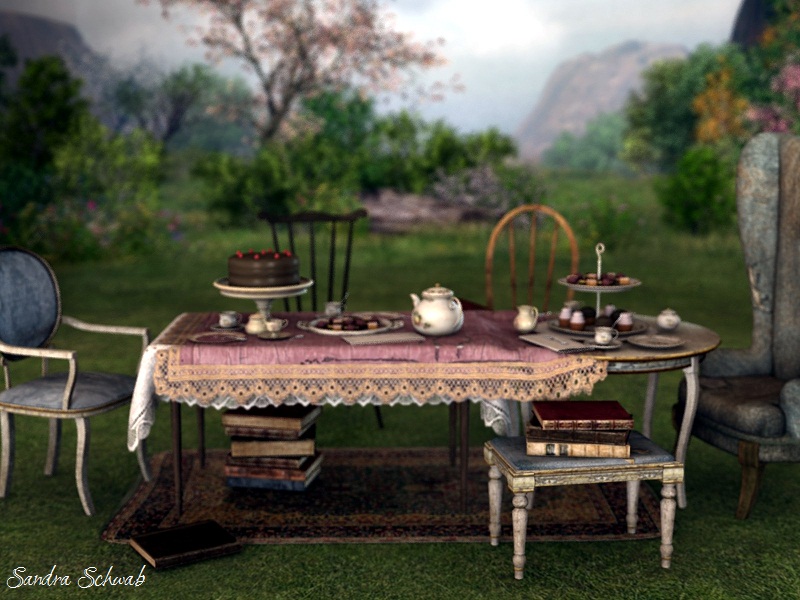
"Tea Party," a picture by Sandra Schwab
The end of the old year must have addled my brains, for I completely forgot to write a post last Wednesday – sorry about that!!!

I hope you all had a good start into 2015! I for one, started the year doing research on food.

I love good food (cheesecake!!!), so perhaps it’s no surprise that dinners, luncheons, & teas feature frequently in my books. Researching 19th-century food is such a joy: not only are there oodles of books available on the subject (like Kristen Olsen’s Cooking with Jane Austen), but you can also easily access primary material – in other words, cookbooks! One of my favorite cookbooks from the Georian era is Frederick Nutt’s The Complete Confectioner; or, The Whole Art of Confectionary Made Easy: Also Receipts for Home-Made Wines, Cordials, French and Italian Liqueurs, &c. It was originally published in the late 18th century, and new editions appeared throughout the Regency era. The 1819 edition is available online from Google Books.

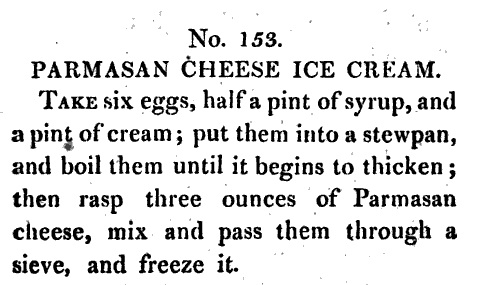
Nutt’s Complete Confectioner is just perfect when you’re looking for something to satisfy your hero’s (or heroine’s) sweet tooth: the book starts with biscuits (including chocolate biscuits, orange biscuits, and French maccaroons), continues with cakes, wafers, drops (perhaps your hero likes munching bergamot drops? Seville orange drops?), and also includes recipes for jellies, creams, ice creams and water ices (well, okay, you’d probably want to skip No. 153, “Parmasan Cheese Ice Cream”). And then, of course, there are the recipes for alcoholic beverages (elder wine, cowslip wine, orange wine, cinnamon liqueur, coffee liqueur, etc.)

Recipe for Parmesan Cheese Ice CreamFor the Victorian period, there is the ever-wonderful Mrs. Beaton, whose cake recipes often include breath-taking amounts of eggs (16 for the Rich Bride Cake!) and who also gives you advice on the duties of servants – perfect! Moreover, Mrs. Beeton’s Book of Household Management includes suggestions for seasonal dinner menus. And while there are a few dishes I really wouldn’t want to see on the table in front of me (boiled calf’s head with tongue and brains, anybody?), I’d be more than happy with the roast ribs of beef, the grilled mushrooms, with the Charlotte Russe and the rhubarb tart (yum!).

But, alas, at the moment I’m not doing research on 19th-century food. I am doing research on Roman food.

Oh dear, Roman food.

*hides behind her couch and whimpers*

First of all, there is the infamous garum, the stuff the Romans apparently poured over almost anything – like ketchup. Only, well, garum wasn’t made from tomatoes, but from fish.

Rotten fish.

In his De re coquinaria (On the Art of Cooking), Apicius included a particularly nice recipe for garum: take gills, fish intestines, fish blood, salt, vinegar, parsley and wine, throw everything into a vessel, and leave it out in the sun for three months. Afterwards, stain and bottle (= fill into an amphora).

And as if rotten fish sauce wasn’t bad enough, there is also the stuff that the Romans ate at posh dinner parties.

Think sow’s udders stuffed with giant African snails.

Or fried dormice rolled in honey and poppy seeds.

But hey, if you don’t like something, you can always pour garum over it!

[Note to self: Should you ever write another historical set in Roman antiquity, DON’T GIVE ANY OF YOUR MAIN CHARACTERS POSH FRIENDS!!!!! No extravagant Roman dinner parties EVER again!!!!]


Follow
Get every new post delivered to your inbox
Join millions of other followers
Powered By WPFruits.com