Back to Top

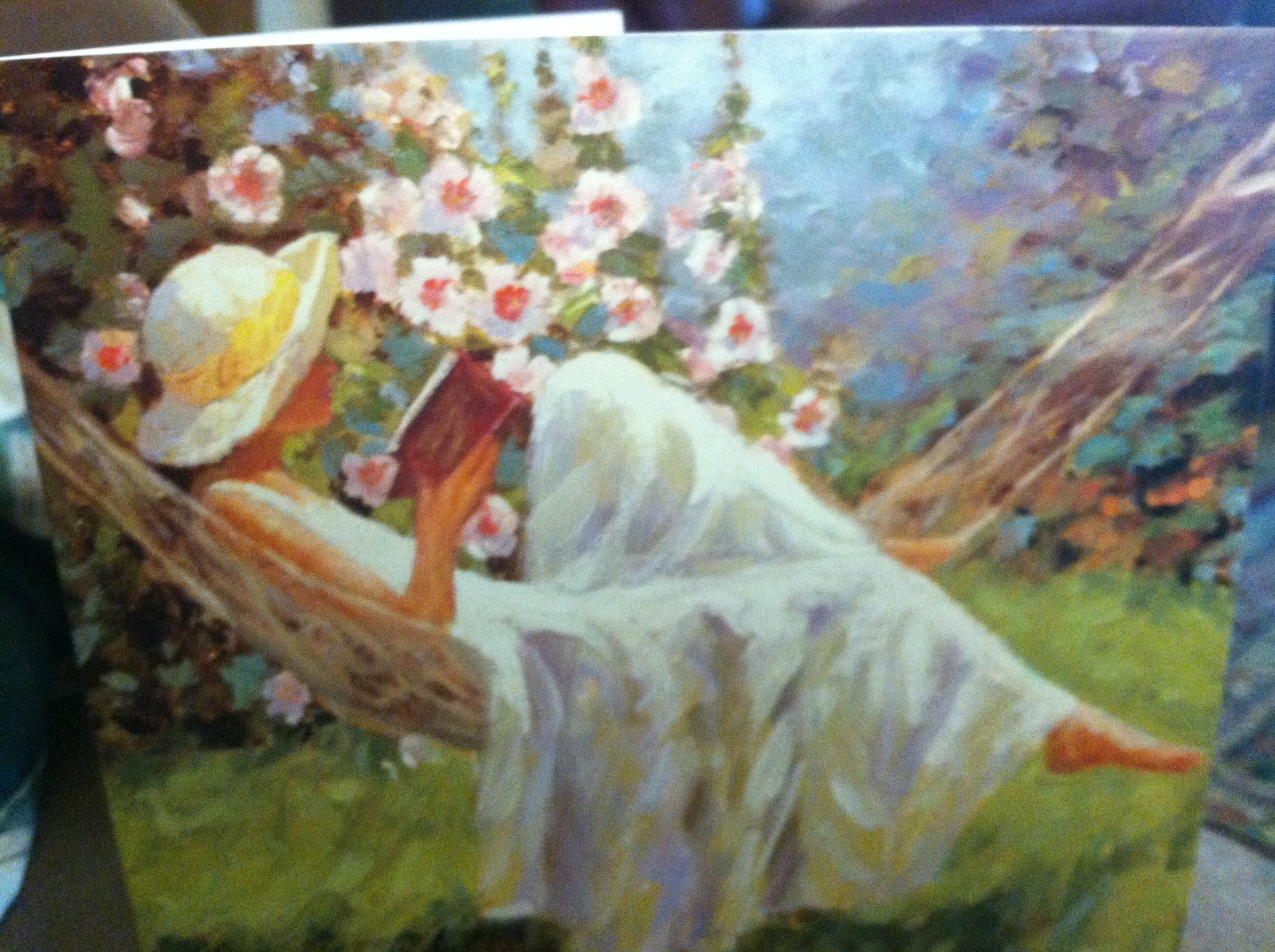
Yesterday was Mother’s Day, a lovely day for me. My daughter gave me a gift, selected from my Amazon wish list- a vegetable grilling pan for the outdoor grill. And this lovely card:

This image is called “Another World” by artist Paul C Milner

To me it perfectly conveys that feeling of being lost in a book

My daughter’s boyfriend gave me flowers, which one of the cats promptly chewed on. We rescued this one:

Along with the dh, we went to brunch, sat outside in beautiful weather and had a very enjoyable meal.

So in my lazy afternoon, I went searching for Regency quotes about mothers for today’s blog:

Let’s start with the Bard, earlier than the Regency, of course, but known to them:

Thou art thy mother’s glass, and she in thee
Calls back the lovely April of her prime
William Shakespeare

I found a quote from Coleridge:

The love of a mother is the veil of a softer light between the heart and the heavenly father
Samuel Taylor Coleridge

That was it! That was the only Regency era quote I found. There were plenty of quotations about mothers in the later years which made me wonder if Motherhood only started to become revered during the Victorian era.

Here’s a really beautiful example:

Women know
The way to rear up children (to be just)
They know a simple, merry, tender knack
Of tying sashes, fitting baby shoes,
And stringing pretty words that make no sense, 
And kissing full sense into empty words–
Elizabeth Barrett Browning

And here’s one, no time frame known, just for fun:

A man loves his sweetheart the most, his wife the best, but his mother the longest
Irish Proverb

Do you have a favorite saying about mothers?
Did you have a good Mother’s Day?

Posted in Regency | Tagged | 4 Replies

Happy Tuesday everyone!  I can’t believe May is already halfway gone.  I am buried in revisions and new projects here, but like Megan I seem to have only one major thing on my mind lately: sleep.  I can never seem to get enough of it!  So I started to wonder (as I lay awake last night thinking about all sorts of things), what would characters in historical novels take to help them sleep?

People have had trouble sleeping since time began.  I have no idea what cavemen took, but in the ancient world (Egypt, Greece, Rome) there were various herbs and things that don’t sound effective at all, such as lettuce juice, mandrake bark, something called “herbane,” and the one thing that was very effective indeed, opium derived from poppies.  (Hypnos, god of sleep, was often portrayed holding a poppy).

Nothing any better came along for a long time.  In 1805 a chemist named Frederick Setumer synthesized opium, which didn’t really change the effectiveness of the drug but led to the synthesis of various other sedatives.  By the 1850s chloryl hydrate was developed in Germany and became popular, but like opium it had a myriad of side effects and it was easy to overdose (especially when mixed with alcohol).  There also came about a variety of bromides (originally meant to cure epilepsy, but they didn’t really work for that).

By the beginning of the 20th century barbiturates such as Veronal became available, but they also had myriad unpleasant side effects.  It wasn’t really until the ’70s that benzodiazepines like Xanax and Valium were in widespread use.  Now the trend has swung back around to herbal solutions such as St. John’s Wort (which my liver doctor warns me not to try…)

What historical sleep solution sounds wackiest?  Lettuce juice?  What do you use to help you sleep?  Now I feel in need of a nap…

And now something that has absolutely nothing to do with this post but which i feel I must share:  I love this dress the Duchess of Cambridge wore last week!  I want to knock her down and steal it, if I didn’t know how ridiculous it would look on me since I am at least 2 feet shorter than her:

Posted in Research | Tagged , | 5 Replies

Since this is my writing day I’m sitting around in my nightie, listening to a CD of music by (mostly) Bach that I bought almost three weeks ago, and seeking inspiration of many kinds. And in case you’re wondering about the rest of my writing day it will consist of taking old paint cans to a recycling depot, getting a pedicure (it’s about time, they’re disgusting) and going to my local romance writers’ chapter meeting, where the lovely and smart Stephanie Dray aka Draven will be speaking. Well, it almost counts as writing, doesn’t it?

Today’s birthdays include those of William Jenner, who developed the polio vaccine, and you can see my earlier post about him here (the contest is long since closed, sorry). Also it’s the birthday of the unhappy wife of Prinny, Queen Caroline, and I thought about bloggin about her, but lord, it’s a depressing and sordid story where no one behaves well and stars two of the most unlikable protagonists ever. I know there’s been some talk about celebrating the “real” start of the Regency–2012 is the 200th anniversary of when Prinny officially took over–but I don’t know that it’s much to celebrate.

So I guess it’s time for a rant.

Mantitty.

We’re still in the era of mantitty. Several decades ago when I came of age, many of us were adamant about the gratuitous use of images of women’s bodies to sell … just about anything. We thought it showed disrespect, it categorized women as bimbos, it meant we were marginalized. And now god help us all over the web our eyes are assaulted daily by those waxed, buffed, hairless, overmuscled images that represent romance. Most of them don’t even look like human beings.

Now come on, confess. Do you really find them sexy? All that static perfection? I think I could take the waxed, buffed, hairless, overmuscled glory of it all if they were actually doing something–like moving. However, the worst ever has to be the Porn for Women book. What is remotely sexy about a man doing housework? Sure, it’s nice. But (1) why should a guy doing chores be something out of the ordinary, and (2) if the title is Porn for Women, why doesn’t it deliver? That’s not porn in my books (or on my internet). As a joke it falls flat in all respects.

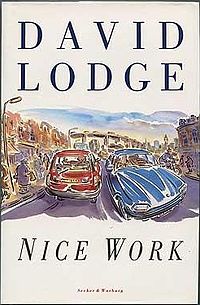
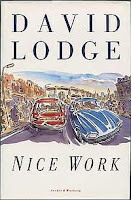
Here’s an excerpt from one of my favorite novels, Nice Work by David Lodge. The main characters are Robyn Penrose, a feminist lecturer who specializes in the industrial novel (lots of North and South references) and industrialist Vic Wilcox, and it’s set in the 1980s. Here’s a discussion of the calendar Vic’s company produces:
“What about a bit of prick and bum, too?” said Robyn.
Everthorpe looked satisfyingly taken aback. “Eh?” he said.
“Well, statistically, at least ten percent of your customers must be gay. Aren’t they entitled to a little porn too?”
“Ha, ha,” Everthorpe laughed uneasily. ‘Not many queers in our line of business, are there, Vic?”
Wilcox, who was following this conversation with amused interest, said nothing.
“Or what about the women who work in the offices where these calendars are stuck up?” Robyn continued. “Why should they have to look at naked women all the time? Couldn’t you dedicate a few months of the year to naked men? Perhaps you’d like to pose yourself, along with Tracey?”
Vic Wilcox guffawed.
“I’m afraid you’ve got it wrong, darling,” said Everthorpe, struggling to retain his poise. “Women aren’t like that. They’re not interested in pictures of naked men.”
I am,” said Robin. “I like them with hairy chests and ten-inch pricks.” Everthorpe gaped at her. “You’re shocked, aren’t you?”

Do you find mantitty covers sexy? Not sexy enough?
What do you find sexy in real life?

Posted in Reading | Tagged , | 11 Replies
So mean-looking! So sexy!

Yay Saturday! It’s been a tough week (as all weeks are…), and today I will be writing more of The Hero’s Return, the second of my 2013 Loveswept titles (No, I will NEVER get tired of mentioning that. Sorry in advance).

My hero and heroine are now in a small town, about to partake in the town’s annual Frolic, which celebrates something or another. Of course, things being what they are, they’ll discover some oddness to the Frolic, something that binds them in unfamiliarity together while the townspeople know exactly what is going on. I’m not sure what that thing will be yet, just something to bring them closer together (even as other things strive to keep them apart). Any thoughts on a weird tradition the Frolic could have? Your suggestions welcome!

Outside of that writing news, I got a website tweak, and it’s all pretty, even if the picture of me is ghastly. I just couldn’t stand to have the five year-old pic up there any longer, I felt it was disingenuous. I will be blogging more regularly, because now I like to visit my own site again. Yay!

Hope everyone is having a great day!

Megan

Long ago when I was writing The Wagering Widow, I created a fictitious gambling house run by “Madame Bisou.” I used the gambling house again in A Reputable Rake and Innocence and Impropriety. So, as I was starting my new gambling house story, I resurrected Madame Bisou’s establishment. Why reinvent the wheel?

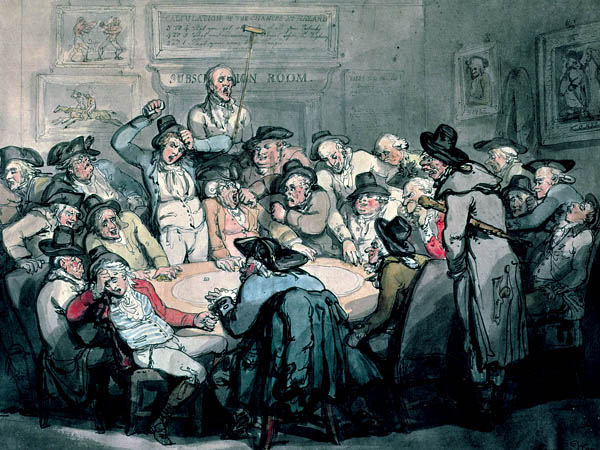
Gambling houses or gaming “hells” appear often in Regency romances, but what were they really like?
The History of Gambling in England by John Ashton gives us a good idea.
Ashton quotes a 1817 pamphlet that describes some of the actual gambling houses of the period:

BENNET STREET, ST JAMES’S. CORNER HOUSE–RED BAIZE DOOR–called A CLUB HOUSE: This is what is called a topping house, where high rank and title resort. We mentioned in the poem (the Annual Register also included a long poem about gaming houses) the luck of a certain Duke’s son there; and, of late, there has been a lucky run in favour of the frequenters of the bank–but lauda finem. Its crisis has arrived. The noble  Marquess, on the night that he lost the money at No. 40 which was closed against him, went full charged with the Tuscan grape, and attacked poor Fielder, vi et pugnis, and, at length, was necessitated to leave this house also….The receipts of these houses are immense: We know the wife a proprietor of a hell…who was so majestic in her attire, that she gained the name of Proserpine.

MRS. LEACH’S, No. 6 KING STREET, ST JAMES’S: is a particularly snug and quiet shop, and the name of the proprietor is singularly appropriate. This concern is suspended.

THE ELDER DAVIS, No. 10 KING STREET, ST JAMES’S: Is but a small affair, recently opened. It gets on swimmingly.

Most of the gambling houses had a Hazard Table. Hazard is a dice game, the precursor to Craps. There is some strategy involved in which numbers the player selects to role, but it is essentially a game of chance which always favors the house. Some houses had other games of pure chance like Rouge et Noir and Faro, both played with a deck of cards.
Gaming houses could make vast fortunes with these games of chance as this description states:

No. 10 ST JAMES’S SQUARE. A low HOUSE, HUMOROUSLY CALLED the Pidgeon hole: This snug little trap is doing remarkably well. Fama volat, that it has netted thirty thousand within twelve months.

My fictional gambling house needs to make lots of money quickly, so needless to say it specializes in games of chance!
Do you like gaming hell stories? What are your favorites?
Did you ever read the traditional Regency (a Signet, I think) that had the villain taking secret photographs in a gaming hell at night? Great research on that one….
Don’t you love the smattering of Latin and French that crops up in some of the writings during the Regency?
Follow
Get every new post delivered to your inbox
Join millions of other followers
Powered By WPFruits.com