 Following our visit from Judith James this week with her Restoration-set book The Libertine, I thought I’d write a little more about that period.
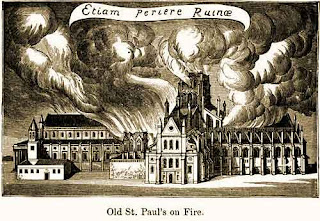
Today’s the anniversary of the Great Fire of London, which began on September 2, 1666 in the appropriately-named Pudding Lane in the bakeshop of one Thomas Farriner, who apparently forgot to bank his fires for the night. At first the fire wasn’t thought to be anything out of the ordinary–after all, in a city built mostly of wooden/daub and wattle structures, fires happened.
But the fire raged out of control, with closely packed, wooden buildings after a dry summer and with no formal fire protection going up like tinder. Over a three day period, the City of London was almost totally razed to the ground, leaving a hundred thousand Londoners homeless and destitute with an estimated 13,000 houses and 89 churches, including Old St. Paul’s Cathedral, destroyed. The estimated restoration cost was over ten million pounds and rebuilding took over thirty years, explaining why historic London, even after the Blitz, is now predominantly an eighteenth century city. eyewitnesstohistory.com has a map showing the comparative damage of 1666 to that of World War II bombings.
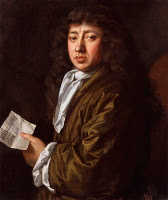 Samuel Pepys was in the thick of things, acting as liaison between the King and the Lord Mayor of London, who was instructed to pull down houses to prevent the spread of the fire:
… all over the Thames, with one’s face in the wind you were almost burned with a shower of Firedrops – this is very true – so as houses were burned by these drops and flakes of fire, three or four, nay five or six houses, one from another. When we could endure no more upon the water, we to a little alehouse on the Bankside over against the Three Cranes, and there stayed till it was dark almost and saw the fire grow; and as it grow darker, appeared more and more, and, in Corners and upon steeples and between churches and houses, as far as we could see up the hill of the city, in a most horrid malicious bloody flame, not like the fine flame of an ordinary fire.
We stayed till, it being darkish, we saw the fire as only one entire arch of fire from this to the other side of the bridge, and in a bow up the hill, for an arch of above a mile long. It made me weep to see it. The churches, houses, and all on fire and flaming at once, and a horrid noise the flames made, and the cracking of houses at their ruin.
This was the second disaster in as many years to hit the city, following the Great Plague of London in 1665 which killed 20% of the population. Oddly enough, only a handful of deaths from the fire were reported, the first casualty being Baker Farriner’s maid; but this has to be inaccurate. There was no formal record of the entire population, and parish records were destroyed. It’s quite likely that thousands of people were incinerated in their houses.
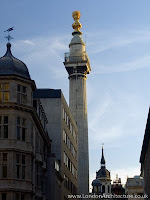 So what does this have to do with the Regency? Well, back to the rebuilding. Christopher Wren, among others, had ambitious plans to build a modern city and had the commission not run out of money after restoring public buildings (Newgate was one of the first) and churches, London might look considerably different today. More about the rebuilding here. But wooden buildings were banned, as was the style of building more and more storeys upon existing buildings, which made the spread of fire likely and lethal.
Two interesting footnotes:
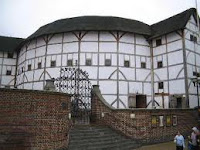 When Shakespeare’s Globe Theatre was built in Southwark, special permission had to be obtained to build a predominantly wooden structure.
And in 1986, the Worshipful Company of Bakers held a ceremony in Pudding Lane in which they offered a formal apology for the fire. As the then Lord Mayor of London, Allen Davis said, “It’s never too late to apologize.”
Samuel Pepys and fellow-diarist John Evelyn are amazing resources for this period. Have you read them? How about diaries from the Regency? Or, do you journal, and what sort of things do you write about?

 Megan has resisted the temptation to turn to a life of crime–stealing wi-fi, that is–and asked me to post for her today.