Back to Top

Monthly Archives: April 2015

I am crawling out briefly from a revision/research cave to celebrate the birthday of a woman who may not be particularly well-known in history, but who I’ve always found to be interesting, Hortense de Beauharnais, daughter of Empress Josephine, a woman whose life was made very unhappy by duty to her stepfather, but who managed to carve out a small happiness and role for herself.  Who are some of your own favorite lesser-known heroines???

hortenseHortense Eugenie Cecile de Beauharnais Bonaparte, daughter of Empress Josephine, Queen Consort of Holland, mother of Napoleon III, and interesting woman in her own right! She was born on April 10 in 1783.

Hortense was born in Paris, the daughter of the nobleman Alexandre, vicomte de Beauharnais and his wife Josephine, their second living child (she had an older brother, Eugene). Her parents’ marriage was never very happy, and they separated informally soon after her birth. Her father was guillotined on July 23, 1794, a few days before the end of the Terror, and her mother barely escaped with her life. Josephine was released from prison and reunited with her children on August 6, but it was a struggle to maintain the family financially. Two years later Josephine married Napoleon, and Hortense was later sent to be educated at the school of Madame Campan (who had been a lady-in-waiting to Marie Antoinette) in St-Germain-en-Laye, along with Napoleon’s sister Caroline. Hortense made many friends at school, and became well-known for her pretty blonde looks and her musical skill (she later composed marches for her stepfather’s Army). One of her friends at this school was US President Monroe’s daughter Eliza, who later named her own daughter Hortensia.

In 1802, Hortense married Napoleon’s brother Louis Bonaparte, despite her misgivings, and they went on to have 3 sons despite a very rocky marriage (Napoleon Louis Charles, 1802-1807; Napoleon Louis, 1804-1831; and Charles Louis Napoleon, 1808-1873, who went on to become Emperor of France). In 1806 Louis became King of Holland, and Hortense set up her court at The Hague, taking refuge from her unhappy marriage in social events and friendships (including those with handsome men!). They were deposed in 1810, but Louis remained in Holland for another 3 years, writing poetry in privacy, until forced to return to France in 1813. The couple then lived separate lives.

Hortense fell in love with Colonel Charles Joseph, the comte de Flauhaut, a man renowned for his handsome looks, sophisticated intelligence, and rumored to be the illegitimate son of Talleyrand. In 1811, at a secluded inn in Switzerland, Hortense gave birth to their son, Charles Auguste Louis Joseph (who was later made duc de Morny his half-brother). After the defeat of Napoleon and the Bourbon Restoration in 1814 Hortense received the protection of Tsar Alexander and went on living at her estate, but when her stepfather returned she supported him. On his final defeat at Waterloo, she traveled to Germany and Italy before settling at the Chateau of Arenenberg in Thurgau in 1817. There she worked on her music, had parties with her friends, and fell in love once in a while. She lived there until her death on October 5, 1837 and was buried next to her mother at St-Pierre-St-Paul church near Malmaison.

Information on Hortense’s life can be found in any biography of Josephine or Napoleon III. A couple books I like are:
Nina Epton, Josephine: The Empress and Her Children (1976)
Francois Jarry, Hortense de Beauharnais (1999). This one is in French, which I read very slooooowly, but worth the effort!
Posted in Research | 2 Replies

2015_CMA_ElenaOver the Easter weekend, I visited the Cleveland Museum of Art with my youngest daughter and a dear high school friend. Although I grew up in Cleveland, I haven’t been to the museum in years, so it was fun to tour the galleries and have lunch at the Café. Their Tandoor Grill has nice curries, Naan bread and chutneys. Mmmm….

Here are a few items of Regency interest.

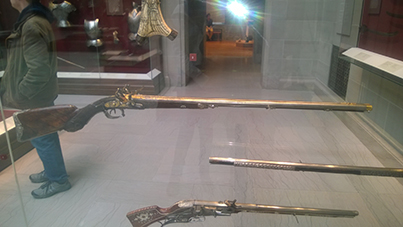
2015_CMA_Napoleon_GunThe first item is in the Armor Court, an impressive collection of armor and weapons. Most of the collection is earlier than our period of course, but this “double-barrelled flintlock sporting gun” was made in 1809 for Napoleon Bonaparte. It was made by Jean Le Page, member of a family firm who supplied firearms to the French nobility. The description says such “deluxe” weapons were often made for display and as gifts and in this case, Napoleon did give this gun to a Polish count. Read more about Napoleon’s gun and check out the Cleveland in HDR blog for a closeup that shows more detail of the gorgeous workmanship.

I picked up postcards of the next two items. Although photography without flash was permitted, I didn’t want to risk the flash going off accidentally (I am clumsy) and often the pictures in the postcards are better anyway.

2015_CMA_Hardy_SistersHere’s one of my favorite Regency portraits, what my daughter likes to call “historical selfies”. It’s a portrait of Charlotte and Sarah Carteret-Hardy, by Sir Thomas Lawrence, 1801. Sarah was married the same year, Charlotte a few years later. The contrasting personalities of the two remind me of my own daughters—one more dreamy and introspective, the other more lively and outgoing. And of course the clothes are lovely. Here’s the link for more information on the Hardy sisters portrait.

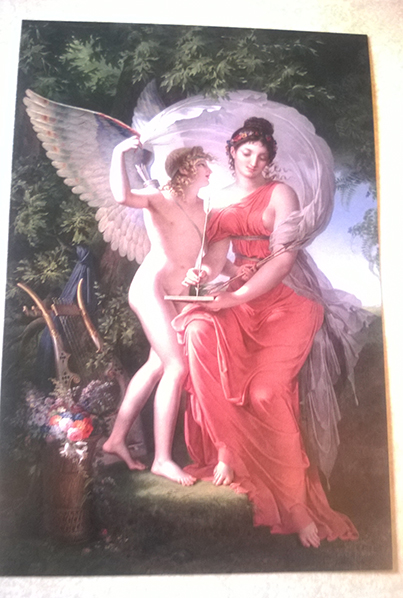
And lastly, I was charmed by a series, “Apollo and the Muses” by the French painter Charles Meynier in 1800. They include Polyhymnia, Muse of Eloquence; Erato, Muse of Lyrical Poetry; Apollo, God of Light, Eloquence, Poetry and the Fine Arts with Urania, Muse of Astronomy; Calliope, Muse of Epic Poetry; and Clio, Muse of History. The one I’m showing here is Erato.

2015_CMA_EratoHere’s a fascinating article on the restoration process. Restoring the Erato painting was particularly challenging, since another artist had over-painted Cupid’s body with a “prudish white veil” an estimated 75 years after Meynier completed the painting. Those Victorians! Fortunately, it was possible to remove the veil and restore the painting to its original beauty.

On the CMA website, you can also see the individual paintings in the Apollo and the Muses series.

Have any of you visited the Cleveland Museum of Art? (I highly recommend it.) Do you enjoy stories of restored treasures?

Elena
www.elenagreene.com

In Regency times, would you have been a “bluestocking”? How many times have you read about (or written) a heroine who either considered herself one, or was warned in no uncertain terms by her mother/aunt/sponsor or best friend against becoming one?

blue_stockingNot too long ago I was invited to join a group of Regency authors calling themselves The Bluestocking League. (A lot of authors are finding it wise to band together to help promote each other’s work.) We haven’t been very active yet, but we discovered soon after naming ourselves that another group of authors had recently formed a group called the Bluestocking Belles. You see? Bluestockings are back!! So it seemed timely to take a look at what was originally an 18th century women’s society, and in the Regency became a (derisive) slang term for educated women with intellectual interests –who might, after all, threaten the social order!

The 18th century, “The Age of Enlightenment,” earned the name because ideas and intellect flourished during the period. While women had few rights, two things they –could- do (and were expected to do) were socialize and engage in the arts. Salons were popular, and hostesses angled to have the most illustrious leaders of culture and literature as guests. The London salons hosted by the well-to-do and well-educated friends

Elizabeth Montagu

Elizabeth Montagu

Elizabeth Montagu (1718-1800), Elizabeth Vesey (c.1715-91) and Frances Boscawen (1719-1805) attracted some of the greatest intellectual minds of the times, such as the writer Samuel Johnson, and artists Francis Reynolds and her brother Sir Joshua Reynolds. By mid-century these get-togethers evolved into a loosely organized network, kind of a “women’s club” that offered more than intimate gatherings for conversation, supplying mutual support, friendship and patronage for a growing pool of writers, artists, and intellectuals. Writers Hannah More and Fanny Burney, poet Anna Seward, and artist Angelica Kaufmann were regulars among many others in later years. The women, and their male guests, also advocated for education and explored options for civic and social improvements.

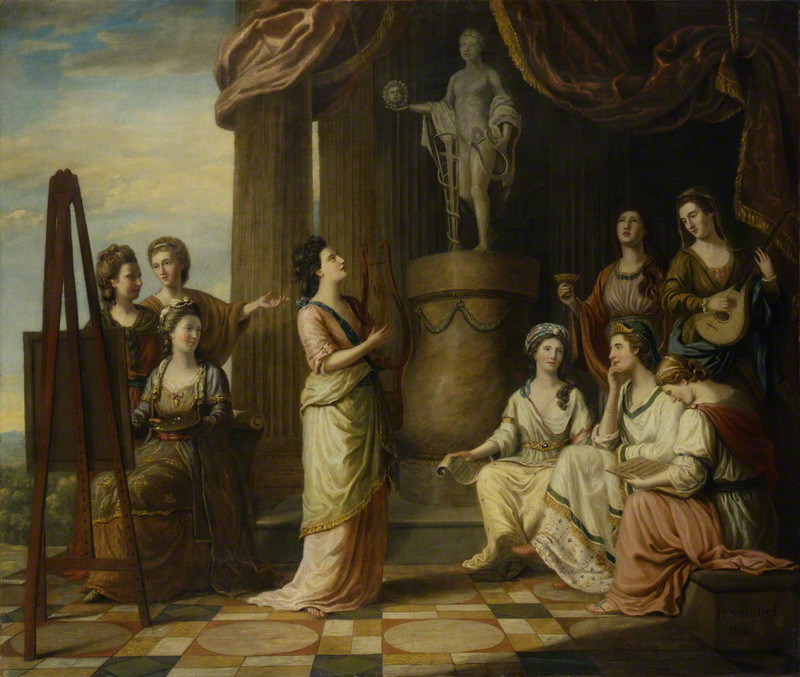
Most of the women portrayed as young Greek Muses in this group portrait by Richard Samuel were Bluestockings. Singer Elizabeth Ann Sheridan is in the centre. Artist Angelica Kauffman sits at the easel with writer/poet Elizabeth Carter and poet Anna Letitia Barbauld behind her. The five at right are (L-R) historian Catharine Macaulay, hostess & literary critic Elizabeth Montagu, and writer Elizabeth Griffith (all seated), and standing behind them, writers Hannah More and Charlotte Lennox. Some were much older than shown by the time the picture was exhibited in 1779. (Montagu was 61.)

Most of the women portrayed as young Greek Muses in this group portrait by Richard Samuel were Bluestockings. Singer Elizabeth Ann Sheridan is in the centre. Artist Angelica Kauffman sits at the easel with writer/poet Elizabeth Carter and poet Anna Letitia Barbauld behind her. The five at right are (L-R) historian Catharine Macaulay, hostess & literary critic Elizabeth Montagu, and writer Elizabeth Griffith (all seated), and standing behind them, writers Hannah More and Charlotte Lennox. Some were much older than shown by the time the picture was exhibited in 1779. (Montagu was 61.)

The story of exactly how the network acquired the affectionately applied name of the Bluestocking Society, or the Bluestocking Circle, is debated. Blue wool stockings were commonly worn for informal or daytime dress then, with white or black silk reserved for evening or more formal occasions. The informal style (and the cross-class nature) of the salon gatherings was unprecedented and set a new style for socializing. One version of the story holds that Mrs Vesey (or Mrs Montagu), inviting the botanist Benjamin Stillingfleet to attend a salon, assured the man who had given up polite society that he was welcome to come “in his blue stockings.” Another version says Stillingfleet simply showed up wearing them. OTOH, the French version of the term (bas bleu) had actually already been in use since the 1500s. At any rate, the group adopted the name with pride. The network expanded well beyond London, and probably peaked during the 1780-90’s, when Elizabeth Montagu opened her new Portman Square home for meetings, and was hailed by Johnson as “the Queen of the Blues”. Hannah More’s poem “Bas Bleu, or the Conversation” was published in 1789.

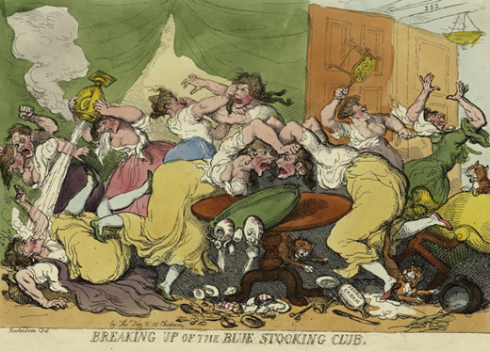
Typically, though, as the term “bluestocking” became widely accepted as a tag for an intellectual woman, it also began to be perverted into derisive slang, belittling the very values it once stood for. The original Bluestockings were dying off at the start of the Regency, and their supportive network had suffered setbacks such as the loss of friendship between Montagu and Johnson, a scandal over patronage and money involving Montagu, More, and the poet Anna Yearsley, and later, scandalous lifestyle choices made by members like Macaulay. Ridicule replaced admiration in the eyes of society –Byron scorned them and Rowlandson did a cartoon, “The Breaking Up of the Bluestocking Club” published in 1815. In the Regency, to be a bluestocking was considered tantamount to declaring spinsterhood and rejecting society. rowlandson-bluestockings

The original Bluestockings were the feminists of their day, ahead of their time in many of their ideas, but especially in valuing the female mind. Their moniker shows up these days in all sorts of ways, from the name of bookstores and a play, to a week-long celebration of women in education at UQ in Australia. I’m happy to be among women ready to reclaim the term and put it back into its original perspective and meaning. So, are you a bluestocking, too?

If you want to read more, there’s a great article connected to an exhibit at London’s National Portrait Gallery: http://www.npg.org.uk/whatson/exhibitions/2008/brilliant-women/the-bluestockings-circle.php, and another with great detail at https://bluestockingssociety.wordpress.com/the-blue-stocking-history/.

Also, there’s a book: Biographical Sketches of Principal Bluestocking Women, by Anna Miegon. I want to read it now! There’s also a collection of essays: Reconsidering the Bluestockings, by Nicole Pohl & Betty A. Schellenberg, and much more, of course. I think the original Bluestockings would be pleased to see how far we women have come, don’t you? Although perhaps dismayed that it took as long as it has, and that we still have more to achieve. What do you think? Please comment!

So I spent most of the day staring at my computer screen half-petrified because I realized this morning that today is April Fool’s day & I have to write a post &, oh my gosh, do I need to write something funny?!!?!? I’ve toyed with several amusing headlines – “The Riskies Will Only Write Zombie Books From This Day On! (and our heroes’ manly appendages will all fall off all the time!!) (or something),” or, “We Just Wanted To Tell You That We Are All Aliens From Outer Space Pretending To Be Romance Authors, But Please Don’t Mind Us & Carry On” – but, well…

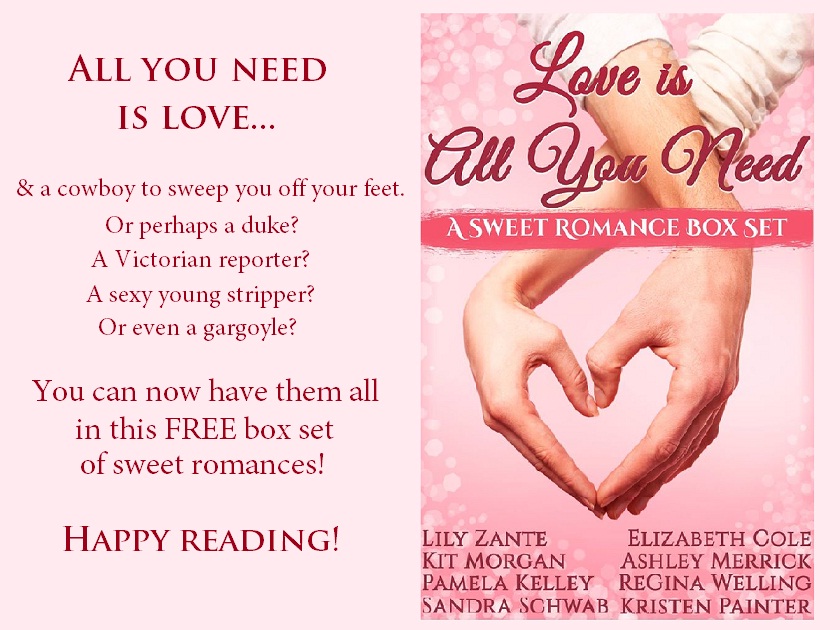
Instead of talking about zombies, wonky manly appendages, and aliens, I’ve decided to turn to much nicer things, like my super-seekrit project: I’ve taken part in a multi-author box set of sweet romances, which came out earlier this week. And did I mention that the box set is free? 🙂

the cover of Love Is All You Need, a box set of sweet romances
I also caved in and added a few more titles to my research library. Among other things, I’ve finally ordered Chatsworth: The Attic Sale, the catalogue of the auction at Sotheby’s in 2010. In expect to find many interesting items in there! Here’s a short YouTube video about the auction:

Moreover, I also stumbled across a number of fascinating research experiments in the form of historical enactments, of which two are of particular interest to the Regency period: in Pride & Prejudice: Having a Ball a Regency ball is staged at Chawton House, the estate of Austen’s brother. The documentary is only 90 minutes long (or rather, short), but it still provides some fascinating insights into the practicalities of preparing the food, of the dancing itself, and the supper that followed.

And then I also found a series about music in the country house. I briefly dipped my toe into this field when I wrote Springtime Pleasures and had my heroine swapping music books with her new friend. “Music’s Hidden Histories” is a joint project of the University of Southampton and Tatton Park. The short videos are all available via the Humanities Southampton YouTube channel:

For now, though, I’m going to return to Roman antiquity and my dashing centurion Marcus Florius Corvus. I’m really looking forward to celebrate the launch of this new series with you next month!

the covers for Sandra Schwab's new series EAGLE'S HONOR


You can find Love Is All You Need on Amazon US, UK, CA, Kobo, Apple, B&N. Happy reading!

Follow
Get every new post delivered to your inbox
Join millions of other followers
Powered By WPFruits.com