I am on a wicked, wicked deadline that might just actually kill me. So today, you-all get this:
WordNik Oh my good gosh how I LOVE this site. Do a search for signify which is a lovely Regency-era word. It’s become my go to place for looking up words and doing, uh, research. Yeah! That’s it. Research.
They have charts! Charts about words. <3 <3 <3 You'll notice that in 1807 this word was used a lot and then blam. Not much at all until, perhaps not so mysteriously, about 1985 it looks like, things really took off. That would be about the time Literary Theorists like Derrida, Barthes and more began talking about signifiers.
Middle English signifien, from Old French signifier, from Latin significāre : signum, sign; see sign + -ficāre, -fy.
I don’t know about you, but I’m practically swooning.
Plus, quick! Everyone go tweet the word signify, then all the Riskies and their readers will show up on WordNik!
Now go look up reticule. Well, did you notice the chart?
Did you notice you can comment? Seriously. You leave comments on the words, and some of the comments are AWESOME!
So, I’ve been a bit crazed the last few days with a Looming Deadline (3 weeks away, ack!) plus a weekend full of holidays and parties (Mother’s Day, graduations, etc) and I had no idea what to write about today. So I did a search to find out what sorts of fun things happened on this day in history. I discovered that Italian ballerina Fanny Cerrito was born on this day in 1817 (she was a prima ballerina at La Scala and one of the pioneers of dancing en pointe. She also lived a very long life, until 1909, and was able to see the Ballet Russes perform). I also found a factoid that said the waltz was introduced in England on this day in 1812. I could find no confirmation of this, which seems a bit suspect. How could they know what day that happened?? And it seems like it would have been a bit earlier, though I’m not sure. Still, it’s fun.
I’ve been thinking about dancing a lot lately. I started a new part-time job, teaching a ballet class for 5-year-olds on Saturdays. Right now I’m helping them get ready for their recital in June (it’s an “Alice in Wonderland” theme, and this class is going to play the pack of cards in little white tutus printed with card faces. SO Cute!), but then I’ll teach a smaller class for the summer, for students who are “more serious” and don’t want to lose a couple months of lessons. So far so good. The first day I thought those 5-year-olds were going to kick my butt–I have never seen so much energy in one room before, all bundled up in adorable black leotards, pink slippers, and hairbows. They’re extremely enthusiastic in their plie-ing and jete-ing and can do a mean fifth position. But we’ve come to an understanding now, and I’m having lots of fun with my tiny Pavlovas. We may have to have a Regency “waltzing party”!
And I pulled a few books off the shelf to try and find more about the history of the waltz. (Gerald Jonas, Dancing; Richard Stephenson, The Complete Book of Ballroom Dancing; and Boyd Hilton, A Mad Bad and Dangerous People: England 1783-1846 were very helpful). It seems Montaigne wrote in 1580 of a dance he saw in Augsburg where the dancers held each other so closely their faces touched, and in the same period a man named Kunz Haas wrote “Now they are dancing the godless Weller or Spinner, whatever they call it”–seemingly a vigorous peasant dance.
By the late 17th century, ladies at the royal Court in Vienna were spun around the room to the tune of a 2-beat measure, which grew into the 3/4 time of the so-called Nach Tanz (“after dance”) and moved with a gliding step. Meanwhile the peasants enjoyed dancing something called a Walzer, which came to notice around 1750. Another country dance, the Landler (which can be seen in The Sound of Music!) spread from the countryside of Austria and Bavaria and into the towns and cities. The hopping motion of the Landler developed into a graceful sliding step, with a gliding rotation replacing the stamping rotation of the folk dance. It was said that while the nobility at Court still mostly danced their staid minuets, many of them were sneaking off to dance at their servants’ parties! (18th century Dirty Dancing??)
In the 1770s, a visitor to Vienna named Don Curzio wrote, “The people were dancing mad! The ladies of Vienna are particularly celebrated for their grace and movements of waltzing of which they never tire.” Deeply shocking when first introduced (the couples faced each other! And touched more than just a hand!), the waltz was all the fashion in Vienna by the 1780s and spread across Europe. In England, it was still considered “riotous and indecent” in 1825! (It’s a good thing they never went to a tango party!). Young ladies did not waltz without express permission. The scandalous Caro Lamb was especially fond of having “waltzing parties” in her drawing room, which should tell us something. But the waltz is now the precursor to many of the ballroom dances we know today (like quickstep, foxtrot, etc). Of course, the waltz of the early 19th century looked quite different from what we see on Dancing With the Stars (as you can see from the YouTube video below, which I so much enjoyed watching!)
What are your favorite dances (or dancers)?? Any good dance recital stories? (It seems when I was about 3 and in my very first performance, I brought the ballet to a screeching halt by sitting down onstage in my tutu to examine some confetti. I have no memory of this and deny it). What are you up to this Tuesday?
I hope everyone–especially the mothers–had a Happy Mother’s Day. My in-laws visited for the weekend and we went to the new Workhouse Arts Center, created from the former prison in Lorton, VA. It is a wonderful place where artists create and sell their art, everything from photography to textiles to glass to painting and sculpture. All kinds of creativity.
So it was only fitting that my daughter gave me “art” for mother’s day, a print she found in a thrift shop (she also bought me a necklace and my son gave me chocolates, which was a whole ‘nuther great gift).
I haven’t had time yet to look up what type of soldier this is. I think he’s French…Believe me, I have a few uniform books I can look though to find out. But I love him. Mostly I love that my daughter saw this print and thought of me.
Another thoughtful gift I received recently involved my uncle, aunt and her sister, who is no relation to me. A long time ago my uncle, who lives in Florida, asked me for the Regency Fashion print I’d used for a Christmas card. I sent it to him wondering a bit why he wanted to have it.
Then a few weeks ago, I received a HUGE box in the mail with this gift inside. My aunt’s sister makes these doll wall hangings as a craft. She copied my Regency Fashion print and made a doll of it Isn’t this clever? Even the face is similar to the print. I love the way she made the hand holding the cape open.
Like my daughter’s gift, this was both unexpected and thoughtful. It went straight to my biggest obsession–The Regency. How grand is that?
Have you received a gift that was both unexpected and incredibly thoughtful?
Remember that my day to blog at Diane’s Blog is Thursdays! Come visit me then too.
This week, RWA’s National Conference was moved from Nashville, TN to Orlando, FL. This was necessitated by the devastating flooding that hit Music City, USA; the hotel at which the conference was to be held is under at least six feet of water.
RWA moved with amazing speed, rebooking the conference for the same dates within two days in Orlando. Immediately, my close friend–and usually on-same-page-as-me-with-most-everything twin–Liz Maverick said we had to go to Disneyworld. To which I replied, “No effing way.” Only I didn’t say ‘effing.’
I have to admit: I hate Mickey Mouse. Despise him. Loathe him. I know it might be odd, in any other context but ours, to admit to hating a fictional character, a cartoon fictional character no less, but I know my fellow readers will understand.
Some fictional characters are so real you can have as potent emotions about them as you would people in your real life. For most of us, it’s the heroes and heroines we recall, but what about the people we hate? Aunt Reed in Jane Eyre, Obadiah Hakeswill in the Sharpe series, Iago in Othello, heck, Scar in The Lion King!–clever, smart, wicked people who almost get the upper hand in their dealings with the more heroic characters. Mickey, to my disgust, has nothing delightfully villainous about him. I cannot stand his white gloves, his high voice and the fact that he is not funny. I wish he were devious, the way Daffy Duck is (I know one is Disney and one is Warner Bros.; bear with me). He’s not dumb, but he’s not smart, particularly. He’s left his girlfriend hanging for years, and he has no visible means of support. I just can’t stand him or his stupid little ears.
But, meanwhile, I will be happy to be in Orlando, and am always happy to talk about the Most Wickedest of Villains here; who do you nominate? Which villain, to your mind, is the most memorable?
Still on hideous deadline and finally taking a day off from the dayjob to write, I found it difficult to pick a topic today. There’s so much going on–an historical general election in the UK, RWA’s national conference change of location to Orlando, FL and why I’m the only person supremely uninterested in the culture of The Mouse, and an announcement.
Oh, okay. The announcement first. I’m taking part in an anthology of Austen-inspired short stories edited by Laurel Ann Nattress of Austenprose with a bunch of Big Names. It will be published some time in 2011 and that’s about all I know. Exciting!
But now let’s talk about pencils. Yes, pencils. I am supremely grateful to pencils because they are about the only way I can plot, as much as I can plot anything. Pens don’t work, computers definitely don’t, but there’s something about a pencil and paper that just do it for me in terms of working things out, creating schedules or lists–it’s pencils all the way for me, baby. Maybe it has its origins in learning to read and write and draw. Does anyone else suffer from this pencil affliction?
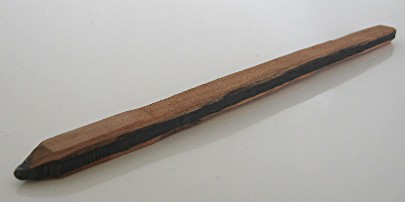
So, pencils in the Regency. England had been a major producer of graphite since the sixteenth century, when the mineral was discovered in England in Borrowdale in the Lake District, and used first to mark sheep. The Borrowdale mine produced the purist graphite in Europe. But graphite was valuable for more than pencils: it was used to line molds to make cannon balls. Graphite was mined under great secrecy and sold under strict conditions in London. There’s a great article at The Regency Redingote, a site I only just discovered today.
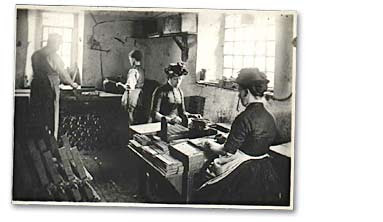
At some point in the eighteenth century, the pencil was “invented”–that is, graphite secured between two pieces of wood (cedar), and produced as a cottage industry until the first pencil factory was founded in 1832.
If you’re in Keswick in the Lake District and it’s raining (which it usually is) you can drop into the Cumberland Pencil Museum to learn more and see the biggest pencil in the world.
Does anyone else experience the pencil-creativity phenomenon? Do you have a favorite writing instrument?