Back to Top

Today I’m sharing all my bread secrets. Bread, but rather unlike the stuff we eat now, was the staple food of the Regency, for the poor in the form of the quartern (four pound) loaf. The Corn Laws, protecting landowners from foreign imports of grain, caused the price of bread to rise dramatically and created much hardship.

Bread in its basic form is yeast, flour, salt, and water. That’s it. Regency yeast would have been skimmed from frothy nasty stuff in beermaking or a form of sourdough from a baker. It would not have had much rising power and the wheat was a soft (i.e. low in gluten) variety so the bread would have been rather solid. Bread takes a hot oven and most poor people bought bread, not owning the fuel or a suitable oven to bake it, thus putting them at the mercy of ever-rising prices.
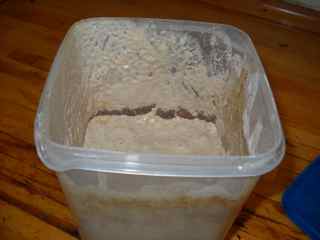
I use a sourdough and here it is. Looks disgusting, doesn’t it. By the way, sourdough is very easy to make and maintain. I read all sorts of dreadful rubbish online about the complexities and terror of sourdough, but here’s the dumb easy way: 2 cups flour, 2 cups water, half Tbsp. yeast. Mix. Let it stand loosely covered (rogue yeast in the air will come a-courting). Stir and take out a cup or so every day, add an equivalent amount of water and flour. After a week transfer it to the refrigerator where it will need a stir and feed weekly. It will go on indefinitely, smelling like beer and producing thin brown liquid (alcohol) and sometimes a rather revolting skin. Some sourdoughs are very old. Mine is only a month or so old.

I make a lot of bread so I don’t usually measure but generally 1 Tbsp yeast to 2 C liquid makes a couple of loaves. I use the sponge method, where you start off with the elements–yeast, water, sugar (not essential but cheers up the yeast). Myth #1: you don’t need to bring your liquid to a boil and let it cool, even if using milk–milk is all pasteurized now. You don’t even have to warm it, but again, it keeps the yeast happy. Myth #2: you must keep everything warm. Cold slows down the yeast but it’s heat that kills it, which is what happens when you bake–otherwise it would eat the oven.

It is a time consuming process but consider this–you can let bread rise overnight, or during the day in the refrigerator. You can freeze dough and bring it back to life at room temperature. It’s very forgiving. I started yesterday’s bread at 4:30 and it was cooked ten hours later but that’s because my sourdough does not work fast. You can make a whole bunch of dough and store it in the refrigerator, where its flavor will improve, and cook it up as you need it.

Since sourdough takes a long time to prove (raise the bread dough) I usually toss in a little yeast, about half Tbsp, and a Tbsp or so of sugar, and enough flour to make a sort of mud. Then you beat the crap out of it. 200 strokes should give you a nice smooth bubbly mud, and the bubbles show that the yeast is having babies. Good!

Cover it with a damp teatowel (or plastic wrap) to keep bugs and cool breezes out and let sit. I gave mine a couple hours in a mid-60 room and this is what happened. Many bubbles. Many yeasty HEAs and epilogues.

Stir down and add in the elements now that inhibit rising–salt, a good splash of olive oil, and I added in some cooked and cooled quinoa and rolled oats this time to up the protein. And then you add in flour. Lots of flour. Incidentally this is the method, if you just keep adding and adding flour, that is the “no-knead” technique. It’s a workout. But we’re going to knead.

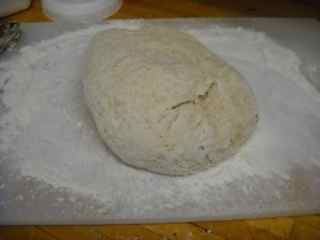
You dump it out onto your floured work surface and it’s a horrible sticky mess. (The black thing is a plastic tool for scraping out the bowl.) You knead in more flour. Your hands look like a zombie’s. (Go to youtube for lots of kneading demos.) I love this part of the process when the dough starts changing, becoming smooth and shiny. And you end up with this, on the right.

At this point I abandon my nice ceramic bowl and use my dollar store plastic containers because it’s so much easier to assess the progress of the bread. You want it to double in size which will take a few hours. Slow rising = good flavor. But you don’t have to watch it. You can go write or read. And then, you meanie, you punch it down, which means you press it down with your knuckles (right) and let it rise all over again. You can skip this step; last night I pulled off a large chunk to make pizza (no pics, we ate it all).

After it’s doubled again (or got pretty close) you punch it down once more and transfer it to your working surface. I’d decided to make mine cinnamon-walnut-raisin bread so I rolled it out and added those ingredients, and then folded it over and over to knead them into the dough.

Here’s the dough shaped into loaves and put into my amazing French bread pan made by Chicago Metallic (this is an excellent site for bread porn, as is the King Arthur Flour site). It’s perforated which creates steam and a crunchy crust.

Cover it and let it rise some. I usually lose track of how long this takes. Preheat the oven to 400 degrees. You need a hot oven. You can put an egg-milk wash on your loaves if you like. You know when they’re done if they look like, well, bread, and have some color and sound hollow if you tap the bottom of the loaf. This is why it’s essential to invest in a high quality bread pan where you can tip the loaf out and examine it.

And here they are, all cooked and lovely:
Yum!

Tell me what you like to bake. Bread, cake, cookies? Try some bread and let me know how it turns out.
Posted in Research | Tagged | 5 Replies

TGIF, everyone! No, it’s not Elena today, it’s me, Amanda, popping in as a substitute (I was a bit catatonic on Tuesday after a deadline…)

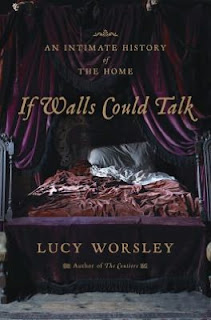
Even though I’ve been in my writing hole a lot lately, I have managed to get out and enjoy the early spring weather (I’ve been wearing shorts! In March!) and also reading. One book I picked up is Lucy Worsley’s tremendously fun If Walls Could Talk: An Intimate History of the Home. (Worsley is the chief curator of Historic Royal Palaces, a job of which I am deeply, deeply envious). As a fan of historical domestic trivia, I gobbled it up, and I’m hoping the series that goes along with it comes out on DVD in the US soon). It’s similar to Bill Bryson’s equally fascinating At Home, but a little more fun and anecdotal. It follows the progression of 4 main living areas–bedroom, bathroom, living room, kitchen–from medieval times onward. (just a quick note–while there are lots of fun facts as well as wonderful illustrations and lists of references, this is mostly “upper and middle class” life, not a comprehensive look at all classes…)

A few fun facts I gathered:

–It was 1826 when coiled metal springs replaced the old rope bed cords that had to be tightened often (and cotton replaced itchy wool as mattress covers). And did you know it took over 50 pounds of feathers for a feather mattress??

–Men’s underwear (drawers) began to appear regularly in the 17th century (William III was very fond of garish colors like red and green!), while women’s fashions “simply precluded wearing knickers. So ladies went commando and squatted over a chamber pot when required.” Regency fashions, with thinner fabrics and slimmer silhouettes, required drawers, but they were still Not Talked About. Here’s an account of what happened when, on a walk with friends, the Duchess of Manchester went keester over teakettle over a fence in 1859: “The other ladies hardly knew whether to be thankful or not that a part of her underclothing consisted in a pair of scarelt tartan knickerbockers which were revealed to the view of the world in general”

–In Tudor times, a medicinal remedy for a frigid wife was to run “the grease of a goat” on her ladyparts. This seemed to help–though probably not for the reasons they thought (that a goat was lusty, therefore this would transfer the goat’s characteristic to the people). Enemas for constipation were administered via a pig’s bladder attached to a tube–one night Henry VIII used this remedy and it was reported he gave his velvet-covered toilet “a very fair siege.”

–In medieval times people actually bathed quite frequently, washing hands and faces frequently and taking soaking baths with various herbs (bathhouses became quite popular when knights brought the Middle Eastern custom back from the Crusades). But the “dirty centuries” began about 1550 and lasted to about 1750, “during which washing oneself all over was considered …to be weird, sexually arousing, or dangerous.” Also, to get stains out of linen, a great bleach was urine…

That’s just a small touch of what can be found in this book! There is stuff about dentistry, makeup, toilets/sewers/toilet paper (“stool ducketts” were squares of linens used in Renaissance bathrooms), cluttered living rooms, heat and light sources, food and drink (the once-rare luxury of tea; the constant state of at least mild drunkeness in the Middle Ages), and so much more. It’s such a fun book.
What have all of you been reading while I’ve been buried here at home???

Posted in Research | Tagged | 8 Replies

Many of the Riskies–probably all, when I review all of our books–have had our heroes and heroines cross class lines to find love.

Right now, I am revising a manuscript where a genteel woman meets and falls in love with a member of the aristocracy. And I am reading Loretta Chase’s Silk Is For Seduction, where a dressmaker meets–and presumably falls in love with–a member of the aristocracy. A duke, no less.
Now, we’ve all discussed how dukes are very thick on the ground in our romances, and that it would be near impossible for a duke to actually marry someone who didn’t share some of his aristocratic blood lines. So just pretend the hero or heroine is a member of the aristocracy, but not as high as a duke; can you suspend disbelief enough to think they’d fall in love? I know it happened in real life, if rarely, and could those couples look forward to a married life of ostracism from the ton? How different would their worlds be?
In my heroine’s case, she’s never left the small village where she grew up, and now she is heading for London, where she will be introduced as the hero’s wife. I’m wrestling with how much she would know already, in terms of polite behavior, and if she would be absolutely freaked out upon encountering London. She does take things in stride, generally, but it would still be a shock.
Last question, do you like reading romances where the couples cross class lines? Which are your favorite?
Thanks!
Posted in Reading, Writing | Tagged | 8 Replies

michelleDiane here, welcoming back Michelle Willingham.

Michelle has returned to the Regency for the moment (taking a little break from her scrumptious Highlanders and Irish Warriors) and comes to talk about her latest venture, her first Montlake release, Undone By The Duke.

Raves for Undone By The Duke

“Well written, aptly conveying a strong sense of family among the sisters, the quartet shows great promise.” –RT Book Reviews, 4 stars (HOT)

undonebytheduke“A tender, exquisitely romantic tale. I so enjoyed this quietly intense and richly satisfying romance.” –Connie Brockway

Giveaways

Michelle has four giveaways today to four lucky commenters who will be chosen at random from all the comments. One lucky winner will receive either an ebook or mass market copy of Undone By The Duke (winner’s choice), but Michelle is also giving away one ebook each of The Accidental Countess, The Accidental Princess, and An Accidental Seduction. Read some exciting new information about these books at the end of the interview!

Welcome back, Michelle!

Interview

1. Tell us about Undone by the Duke.
Undone by the Duke is the story of an agoraphobic heroine, Victoria Andrews, who hasn’t gone outside in five years and a wounded duke who ends up
stranded on her doorstep in rural Scotland. This is the first book in the Secrets in Silk quartet, and it’s a cross between Little Women and Project Runway. Instead of sewing dresses, the sisters sew corsets and chemises. And, yes, the scandalous underwear is Victoria’s secret.

2. I think this is our first Montlake book. How was it to work with Amazon Montlake?
It was wonderful! Just to clarify, Montlake is a traditional romance publisher owned by Amazon. Some of Montlake’s authors include Connie Brockway, Kendra Elliott, Melinda Leigh, and Robin Perini, to name a few. There are a few differences in working with Montlake, namely that it’s a true team effort instead of just you and your editor. There is an acquisitions editor who buys for the house (Kelli Martin was mine). Then when it was time for editing, my book was edited by Shannon Godwin, who formerly edited for Harlequin. What I liked about this system is that the developmental edits were done by one person who wasn’t worrying about marketing, scheduling, acquisitions, or office meetings. Her focus was only on making my book the very best it could be. Then it went back to Montlake, had copyedits and galleys, and publicity was done by our in-house publicist. We also have an Author Team for any questions that come up along the way. It’s like a concierge where questions not involving the book can be handled. It’s great when you have a small question and don’t know who to ask.

3. You and the book got a mention in February’s issue of RT Book Reviews. Tell us about that.
We found out that RT was writing an article about historical underwear in the February edition, and since my book was released on February 12th, the timing was perfect! One of my favorite resources regarding unmentionables was The History of Underclothes by C. Willett and Phillis Cunnington. I also visited various museums, but the best research was when I attended a Beau Monde function, wearing a Regency re-enactment gown that was laced up the back. During that process, I learned how impossible it was to dress (or undress) yourself without help*. I used this experience in The Accidental Prince, where my princess heroine is stranded without a maid and has to sleep in her clothes.

(*Diane note: I think Michelle’s modiste that night was our Riskie Amanda!)

4. What is risky about Undone by the Duke?
Definitely the naughty underwear and the risk of scandal! These are four sisters whose parents are deeply into debt and Victoria believes her sewing can lead to prosperity for their family. But when she gets the idea to make the chemises and corsets out of silk and satin (instead of gowns), she never dreamed that the garments would take London by storm. There’s an enormous risk in keeping the secret of who is making the garments, for it will destroy their reputations if anyone finds out who is responsible.

In reality, it’s unlikely that women would buy underwear out of those fabrics, because the lye soap used during that time would burn right through it. You could only wear the underwear a few times and then you’d have to discard it. But there were women during that time who were so wealthy, they could wear a gown once and never wear it again. That’s where fiction and reality could intersect–because a woman rich enough to do this with a gown could certainly afford high-end underwear. So it was a fun concept to play with.

5. Did you come across any interesting research while writing the book?
Some Regency men wore corsets! The Prince Regent and many dandies sometimes wore a Cumberland corset with a whalebone back. And no, I will never put a hero in a corset. Can you imagine a scene with the hero and heroine trying to undress each other? The horror

accidentalprince6. What is next from you?
On February 19, The Accidental Prince will release from Harlequin Historical. This book is the third in a trilogy, and it’s a Cinderella reversal where the handsome prince becomes a pauper and must marry a
princess to regain his kingdom. The previous titles in the series have been discounted online from February 13-March 13 in e-book format. The Accidental
Countess (book one) and The Accidental Princess (book two) will be on sale
for $1.99. The prequel novella, “An Accidental Seduction” will be on sale
for $0.99.

Now I have a question for your readers. Since this is February, the month of Valentine’s Day, many people give flowers to their sweetheart. What’s your favorite flower to receive?

Diane here again. Remember, Michelle is giving away one copy of Undone by the Duke (reader’s choice of ebook or paperback) and one Kindle copy each of The Accidental Countess, The Accidental Princess, and An Accidental Seduction. So answer Michelle’s question or ask of question of your own or make another comment for a chance to win. I’ll randomly pick the winners after midnight on Monday Feb 19.

WLR_logoAnd if you are in the Washington, D.C., area today, Sunday, Feb 17, Michelle and I (and several other DC area Romance authors) will be attending the first ever Romance Lovers Get Together, where readers and authors can meet and chat, at Arlington Rooftop and Grill, 2:30 – 4:30 pm. If you can come, be sure to introduce yourself to me and tell me you read Risky Regencies!

I approach writing my weekly Risky Regencies posts as I do my fiction writing: I let my mind wander and seize on something that seems like it might go somewhere. Usually, it works, at least enough for me to get something tapped out on the keyboard.

But today? I am Tapped Out. I officially have NO IDEAS for this post. Which means, unfortunately for you all, I’ll have to let my mind wander as I type, not just show the finished product.

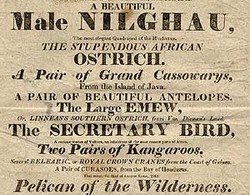
Yesterday, my son, my father and I went to the Bronx Zoo, which is truly spectacular. It made me think about what zoos were like in the Regency–pretty pathetic things, I think, and I am pretty sure they were called “menageries,” not zoos, and can you imagine how poorly the animals were treated? Horses were treated well, they had to carry the Men on their Important Hunting Expeditions, after all, but other animals did not get very good treatment. No wonder our heroines always befriend cats and dogs and the like.

I was also thinking about what made a plot good–sure, there’s that catch in the throat when you’re not quite sure the author is going to live up to the expectations of a romance, and are they really going to get together, because sheesh, it sure seems like there’s no way they can get out of this mess, not without a lot of deus ex machina. And when they do, you’re almost pathetically grateful to the author for making us breathe easier. Mary Balogh is the queen of this, and she makes my heart stop almost every time I read one of her books. Who does that for you?

And the weather–our heroes and heroines did not have the benefit of central air, heat, or Polartec fabric. It’s gorgeous here on the East Coast now, and the crocuses are starting to spring up and the weather will be in the 70s today, and it fills one (meaning me) with a feeling of enthusiasm and joy. I wonder if our heroes and heroines felt the same, only moreso, because they were confined inside their drafty houses? Or did they combat their winter lassitude by doing all sorts of outdoorsy things that put a sparkle in their eyes and a healthy pink blush in their cheeks? Did they even talk about seasonal depression?

Now, here’s the class participation part: When your mind wanders, what does it wonder about? What authors make your breath catch in your throat? And is it Spring where you live? If so, what’s the part you like the best about Spring?

Megan
www.meganframpton.com

Follow
Get every new post delivered to your inbox
Join millions of other followers
Powered By WPFruits.com