(Today at Risky Regencies we’ve invited Andrea Pickens to be a guest blogger, and tell us about her newest release The Scarlet Spy! Comment for a chance to win an autographed copy…)
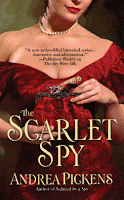 “Deftly blending an expertly realized historical setting and a deliciously subtle sense of wit, Pickens gives the popular espionage-tinged Regency plot a refreshing new twist as she brings the Spy trilogy to a spellbinding conclusion”–Booklist
Hi everyone! Amanda has invited me back to the Riskies to talk about my new book, which hit stores October 1. First of all, it’s so great to be back here among such a fun community of readers. I love stopping by and seeing all the smart, savvy discussions–and I never cease to be amazed by all the great things I learn here. It’s–well, it’s humbling. And inspiring, for I feel a knowledgeable, discerning audience challenges an author to try to create something really special.
Now back to the book! The Scarlet Spy is the third in my Regency-set “Spy” trilogy. The series revolves around the idea of a secret school for female spies. The students are orphans from the rough slums of London, who are trained in the art of swordplay and seduction. They’re tough, courageous, and smart (not to mention sexy!). Yet they also have an inner vulnerability.
For me, this was the foremost challenge–to create strong heroines who had very complex, and at times opposing, facets to their characters and use those conflicts to make them interesting and appealing to present-day readers. And I liked the idea of turning tradition on its ear by making women the kick-ass agents. After all, the Regency was really the beginning of the “modern” world, when so many old assumptions and attitudes were being questioned in art, politics, science, and society in general. The wars raging throughout the Continent reflected this clash of old and new. Women, in particular, were rebelling against the constrictions of the past. Many weren’t content with traditional roles and dared to explore their passions.
I’ve tried to make each of the three heroines very different individuals, and place them in different settings. Siena, from The Spy Wore Silk, is a brooding, introspective agent whose assignment involves attending an art auction at a rambling manor house in the wilds of Dartmoor. Shannon, whose explosive temper gets her in trouble, is the star of Seduced By A Spy. She sees action in Ireland and the Highlands of Scotland, where she teams with a rakish Russian spy to defeat a French assassin.
Sofia, who is featured in The Scarlet Spy, is the most ladylike of the three. Unlike her roomates, she has a natural grace and regal bearing. So it seemed right to put her in the heart of London, with a mission that calls for her to be introduced into the ton in order to learn who is running a ring of corruption operating in the highest circles of government. Not only does she spin through the glittering ballrooms of Mayfair, she also must explore the seedier parts of the city, where drugs and high-stakes gambling are just a few of the vices that abound.
I was very careful to base my plot on the realities of the time. For instance, smoking opium attracted a number of rich aristocrats who were drawn to “living on the edge.” One of the things that excites me about writing historical fiction is trying to make history come alive for those who might now know much about a particular era. For some odd reason, I’ve always been fascinated by the past–maybe because there are so many parallels to the present. I love trying to conjure up the taste, the smells, the feel of an era, so that it becomes richly textured, relevant, and real to readers.
That said, some readers have complained that my books aren’t “traditional Regency stories.” In other words, they are Risky! I take that as a huge compliment. Those who think the Regency just a polite world of formal tea parties and balls, governed by rigid rules of decorum that no one ever dared to defy have obviously never read the posts here. As all the Riskies have often pointed out, beneath the silks and satins was a darker side to Regency life. Sex, gambling, drugs, gossip, corruption–these forces were just as much in play in the 19th century as they are now. After all, human nature is human nature! So, while I may push the boundaries a bit, I take pains to be precise with historical details. Truth is sometimes stranger than fiction!
I’ve been accused of being far-fetched in making women sword-wielding spies. But I like to point out that my research turned up a number of fascinating facts that show the era was anything but strait-laced. I wonder how many people know that there were actually women fighting onboard British ships at the Battle of the Nile, one of Nelson’s great victories. There are stories of females enlisted in the navy disguised as men, but Naval records confirm that Ann Hopping, who later remarried and was known as Ann Perriam, served as a powder monkey during the Napoleonic Wars.
 And there’s the story of the cross-dressing Cound d’Eon, who disguised himself as a woman to spy in Russia–or was ‘he’ a ‘she’ who disguised herself as a man to spy in England? Wagers abound in the betting books of London regarding the true sex of the expert duelist. (An autopsy proved once and for all that d’Eon was indeed a man).
Research is always a fun part of writing a book. The Scarlet Spy is set in London, one of my favorite cities in the world, and I’ve been lucky enough to visit there a number of times over the years. So I’ve had a chance to walk through the parks and streets, studying the architecture and little details like door handles and window shapes. One of my favorite afternoons was accidentally stumbling upon St. George’s, Hanover Square, where many aristocratic weddings were held!
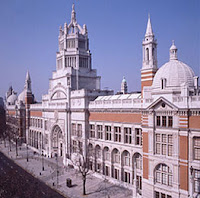 And of course the museums and galleries offer a wealth of inspiration. The Victoria and Albert is a treasure trove of fashion and everyday items, from keys and dinner plates to tea tables and wallpaper designs. (I think the guards thought I was a little weird getting down on my hands and knees to study a carpet pattern…) The world class art galleries, especially the National Portrait Gallery, also show a fascinating array of people and scenes of everyday life from the era.
 Closer to home, I’m very lucky to live near a fabulous resource of original material from the Regency. The Center for British Art at Yale has a wonderful study room, where visitors can peruse the collection of prints and watercolors. I’ve spent hours looking at prints by Rowlandson and Gilray. I’ve also been able to go through boxes of Turner watercolor sketches (yes, actually touch them!). That’s been such an inspiring experience I’ve made the hero of my current WIP a gentleman artist.
In case you’re wondering what’s next after the spies of Mrs. Merlin’s Academy, I’m working on a new trilogy for Grand Central Publishing, which revolved around a small circle of intellectual females. The new trio of heroines are beautiful, brainy ladies with an expertise in science–and each has a dark secret in her past that comes back to haunt her. They’re scheduled for release in 3 consecutive months, but they won’t hit the shelves until early 2010. I hope to be back sometime in the future to tell you more about it! In the meantime, please check out my website for chapter excerpts, arcane trivia, and the chance to win autographed books from me and other GCP authors.

 I often like to do country settings, perhaps because I have so many happy memories of walking and riding through the English countryside. I sometimes choose counties I’ve visited. Sometimes I choose an area based on the mood of the story or what seems right for my characters.
 I used a Sussex setting for LORD LANGDON’S KISS, as that’s where I lived during my UK assignment and thus knew best. For THE INCORRIGIBLE LADY CATHERINE, I wanted a setting that was wilder, to match my rather tempestuous heroine. I ended up using the northern Lake District, around Ullswater. I even had my characters stroll through the area that inspired Wordsworth’s famous poem about the daffodils and was delighted with how the art department depicted that scene (I am less delighted with the depiction of the hero, but enough of that!) I used the Cotswolds for THE REDWYCK CHARM; I felt the more rolling, pleasant landscape suited to the lighter story.
 SAVING LORD VERWOOD had a darker thread, which I thought worked best in the far reaches of Cornwall (all sorts of cool ancient sites and great craggy cliffs to push people off). When inventing fictional stately homes, I like to use real houses from the same area as inspiration.
 Not that I incorporate every detail of the architecture or imitate exact floor plans, but I like to know some of the materials and building styles used. Though I adore Palladian mansions, for Verwood’s home I wanted something older. I found what I was seeking in Trerice House, pictured above. I think the art department captured the essence very nicely (the hero looks hot, too.) 🙂


 So I don’t know how the cover ended up the way it did. Though I do like the overall layout and the color, the close up is reminding me of how very UN-Colin-Firth-like the hero looks. And that hair is giving me the shakes!


